
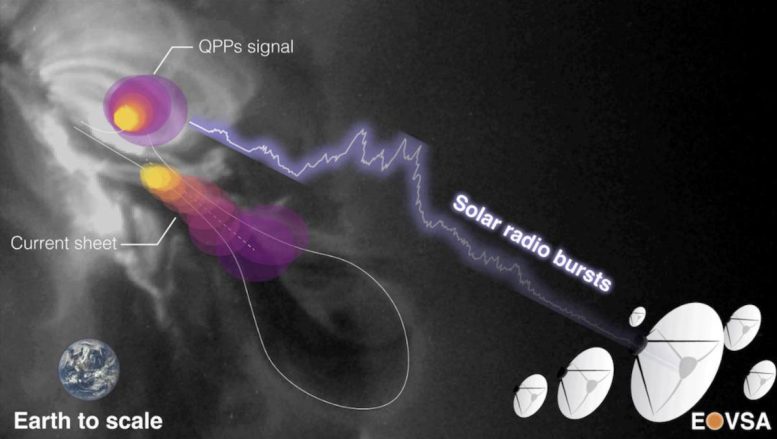
A 2017 solar flare revealed heartbeat-like radio bursts have been traced to periodic magnetic reconnections, driven by magnetic islands in the Sun’s current sheet, providing insights into solar energy release dynamics.
According to a new study, scientists have pinpointed a solar radio burst in the Sun’s atmosphere that exhibits a signal pattern similar to that of a heartbeat.
An international team of researchers has published their discovery of the source location of a radio signal emanating from a C-class solar flare over 5,000 kilometers (3,100 miles) above the surface of the Sun in the journal Nature Communications.
Researchers say the study’s findings could help scientists better understand the physical processes behind the energy release of solar flares — the solar system’s most powerful explosions.
“The discovery is unexpected,” said Sijie Yu, the study’s corresponding author and astronomer affiliated with NJIT’s Center for Solar-Terrestrial Research. “This beating pattern is important for understanding how energy is released and is dissipated in the Sun’s atmosphere during these incredibly powerful explosions on the Sun. However, the origin of these repetitive patterns, also called quasi-periodic pulsations, has long been a mystery and a source of debate among solar physicists.”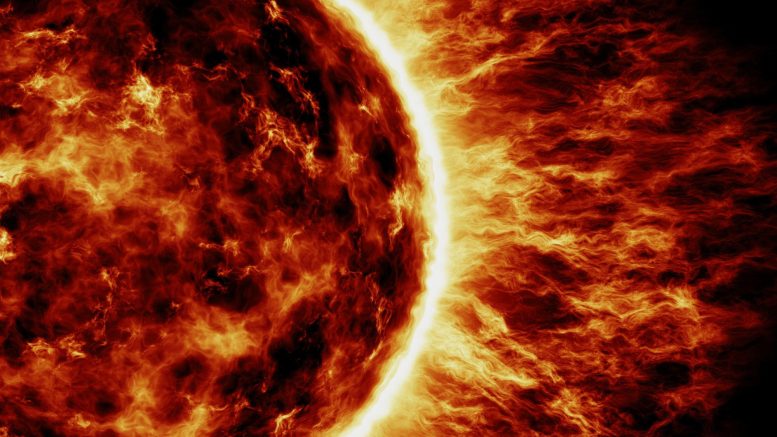
Solar radio bursts are intense bursts of radio waves from the Sun, which are often associated with solar flares and have been known to feature signals with repeating patterns.
The team was able to uncover the source of these pattern signals after studying microwave observations of a solar flare event on July 13, 2017, captured by NJIT’s radio telescope called the Expanded Owens Valley Solar Array (EOVSA), which is located at Owens Valley Radio Observatory (OVRO), near Big Pine, Calif.
EOVSA routinely observes the Sun in a wide range of microwave frequencies over 1 to 18 gigahertz (GHz) and is sensitive to radio radiation emitted by high-energy electrons in the Sun’s atmosphere, which are energized in solar flares.
From EOVSA’s observations of the flare, the team revealed radio bursts featuring a signal pattern repeating every 10-20 seconds, “like a heartbeat”, according to study leading author Yuankun Kou, a Ph.D. student at Nanjing University (NJU).
The team identified a strong quasi-periodic pulsation (QPP) signal at the base of the electric current sheet stretching more than 25,000 kilometers through the eruption’s core flaring region where opposing magnetic field lines approach each other, break and reconnect, generating intense energy powering the flare.
But surprisingly, Kou says they discovered a second heartbeat in the flare.
Magnetic Reconnection Drives Quasi-Periodic Pulsations
“The repeating patterns are not uncommon for solar radio bursts,” Kou said. “But interestingly, there is a secondary source we did not expect located along the stretched current sheet that pulses in a similar fashion as the main QPP source.”
“The signals likely originate from quasi-repetitive magnetic reconnections at the flare current sheet,” added Yu. “This is the first time a quasi-periodic radio signal located at the reconnection region has been detected. This detection can help us to determine which of the two sources caused the other one.”
Using the unique microwave imaging capabilities of EOVSA, the team was able to measure the energy spectrum of electrons at the two radio sources in this event.
“EOVSA’s spectral imaging gave us new spatially and temporally resolved diagnostics of the flare’s nonthermal electrons. … We found the distribution of high-energy electrons in the main QPP source vary in phase with that of the secondary QPP source in the electronic current sheet,” said Bin Chen, associate professor of physics at NJIT and co-author of the paper. “This is a strong indication that the two QPPs sources are closely related.”
Continuing their investigation, the team members combined 2.5D numerical modeling of the solar flare, led by the other corresponding author of the paper and professor of astronomy Xin Cheng at NJU, with observations of soft X-ray emission from the solar flares observed by NOAA’s GOES satellite, which measures the soft X-ray fluxes from the Sun’s atmosphere in two different energy bands.
“We wanted to know how the periodicity occurs in the current sheet,” said Cheng. “What is the physical process driving the periodicity and how is it related to the formation of the QPPs?”
Magnetic Islands: The Key to Solar Flare Periodicity
The team’s analysis showed there are magnetic islands, or bubble-like structures that form in the current sheet, quasi-periodically moving toward the flaring region.
“The appearance of magnetic islands within the long-stretched current sheet plays a key role in tweaking the energy release rate during this eruption,” explained Cheng. “Such a quasi-periodic energy release process leads to a repeating production of high-energy electrons, manifesting as QPPs in the microwave and soft X-ray wavelengths.”
Ultimately, Yu says the study’s findings cast fresh light on an important phenomenon underlying the reconnection process that drives these explosive events.
“We’ve finally pinpointed the origin of QPPs in solar flares as a result of periodic reconnection in the flare current sheet. … This study prompts a reexamination of the interpretations of previously reported QPP events and their implications on solar flares.”
Reference: “Microwave imaging of quasi-periodic pulsations at flare current sheet” by Yuankun Kou, Xin Cheng, Yulei Wang, Sijie Yu, Bin Chen, Eduard P. Kontar and Mingde Ding, 12 December 2022, Nature Communications.
DOI: 10.1038/s41467-022-35377-0
The study was funded by the National Science Foundation.
Never miss a breakthrough: Join the SciTechDaily newsletter.
Follow us on Google and Google News.
6 Comments
That’s what light bulbs do, too! Whose finger is on the switch? Who: Precedent Hsien. Thanks. Really fine presentation.
I’m seeing “magnetism” & “electronic current sheet” …..but none of this is “Electric” right ?? Just amazing to me to see them gradually moving over to ‘Electric Universe” concepts, bit by bit, yet they all poo-poo’d the very idea when suggested by ‘others’ – snobbery? refusal of ideas from those not in their own profession ? fear of admitting they could have been wrong all along ? Hmmm !
No one in the physics community denies that electromagnetism exists or plays a role in the universe — of course it does, it’s one of the four fundamental forces of the universe.
But the reason no one takes the “electric universe” quackery seriously is that electromagnetism is simply not powerful enough to account for such things as the energy behind stars. It takes forces many times stronger — the strong and to some extent the weak force — to account for the energy behind fusion. Much of the resulting energy is radiated away as electromagnetic radiation, but that’s not the same as saying the process itself is electrical.
Do we not really think that our sun isn’t a lot older than they tell us? I personally think it is and that the truth always comes out in the wash / in the end?! Meaning, I think that it’s turning into a RedGaint!! In which I think that it’s going to over course turn into a Supernova is to whybthee looking for inhabitable planets because they have just about ruined this one from all the lies and deceit and deception from all the greed of capitalism in the people in this world and now that they have just about raped and pillaged everything here now they want to spread there joy everywhere else they can find to take and gíve nothing back in return!! So that’s just part of the Real truth of
why their are not telling us the truth as our/ United Nations always has!!
Maybe NOW WE KNOW ! ! ! (?)
Great read hobbies are better universe has lots of finds . Like black hole ,🌟 star/suns, planets creatures . Hobby right for fun not money 🙃 🙂 right .ok👽👽👽👽👽👽👽👽👽👽👽🛸