
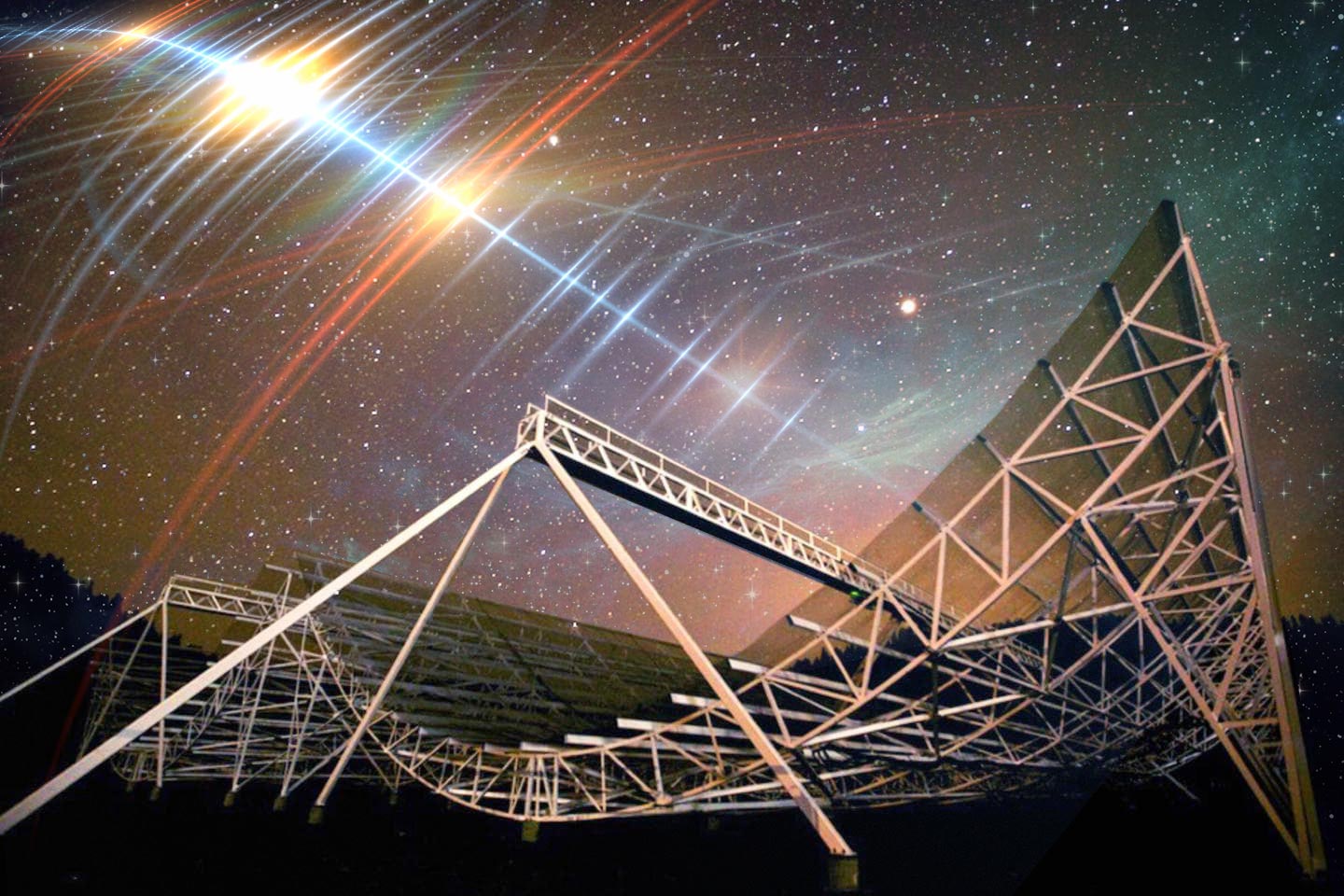
A distant neutron star could be the origin of the clear and periodic pattern of fast radio bursts.
A strange and persistent radio signal from a far-off galaxy that appears to be flashing with surprising regularity has been detected by astronomers at MIT and elsewhere.
The signal has been classified as a fast radio burst, or FRB — an intensely strong burst of radio waves of unknown astrophysical origin, that typically lasts for a few milliseconds at most. However, this new signal is quite unique in that it persists for up to three seconds, about 1,000 times longer than the average FRB. Within this window, the team of researchers detected bursts of radio waves that repeat every 0.2 seconds in a clear periodic pattern, similar to a beating heart.
Labeled by astronomers as FRB 20191221A, the signal is currently the longest-lasting FRB, with the clearest periodic pattern, ever detected to date.
The source of the signal lies in a distant galaxy located several billion light-years from Earth. Exactly what that source might be remains a mystery, though astrophysicists suspect the signal could emanate from either a radio pulsar or a magnetar, both of which are types of neutron stars — extremely dense, rapidly spinning collapsed cores of giant stars.
“There are not many things in the universe that emit strictly periodic signals,” says Daniele Michilli, a postdoc in MIT’s Kavli Institute for Astrophysics and Space Research. “Examples that we know of in our own galaxy are radio pulsars and magnetars, which rotate and produce a beamed emission similar to a lighthouse. And we think this new signal could be a magnetar or pulsar on steroids.”
The team of scientists hopes to detect more periodic signals from this source, which could then be used as an astrophysical clock. For instance, they could use the frequency of the bursts, and how they change as the source moves away from Earth, to measure the rate at which the universe is expanding.
The discovery is reported today (July 13, 2022) in the journal Nature, and is authored by members of the CHIME/FRB Collaboration, including MIT co-authors Calvin Leung, Juan Mena-Parra, Kaitlyn Shin, and Kiyoshi Masui at MIT, along with Michilli, who led the discovery first as a researcher at McGill University, and then as a postdoc at MIT.
“Boom, Boom, Boom”
Since the first FRB was discovered in 2007, hundreds of similar radio flashes have been detected across the universe, most recently by the Canadian Hydrogen Intensity Mapping Experiment, or CHIME, an interferometric radio telescope consisting of four large parabolic reflectors that is located at the Dominion Radio Astrophysical Observatory in British Columbia, Canada.
CHIME continuously observes the sky as the Earth rotates, and is designed to pick up radio waves emitted by hydrogen in the very earliest stages of the universe. The telescope also happens to be sensitive to fast radio bursts, and since it began observing the sky in 2018, CHIME has detected hundreds of FRBs emanating from different parts of the sky.
The vast majority of FRBs observed to date are one-offs — ultrabright bursts of radio waves that last for a few milliseconds before blinking off. Recently, researchers discovered the first periodic FRB that appeared to emit a regular pattern of radio waves. This signal consisted of a four-day window of random bursts that then repeated every 16 days. This 16-day cycle indicated a periodic pattern of activity, though the signal of the actual radio bursts was random rather than periodic.
On December 21, 2019, CHIME picked up a signal of a potential FRB, which immediately drew the attention of Michilli, who was scanning the incoming data.
“It was unusual,” he recalls. “Not only was it very long, lasting about three seconds, but there were periodic peaks that were remarkably precise, emitting every fraction of a second — boom, boom, boom — like a heartbeat. This is the first time the signal itself is periodic.”
Brilliant Bursts
In analyzing the pattern of FRB 20191221A’s radio bursts, Michilli and his colleagues found similarities with emissions from radio pulsars and magnetars in our own galaxy. Radio pulsars are neutron stars that emit beams of radio waves, appearing to pulse as the star rotates, while a similar emission is produced by magnetars due to their extreme magnetic fields.
The main difference between the new signal and radio emissions from our own galactic pulsars and magnetars is that FRB 20191221A appears to be more than a million times brighter. Michilli says the luminous flashes may originate from a distant radio pulsar or magnetar that is normally less bright as it rotates and for some unknown reason ejected a train of brilliant bursts, in a rare three-second window that CHIME was luckily positioned to catch.
“CHIME has now detected many FRBs with different properties,” Michilli says. “We’ve seen some that live inside clouds that are very turbulent, while others look like they’re in clean environments. From the properties of this new signal, we can say that around this source, there’s a cloud of plasma that must be extremely turbulent.”
The astronomers hope to catch additional bursts from the periodic FRB 20191221A, which can help to refine their understanding of its source, and of neutron stars in general.
“This detection raises the question of what could cause this extreme signal that we’ve never seen before, and how can we use this signal to study the universe,” Michilli says. “Future telescopes promise to discover thousands of FRBs a month, and at that point we may find many more of these periodic signals.”
Reference: “Sub-second periodicity in a fast radio burst” by The CHIME/FRB Collaboration, Bridget C. Andersen, Kevin Bandura, Mohit Bhardwaj, P. J. Boyle, Charanjot Brar, Daniela Breitman, Tomas Cassanelli, Shami Chatterjee, Pragya Chawla, Jean-François Cliche, Davor Cubranic, Alice P. Curtin, Meiling Deng, Matt Dobbs, Fengqiu Adam Dong, Emmanuel Fonseca, B. M. Gaensler, Utkarsh Giri, Deborah C. Good, Alex S. Hill, Alexander Josephy, J. F. Kaczmarek, Zarif Kader, Joseph Kania, Victoria M. Kaspi, Calvin Leung, D. Z. Li, Hsiu-Hsien Lin, Kiyoshi W. Masui, Ryan Mckinven, Juan Mena-Parra, Marcus Merryfield, B. W. Meyers, D. Michilli, Arun Naidu, Laura Newburgh, C. Ng, Anna Ordog, Chitrang Patel, Aaron B. Pearlman, Ue-Li Pen, Emily Petroff, Ziggy Pleunis, Masoud Rafiei-Ravandi, Mubdi Rahman, Scott Ransom, Andre Renard, Pranav Sanghavi, Paul Scholz, J. Richard Shaw, Kaitlyn Shin, Seth R. Siegel, Saurabh Singh, Kendrick Smith, Ingrid Stairs, Chia Min Tan, Shriharsh P. Tendulkar, Keith Vanderlinde, D. V. Wiebe, Dallas Wulf and Andrew Zwaniga, 13 July 2022, Nature.
DOI: 10.1038/s41586-022-04841-8
This research was supported, in part, by the Canada Foundation for Innovation.
Never miss a breakthrough: Join the SciTechDaily newsletter.
Follow us on Google and Google News.