
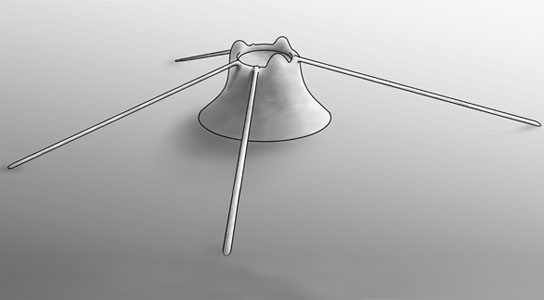
Paleontologists found the remains of what appears to be the oldest animal with a Skeleton. Scientists believe the organism, Coronacollina acula, lived on the seafloor during the Ediacaran period and is between 560 million and 550 million years old.
A team of paleontologists has discovered the oldest animal with a skeleton. Called Coronacollina acula, the organism is between 560 million and 550 million years old, which places it in the Ediacaran period, before the explosion of life and diversification of organisms took place on Earth in the Cambrian.
The finding provides insight into the evolution of life – particularly, early life – on the planet, why animals go extinct, and how organisms respond to environmental changes. The discovery also can help scientists recognize life elsewhere in the universe.
The Ediacaran Period, named after the Ediacara Hills of South Australia, ranges 630-542 million years ago. The Cambrian Period, marked by a rapid diversification of life-forms on Earth as well as the rise of mineralized organisms, ranges 542-488 million years ago.
“Up until the Cambrian, it was understood that animals were soft-bodied and had no hard parts,” said Mary Droser, a professor of geology at the University of California, Riverside, whose research team made the discovery in South Australia. “But we now have an organism with individual skeletal body parts that appears before the Cambrian. It is therefore the oldest animal with hard parts, and it has a number of them – they would have been structural supports – essentially holding it up. This is a major innovation for animals.”
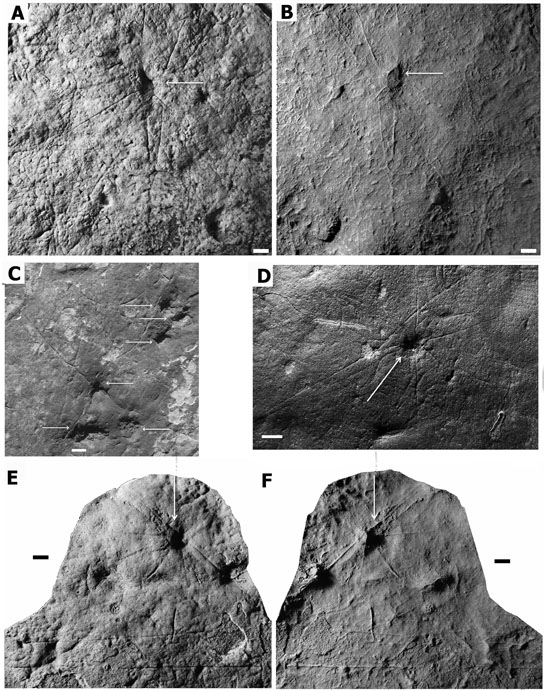
Coronacollina acula is seen in the fossils as a depression measuring a few millimeters to 2 centimeters (0.8 inches) deep. But because rocks compact over time, the organism could have been bigger – 3 to 5 centimeters (.2 to 2 inches) tall. Notably, it is constructed in the same way that Cambrian sponges were constructed.
“It therefore provides a link between the two time intervals,” Droser said. “We’re calling it the ‘harbinger of Cambrian constructional morphology,’ which is to say it’s a precursor of organisms seen in the Cambrian. This is tremendously exciting because it is the first appearance of one of the major novelties of animal evolution.”
According to Droser, the appearance of Coronacollina acula signals that the initiation of skeletons was not as sudden in the Cambrian as was thought, and that Ediacaran animals like it are part of the evolutionary lineage of animals as we know them.
“The fate of the earliest Ediacaran animals has been a subject of debate, with many suggesting that they all went extinct just before the Cambrian,” she said. “Our discovery shows that they did not.”
Study results appeared online on February 14 in Geology.
The researchers note that Coronacollina acula lived on the seafloor. Shaped like a thimble to which at least four 20-40-centimeter-long needle-like “spicules” were attached, Coronacollina acula most likely held itself up by the spicules. The researchers believe it ingested food in the same manner a sponge does, and that it was incapable of locomotion. How it reproduced remains a mystery.
Coronacollina acula is so named because it translates as “little rimmed hill with needles” (corona – rim or crown; collis – hill; acula – needle). The name describes the fossil organism’s morphology, and, specifically, its two components: the truncated cone-shaped body, which appears in the fossils as a pit, and the long brittle spicules, which appear in the fossils as thin grooves.
Ediacaran fossils often show the imprint of the whole body of the organism. With Coronacollina acula, however, skeletal parts were found to have fallen off.
“If you have soft parts holding your body together, then, as they decay, you lose your skeletal parts,” Droser explained. “Which is why it’s rare to find two clam shells together in fossils. We’ve now found whole organisms of Coronacollina acula – the thimble-shaped body in the center, with spicules coming off it like knitting needles. And we have found hundreds of them. They appear to have been a gregarious species, with a lot of them living together.”
Droser explained that the spicules had to have been mineralized because the casts show they are ruler-straight. Moreover, they broke.
“We often associate skeletons with predation since skeletons greatly assist animals in their fight against predators,” Droser said. “But Coronacollina acula used its skeleton only for support, there being no predators in the Ediacaran.”
The research work began as a master’s thesis project in Droser’s lab. Erica Clites, now a physical science technician at Glen Canyon National Recreation Area for the National Park Service, chose to work on this project because it promised a good challenge with rewarding results.
“Every aspect of the organism’s reconstruction had to be backed up by supporting statistics,” said Clites, who graduated from UCR in 2009 and is the first author of the research paper. “Through painstaking measurements and detailed descriptions, the pits and needles contained in the rock were revealed as a sponge-like animal.”
Reference: “The advent of hard-part structural support among the Ediacara biota: Ediacaran harbinger of a Cambrian mode of body construction” by Erica C. Clites, Mary L. Droser and James G. Gehling, 1 April 2012, Geology.
DOI: 10.1130/G32828.1
Droser and Clites were joined in the study by James G. Gehling of the South Australian Museum, Adelaide.
The research was supported by grants from NASA, the National Science Foundation, a UC Riverside John Dunham Field Grant, and an Australian Research Council Discovery Grant.
Never miss a breakthrough: Join the SciTechDaily newsletter.
Follow us on Google and Google News.