
Close Menu
    Facebook X (Twitter) Instagram
    SciTechDaily
    • Biology
    • Chemistry
    • Earth
    • Health
    • Physics
    • Science
    • Space
    • Technology
    Facebook X (Twitter) Pinterest YouTube RSS
    SciTechDaily
    Home»Space»The Cosmic Confusion of the Microwave Background in the Search for B-Mode Polarization
    Space

    The Cosmic Confusion of the Microwave Background in the Search for B-Mode Polarization

    By Harvard-Smithsonian Center for AstrophysicsFebruary 10, 2020No Comments4 Mins Read
    Facebook Twitter Pinterest Telegram LinkedIn WhatsApp Email Reddit
    Share
    Facebook Twitter LinkedIn Pinterest Telegram Email Reddit
    South Pole Telescope SPTpol Instruments Core
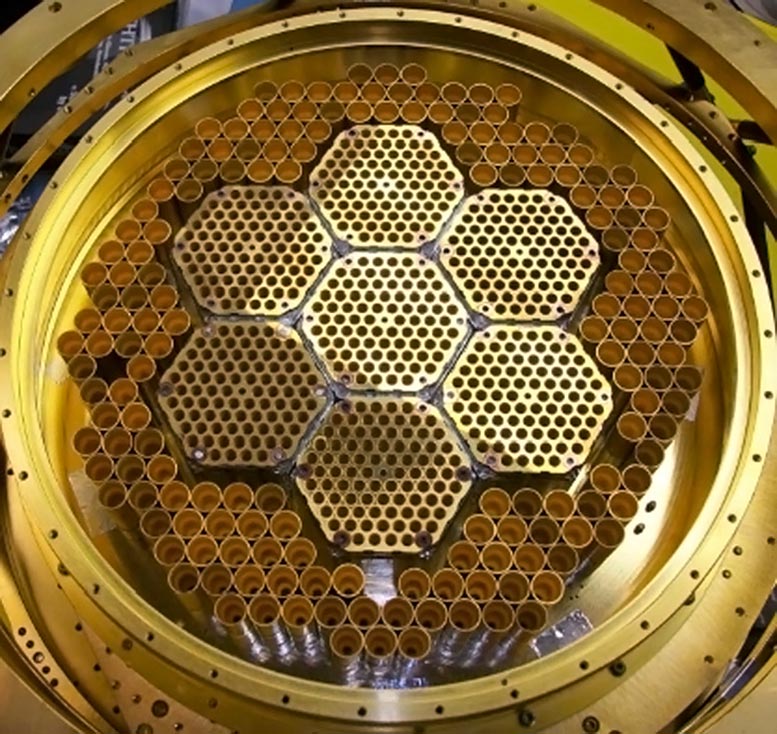
    The South Pole Telescope’s “SPTpol” instruments core, containing 768 pixels and 1536 detectors capable of measuring the polarization of incoming millimeter radiation. The SPT team used SPTpol to determine that the combined polarized radiation from distant galaxies is not strong enough to obscure the search for polarization effects in the cosmic microwave background radiation. Credit: SPT collaboration; DOE

    Roughly 380,000 years after the big bang, about 13.7 billion years ago, matter (mostly hydrogen) cooled enough for neutral atoms to form, and light was able to traverse space freely. That light, the cosmic microwave background radiation (CMBR), comes to us from every direction in the sky, uniform except for faint ripples and bumps at brightness levels of only a few part in one hundred thousand, the seeds of future structures like galaxies.

    Astronomers have conjectured that these ripples also contain traces of an initial burst of expansion — the so-called inflation — which swelled the new universe by thirty-three orders of magnitude in a mere ten-to-the-power-minus-thirty-three seconds. Clues about the inflation should be faintly present in the way the cosmic ripples are curled, an effect that is expected to be perhaps one hundred times fainter than the ripples themselves. CfA astronomers and their colleagues, working at the South Pole, have been working to find evidence for such curling, the “B-mode polarization.”

    Traces of this tiny effect are not only difficult to measure, they may be obscured by unrelated phenomena that can confuse or even mask it. CfA astronomer Tony Stark is a member of the large South Pole Telescope (SPT) consortium, a collaboration that has been studying galaxies and galaxy clusters in the distant universe at microwave wavelengths. Individual cosmic sources are in general dominated either by active supermassive black hole nuclei and emit radiation from the charged particle jets ejected from the regions around them, or by star formation whose radiation comes from warm dust. The emission is also probably polarized and could complicate the positive identification of CMBR B-mode radiation signals. The SPT team used a new analysis method to study the combined polarization strength of all the millimeter emission sources they find in a 500 square degree field in the sky, about four thousand objects. They conclude – good news for CMBR researchers – that the extragalactic foreground effects should be smaller than any expected B-mode signals, at least over a wide range of spatial scales.

    Reference: “Fractional polarization of extragalactic sources in the 500 deg2 SPTpol survey” by N Gupta, C L Reichardt, P A R Ade, A J Anderson, M Archipley, J E Austermann, J S Avva, J A Beall, A N Bender, B A Benson, F Bianchini, L E Bleem, J E Carlstrom, C L Chang, H C Chiang, R Citron, C Corbett Moran, T M Crawford, A T Crites, T de Haan, M A Dobbs, W Everett, C Feng, J Gallicchio, E M George, A Gilbert, N W Halverson, N Harrington, J W Henning, G C Hilton, G P Holder, W L Holzapfel, Z Hou, J D Hrubes, N Huang, J Hubmayr, K D Irwin, L Knox, A T Lee, D Li, A Lowitz, D Luong-Van, D P Marrone, J J McMahon, S S Meyer, L M Mocanu, J J Mohr, J Montgomery, A Nadolski, T Natoli, J P Nibarger, G I Noble, V Novosad, S Padin, S Patil, C Pryke, J E Ruhl, B R Saliwanchik, J T Sayre, K K Schaffer, E Shirokoff, C Sievers, G Smecher, Z Staniszewski, A A Stark, K T Story, E R Switzer, C Tucker, K Vanderlinde, T Veach, J D Vieira, G Wang, N Whitehorn, R Williamson, W L K Wu, V Yefremenko and L Zhang, 21 October 2019, Monthly Notices of the Royal Astronomical Society.
    DOI: 10.1093/mnras/stz2905

    Never miss a breakthrough: Join the SciTechDaily newsletter.
    Follow us on Google and Google News.

    Astrophysics Harvard-Smithsonian Center for Astrophysics
    Share. Facebook Twitter Pinterest LinkedIn Email Reddit

    Related Articles

    Gamma-Ray Beams Suggest Milky Way’s Central Black Hole Had Active Past

    Calculations Show the Ideal Time to Study the Cosmos

    Using Infrared Images from Hubble & Spitzer, Scientists Discover 25 Distant Galaxies

    Supernova Shock Wave Breaks Through a Cocoon of Gas

    Astronomers Observed Evolved Star Being Devoured

    Rogue Planets Captured by Stars

    Runaway Planets at 30 Million MPH

    Origins of Type Ia Supernovae

    Hubble Reveals GJ1214b is a Waterworld Enshrouded by a Steamy Atmosphere

    Leave A Reply Cancel Reply

    • Facebook
    • Twitter
    • Pinterest
    • YouTube

    Don't Miss a Discovery

    Subscribe for the Latest in Science & Tech!

    Trending News

    Massive Study Warns Marijuana Use in Teens Is Linked to Serious Mental Illness

    Scientists Discover a Completely Unexpected Way T Cells Kill Cancer

    Scientists Just Found the Solar System’s Original “Planet Factory”

    Study Warns Widely Used Food Preservatives Linked to High Blood Pressure and Heart Disease

    New Treatment Could Reverse Osteoarthritis Within Weeks

    Physicists Have Measured “Negative Time” in Bizarre Quantum Experiment

    The Deadly Tapeworm Spreading Across America Has Reached the Pacific Northwest

    Could Low Vitamin D Be Making Your Pain Worse?

    Follow SciTechDaily
    • Facebook
    • Twitter
    • YouTube
    • Pinterest
    • Newsletter
    • RSS
    SciTech News
    • Biology News
    • Chemistry News
    • Earth News
    • Health News
    • Physics News
    • Science News
    • Space News
    • Technology News
    Recent Posts
    • Scientists Discover Mysterious Creature Living in the Great Salt Lake – and It Exists Nowhere Else on Earth
    • It’s Alive? Surprising Discovery Changes What We Know About Fog
    • Simple Family Routines May Be the Secret to a Smoother Start at School
    • Brain Study Overturns Long-Held Beliefs About How Humans Learn Speech
    • Ancient Goose Fossil Challenges Long-Held Theories About New Zealand Birds
    Copyright © 1998 - 2026 SciTechDaily. All Rights Reserved.
    • Science News
    • About
    • Contact
    • Editorial Board
    • Privacy Policy
    • Terms of Use

    Type above and press Enter to search. Press Esc to cancel.