
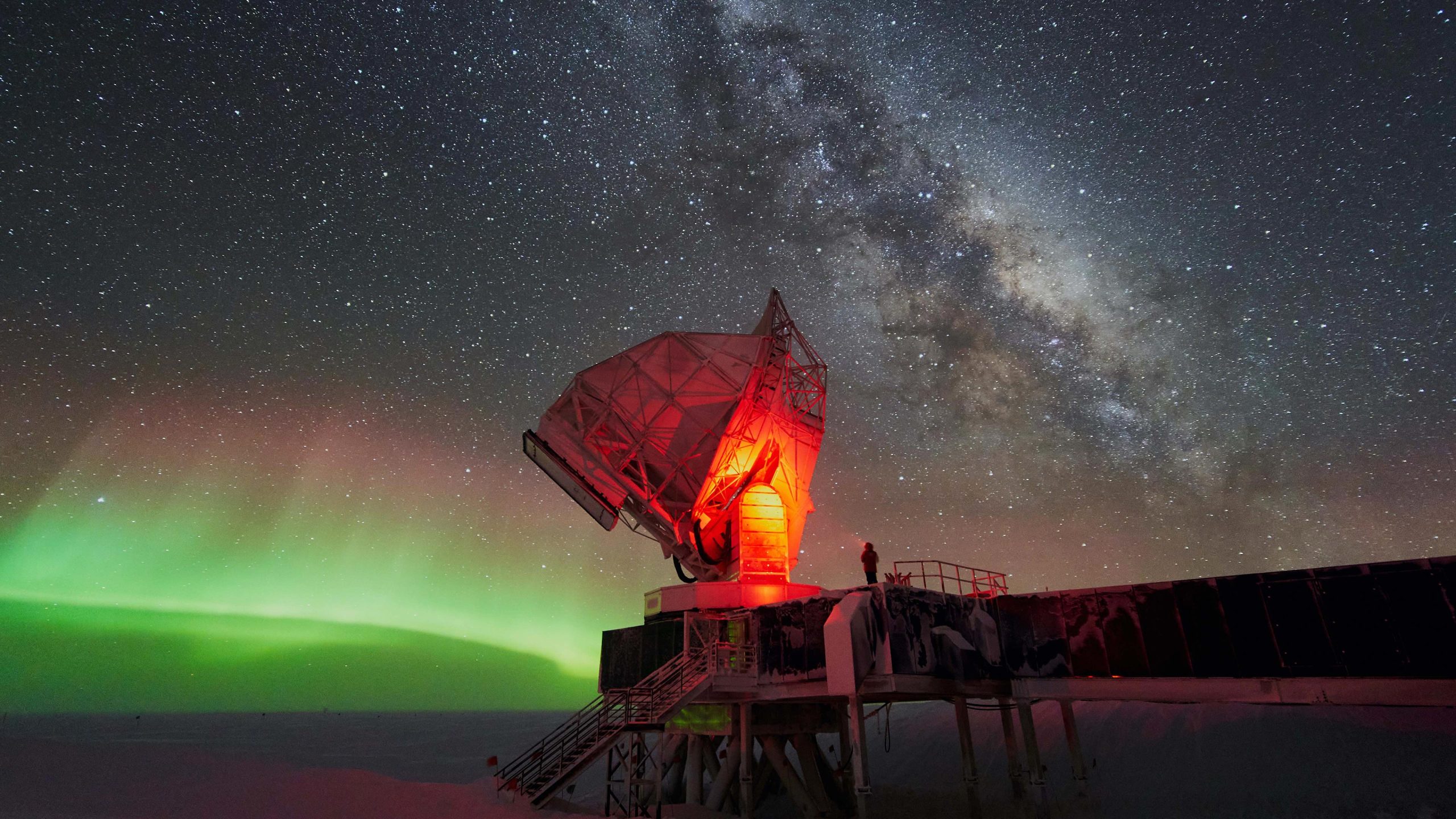
Argonne physicists say cold, dry is perfect for examining the oldest light in the universe.
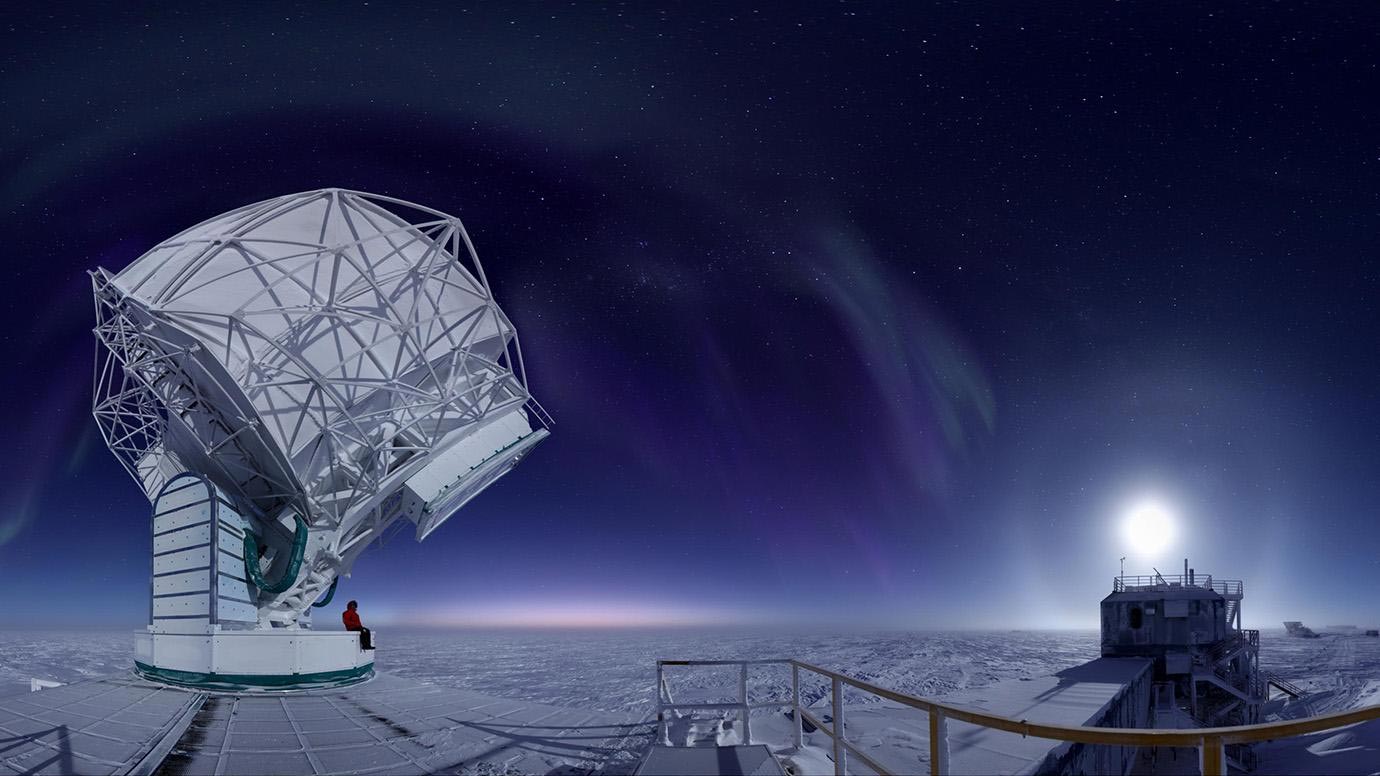
When your workplace is the South Pole, things can get a little unusual. Light emitted billions of years ago could help solve enduring mysteries about the evolution of the universe. It turns out the best place on Earth to detect this light, known as the cosmic microwave background, is the South Pole. So that’s where the telescope is. The South Pole Telescope, a collaboration among over 20 universities and national laboratories including the University of Chicago and Argonne National Laboratory, began operating in 2007.
Here, two physicists from Argonne National Laboratory talk about their work with the South Pole Telescope and why it matters. Lindsey Bleem collects and analyzes data at the telescope, and Clarence Chang develops superconducting detectors for the telescope.
What is the cosmic microwave background, and what does it tell us about the universe?
Chang: The cosmic microwave background is the signal that was produced when the universe was about 380,000 years old. It corresponds to a period where the universe transformed from this superhot plasma where protons and electrons were flying around to when, after the universe had cooled down far enough, protons and electrons could form atoms.
Today, that signal appears at the longer wavelengths, in the microwave range (a few millimeters). So by studying and looking at the universe in those wavelengths, we can look at the early universe — essentially, capture a baby picture.

Bleem: We’ve known since it was first discovered in the 1960s that the CMB is incredibly uniform. The deviations in the temperature, which are tracing changes in the density of this early plasma Clarence talked about, are only about one part in 100,000. We know that these small fluctuations had to grow over the entire age of the universe.
Besides just giving us this nice photograph, effectively, of the baby universe, the light that was emitted at the time has been traveling the entire age of the universe, 14 billion years. It has interacted with all of the structures that have formed since these early times. So we can study the very subtle imprints that these structures make in the CMB to actually tease out the processes and the physics that have happened between when it was emitted and today.
How do you do that?
Bleem: We do that through a couple of important, different scientific analyses. One is called gravitational lensing. This is where astronomical masses along the line of sight can actually deflect the path of light.
The second is physics that occurs when the photons — the light from the cosmic microwave background — can scatter off the material in these intervening structures. We can trace this scattering process, and then map out structures along the line of sight, which can help us probe things like dark energy, which is heavily impacting the ability of really massive structures such as galaxy clusters to form.
And why does the telescope need to be at the South Pole?
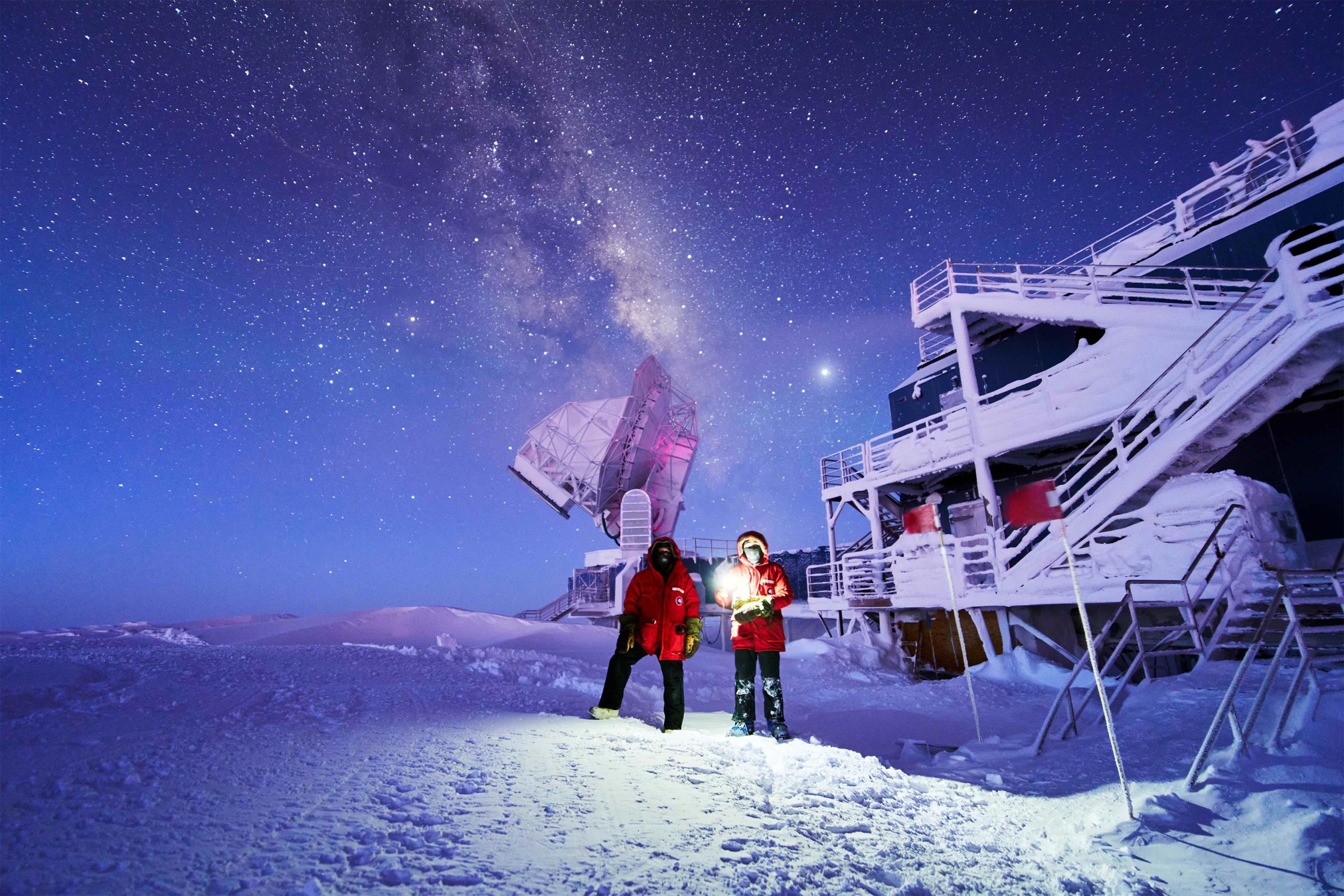
Bleem: The Antarctic itself, as you can probably imagine from the pictures, is quite cold. It’s extremely dry. It’s the world’s largest desert. This makes it a fantastic place for the astronomy we do at the South Pole Telescope. Our telescope observes at millimeter wavelengths. Water in the atmosphere attenuates the millimeter wavelengths we’re interested in, and the jiggling around of the water molecules can add a great source of noise to the data. So we have to go to these remote dry places to do these observations. And it turns out that the South Pole is the absolute best place on Earth to do this, followed by the Atacama Desert in Chile.
What is it like working in that environment?
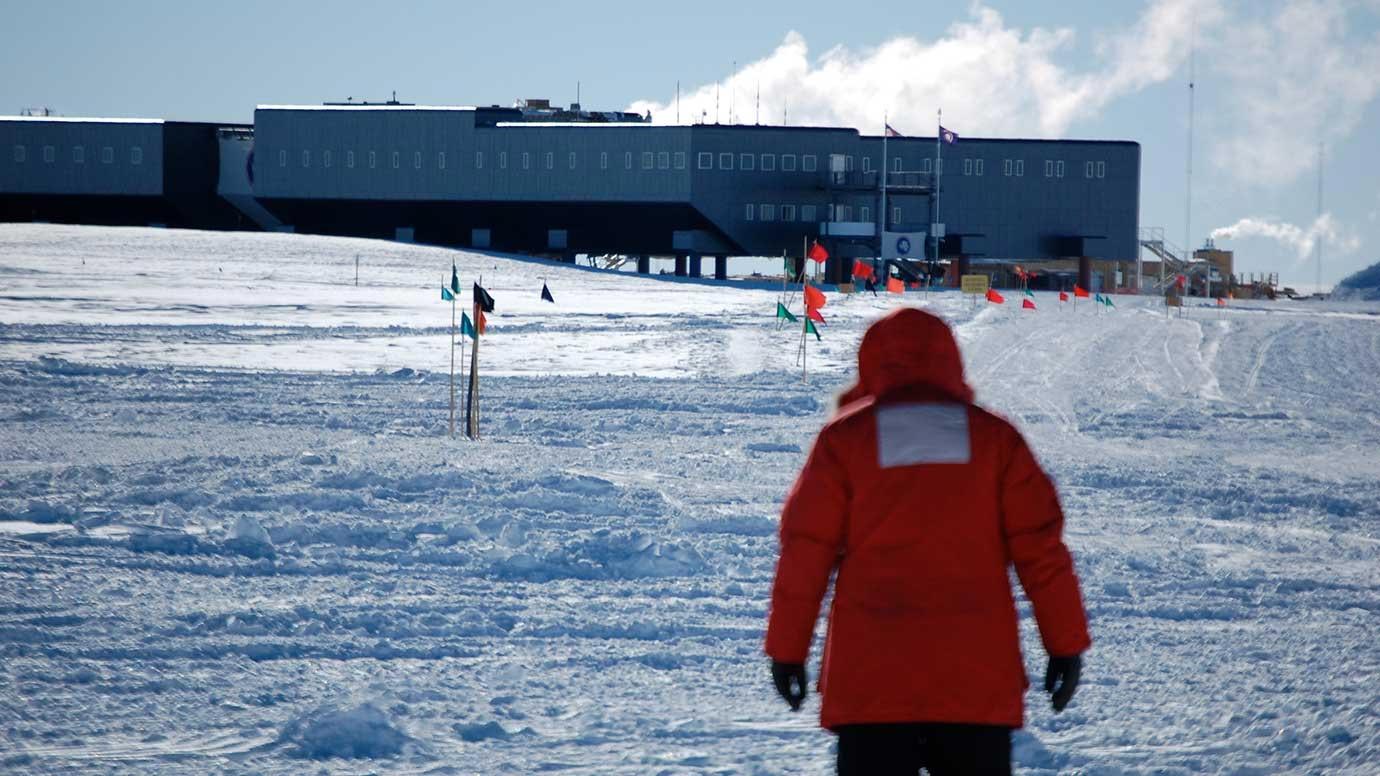
Chang: We’re at the South Pole because it is dry. That dryness is great for our observations. But as human beings, we like a little bit of humidity in the air. That’s something that’s a bit challenging and can also interfere with how things go day to day.
Bleem: Yeah. It’s not the most human-friendly. Your skin will crack. Wounds don’t heal super well at the South Pole. It’s not great for computers to be in that dry environment. We actually had a humidifier that blew on one of our computers to keep it running a little bit happier.
How does your work at Argonne connect to the telescope?
Chang: At Argonne we developed a superconducting technology for the detectors. These detectors have to measure photons that are fairly long in wavelength — typically a millimeter, 2 millimeters, 3 millimeters. Typical camera technology, such as what’s used in our phones, even pushed to its extreme, still doesn’t see these photons very well. In fact, it doesn’t see them at all.
So we have to make a new technology to do it. And at its core, that means understanding and controlling superconducting materials and then processing them to make these really sensitive detectors and to manufacture lots of them. At Argonne, there is a strong program in researching basic materials and in applying that to different technologies.
Bleem: We also coupled our detector development very closely to all the work that’s being done using the state-of-the-art supercomputers in the Argonne Leadership Computing Facility. We are thus able to make the important theoretical predictions that allow us to connect the observations that we make with the South Pole Telescope to the predictions from different cosmological models about what we should be seeing.
So there’s this really powerful interconnection at Argonne, not only between cosmologists and the material fabrication facilities and the scientists there, but also with our great computing experts.
The South Pole Telescope is funded and supported by the National Science Foundation, the DOE Office of High Energy Physics, the Kavli Institute for Cosmological Physics, the U.S. Antarctic Program and the Antarctic Support Contract.
Never miss a breakthrough: Join the SciTechDaily newsletter.
Follow us on Google and Google News.