
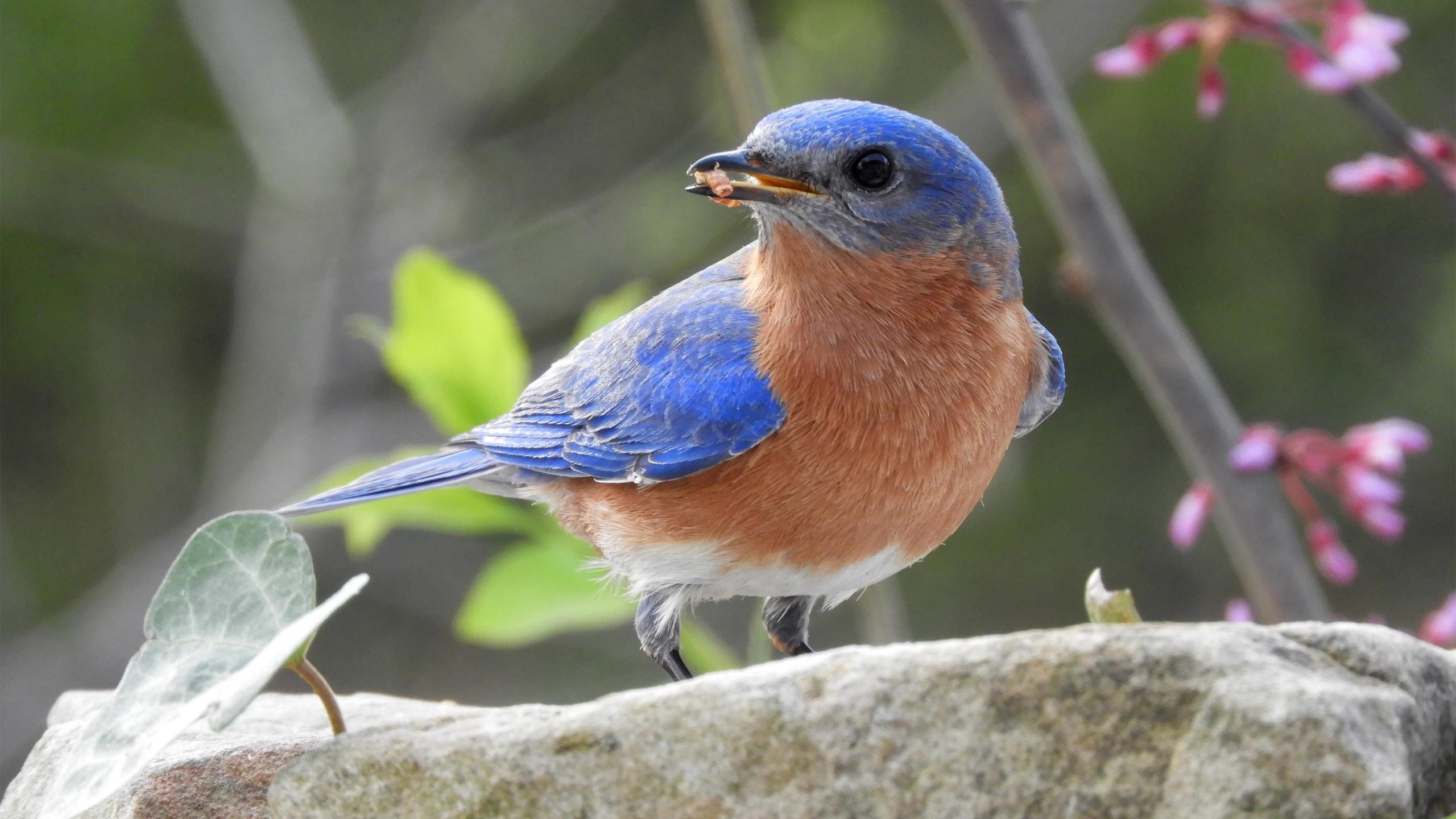
If you feed the birds in your backyard, you may be doing more than just making sure they have a source of food: you may be helping baby birds give parasites the boot.
New research published in the Journal of Applied Ecology from University of Connecticut assistant professor of ecology and evolutionary biology Sarah Knutie shows that feeding bluebirds can have a significant impact on parasitic nest flies feeding on baby bluebirds.
Parasitic flies can be found in the nests of many bird species, and some can have significant impacts on nestling survival.
The flies lay eggs in the nests, and once the eggs hatch, the larvae feed on the blood of nestlings by drilling holes through the young birds’ skin.
In the case of bluebirds, Knutie says it appears nestlings are generally tolerant of the flies, meaning they can sustain high loads of parasites but not suffer significant negative impacts on survival and growth. However, the parasite removes a lot of blood from the nestling, which could have lasting impacts.
“Bluebirds do not have a detectable immune response to the parasitic flies,” says Knutie. “Since backyard bird feeding by humans is so popular, I was interested in how giving these birds food could influence their immune response against the parasite, and whether there is a particular time during the breeding season when supplemental feeding is most effective.”
To perform the study, Knutie and her father set up 200 nest boxes in northern Minnesota. She followed each nest for the presence of bird eggs, and then, when the eggs hatched, fed some of the birds live mealworms.
The growth and survival of the nestlings was tracked until the birds fledged. After leaving the nest, the number of parasites was recorded.
Nestling birds that were fed had higher overall survival and less blood loss than birds that were not fed.
“When the nestlings were not fed, every nest had parasites, with up to 125 flies in a single nest,” Knutie says. “When the nestlings had been fed, I found very few or no parasites. These results suggest that food supplementation could be increasing the birds’ ability to kill the parasites.”
Next, Knutie wanted to explore why this trend is seen with supplemented birds. She looked to the antibody response in the nestlings, which could be helping the birds kill the parasites.
“With unsupplemented nestlings, there is a low-to-no detectable antibody response. With supplemented nestlings, there was a significantly higher antibody response,” she says. “Higher antibody levels mean fewer parasites.”
This could be attributable to the birds having more nutrient resources to devote to mounting a response sooner in life than the un-supplemented cohort. With an immune response, the parasites are killed. The timing of the feeding therefore seems important, with feeding earlier in the breeding season benefiting the young birds more than later in the season.
“If food availability is driving the nestlings’ immune response to parasites, feeding early could really help the birds,” Knutie says.
The other aspect of the response Knutie explored was whether the antibody response could be related to the birds’ gut microbiota. To study this, the microbial communities were analyzed. Knutie found that overall, the microbial communities between the supplemented and unsupplemented birds were similar, however, there were some slight differences.
“The relative abundance of Clostridium species was much higher in supplemented birds, and there were correlations with antibody levels and parasites. More Clostridium meant more antibodies and fewer parasites,” she says.
Knutie is quick to point out that correlation does not mean causation, and that her research team is delving further into the question of the gut microbiota playing a role in mediating an immune response in the bluebirds.
“The interesting piece of this work suggests that if you feed your birds, it can really reduce the parasite load for the young birds, and that timing of feeding matters,” says Knutie.
Reference: “Food supplementation affects gut microbiota and immunological resistance to parasites in a wild bird species” by Sarah A. Knutie, 3 February 2020, Journal of Applied Ecology.
DOI: 10.1111/1365-2664.13567
This project was funded in part by the North American Bluebird Society, the Minnesota Ornithologists Union, and the University of Connecticut. If you are interested in building or setting up nest boxes for bluebirds, helpful information can be found from the North American Bluebird Society.
Never miss a breakthrough: Join the SciTechDaily newsletter.
Follow us on Google and Google News.