
Close Menu
    Facebook X (Twitter) Instagram
    SciTechDaily
    • Biology
    • Chemistry
    • Earth
    • Health
    • Physics
    • Science
    • Space
    • Technology
    Facebook X (Twitter) Pinterest YouTube RSS
    SciTechDaily
    Home»Space»Scientists Discover Evidence of Methane in Martian Meteorites
    Space

    Scientists Discover Evidence of Methane in Martian Meteorites

    By Jim Shelton, Yale UniversityJune 16, 2015No Comments3 Mins Read
    Facebook Twitter Pinterest Telegram LinkedIn WhatsApp Email Reddit
    Share
    Facebook Twitter LinkedIn Pinterest Telegram Email Reddit
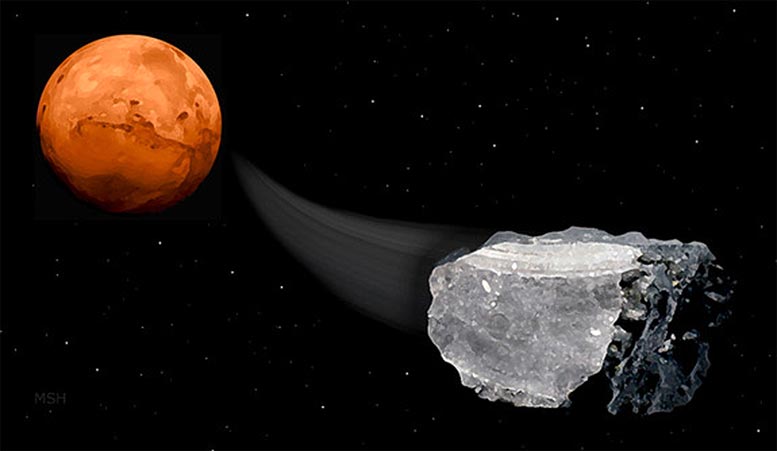
    Methane in Mars Meteorites
    Researchers analyzed six Martian meteorites and discovered the presence of methane in all of them. Credit: Image by Michael S. Helfenbein

    A newly published study details the discovery of methane in Martian meteorites, a possible clue in the search for life on the Red Planet.

    The researchers examined samples from six meteorites of volcanic rock that originated on Mars. The meteorites contain gases in the same proportion and with the same isotopic composition as the Martian atmosphere. All six samples also contained methane, which was measured by crushing the rocks and running the emerging gas through a mass spectrometer. The team also examined two non-Martian meteorites, which contained lesser amounts of methane.

    The discovery hints at the possibility that methane could be used as a food source by rudimentary forms of life beneath the Martian surface. On Earth, microbes do this in a range of environments.

    “Other researchers will be keen to replicate these findings using alternative measurement tools and techniques,” said co-author Sean McMahon, a Yale University postdoctoral associate in the Department of Geology and Geophysics. “Our findings will likely be used by astrobiologists in models and experiments aimed at understanding whether life could survive below the surface of Mars today.”

    The discovery was part of a joint research project led by the University of Aberdeen, in collaboration with the Scottish Universities Environmental Research Center, the University of Glasgow, Brock University in Ontario, and the University of Western Ontario.

    “One of the most exciting developments in the exploration of Mars has been the suggestion of methane in the Martian atmosphere,” said University of Aberdeen professor John Parnell, who directed the research. “Recent and forthcoming missions by NASA and the European Space Agency, respectively, are looking at this, however, it is so far unclear where the methane comes from, and even whether it is really there. However, our research provides a strong indication that rocks on Mars contain a large reservoir of methane.”

    Co-author Nigel Blamey, of Brock University, said the team plans to expand its research by analyzing additional meteorites.

    Yale’s McMahon noted that the team’s approach may prove helpful in future Mars rover experiments. “Even if Martian methane does not directly feed microbes, it may signal the presence of a warm, wet, chemically reactive environment where life could thrive,” McMahon said.

    Reference: “Evidence for methane in Martian meteorites” by Nigel J. F. Blamey, John Parnell, Sean McMahon, Darren F. Mark, Tim Tomkinson, Martin Lee, Jared Shivak, Matthew R. M. Izawa, Neil R. Banerjee and Roberta L. Flemming, 16 June 2015, Nature Communications.
    DOI: 10.1038/ncomms8399

    Never miss a breakthrough: Join the SciTechDaily newsletter.
    Follow us on Google and Google News.

    Astrobiology Astronomy Mars Meteorites Planetary Science Popular Yale University
    Share. Facebook Twitter Pinterest LinkedIn Email Reddit

    Related Articles

    Martian Meteorite Reveals the Possibility of Life on Mars

    Curiosity Finds Ancient Streambed on Mars

    NASA’s Opportunity Discovers Geological Mystery on Mars

    NASA Data Suggests “Dry Ice” Snowfall on Mars

    “Habitable Zone” Might Help Extreme Life Forms Survive on Exoplanets

    NASA’s Curiosity Readies for First Drive on Mars

    Color HiRISE Image of Curiosity Rover on Mars

    A Connection Between Volatiles in the Subsurface of Mars and the Impact Process

    High-Energy UV Radiation Triggers Methane on Mars

    Leave A Reply Cancel Reply

    • Facebook
    • Twitter
    • Pinterest
    • YouTube

    Don't Miss a Discovery

    Subscribe for the Latest in Science & Tech!

    Trending News

    NASA’s Voyager 1 Is About to Become the First Spacecraft One Light-Day From Earth

    A Woman Who Lived 30,000 Years Ago Is Changing What We Know About Ice Age Europe

    A Rare Radioactive Element Reveals a Hidden Secret About the Heaviest Atoms

    Breakthrough Cancer Treatment Wipes Out Deadly Brain Tumors in Every Mouse Tested

    Something Remarkable Is Happening to Dogs Living Near Chernobyl’s Nuclear Plant

    Hubble Uncovers a Mysterious 93-Billion-Mile Structure Hiding in a Nearby Star System

    Earth’s Oceans Were Slowly Suffocating Millions of Years Before a Devastating Mass Extinction

    Why Are Men Twice As Likely To Develop Parkinson’s? Scientists Discover a Hidden Clue in the Brain

    Follow SciTechDaily
    • Facebook
    • Twitter
    • YouTube
    • Pinterest
    • Newsletter
    • RSS
    SciTech News
    • Biology News
    • Chemistry News
    • Earth News
    • Health News
    • Physics News
    • Science News
    • Space News
    • Technology News
    Recent Posts
    • Scientists Engineer Rice That Fights Back Against a Devastating Crop Disease
    • Deep-Sea Scientists Capture Extraordinary 4K Footage of a Fish With a See-Through Head
    • Scientists Find That Older Brains React Very Differently to a Night of Poor Sleep
    • A Hidden Substance in Drinking Water May Be Linked to Heart Problems in Children
    • Scientists Find a Clever Way to Read Quantum Information Without Destroying It
    Copyright © 1998 - 2026 SciTechDaily. All Rights Reserved.
    • Science News
    • About
    • Contact
    • Editorial Board
    • Privacy Policy
    • Terms of Use

    Type above and press Enter to search. Press Esc to cancel.