
Close Menu
    Facebook X (Twitter) Instagram
    SciTechDaily
    • Biology
    • Chemistry
    • Earth
    • Health
    • Physics
    • Science
    • Space
    • Technology
    Facebook X (Twitter) Pinterest YouTube RSS
    SciTechDaily
    Home»Space»Unlocking the Universe’s Deepest Rhythms With Gravitational Waves
    Space

    Unlocking the Universe’s Deepest Rhythms With Gravitational Waves

    By University of FloridaMarch 14, 2024No Comments3 Mins Read
    Facebook Twitter Pinterest Telegram LinkedIn WhatsApp Email Reddit
    Share
    Facebook Twitter LinkedIn Pinterest Telegram Email Reddit
    Gravitational Waves Black Hole Merger Concept
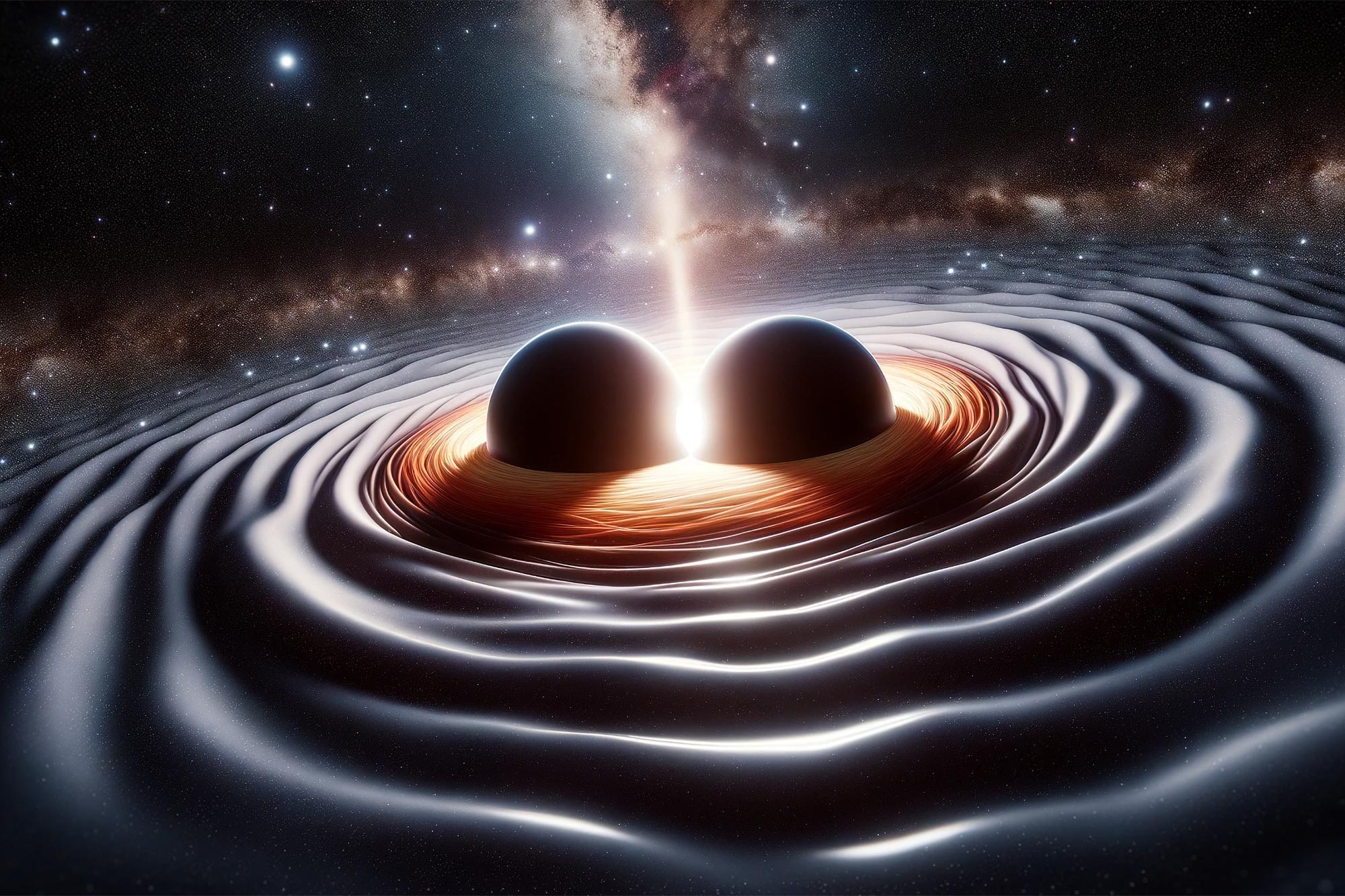
    Physicists have developed a new method to detect extremely low-frequency gravitational waves, potentially illuminating the early universe and the nature of supermassive black holes. Credit: SciTechDaily.com

    Lowest-ever frequency gravitational waves spotted in pulsar data.

    A team of physicists has developed a method to detect gravity waves with such low frequencies that they could unlock the secrets behind the early phases of mergers between supermassive black holes, the heaviest objects in the universe.

    The method can detect gravitational waves that oscillate just once every thousand years, 100 times slower than any previously measured gravitational waves.

    “These are waves reaching us from the farthest corners of the universe, capable of affecting how light travels,” said Jeff Dror, Ph.D., an assistant professor of physics at the University of Florida and co-author of the new study. “Studying these waves from the early universe will help us build a complete picture of our cosmic history, analogous to previous discoveries of the cosmic microwave background.”

    Dror and his co-author, University of California, Santa Cruz postdoctoral researcher William DeRocco, published their findings on February 26 in the journal Physical Review Letters.

    Insights Into Cosmic History

    Gravitational waves are akin to ripples in space. Like sound waves or waves on the ocean, gravitational waves vary in both frequency and amplitude, information that offers insights into their origin and age. Gravitational waves that reach us can be oscillating at extremely low frequencies, much lower than those of sound waves detectable with the human ear. Some of the lowest frequencies detected in the past were as low as one nanohertz.

    “For reference,” Dror explained, “the frequency of sound waves created by an alligator roar is about 100 billion times higher than this frequency – these are very low-pitched waves.”

    Their new method of detection is based on analyzing pulsars, neutron stars that emit radio waves at highly regular intervals. Dror hypothesized that searching for gradual slowdown in the arrivals of these pulses could reveal new gravitational waves. By studying existing pulsar data,  Dror was able to search for gravitational waves with lower frequencies than ever before, increasing our “hearing range” to frequencies as low as 10 picohertz, 100 times lower than previous efforts that detected nanohertz-level waves.

    Future Directions and Simulations

    While gravitational waves with frequencies around a nanohertz have been detected before, not much is known about their origin. There are two theories. The leading idea is that these waves are the result of a merger between two supermassive black holes, which, if true, would give researchers a new way to study the behavior of these giant objects that lie at the heart of every galaxy.

    The other main theory is that these waves were created by some sort of cataclysmic event early in the universe’s history. By studying gravitational waves at even lower frequencies, they may be able to differentiate these possibilities.

    “Looking ahead, the next step is to analyze newer data sets,” Dror said. “The datasets we used were primarily from 2014 and 2015, and a huge number of pulsar observations have been undertaken since that time.”

    Dror also plans to run simulations on mock data using UF’s HiPerGator supercomputer to further unravel cosmic history. The supercomputer can efficiently run large, complex simulations, significantly reducing the time required to analyze data.

    Reference: “Using Pulsar Parameter Drifts to Detect Subnanohertz Gravitational Waves” by William DeRocco and Jeff A. Dror, 8 March 2024, Physical Review Letters.
    DOI: 10.1103/PhysRevLett.132.101403

    This study was supported in part by the National Science Foundation and the Department of Energy.

    Never miss a breakthrough: Join the SciTechDaily newsletter.
    Follow us on Google and Google News.

    Astronomy Astrophysics Gravitational Waves Popular Pulsars University of Florida
    Share. Facebook Twitter Pinterest LinkedIn Email Reddit

    Related Articles

    The Hunt for the Gravitational Wave Background: NASA’s FERMI Searches for Ripples in Spacetime

    Searching for Elusive Continuous Gravitational Waves From the Densest Objects in the Universe

    Gravitational Wave Search Finds Tantalizing New Clue: Unexplained Fluctuations in Space-Time

    Milky Way’s Dark Side Revealed by Measurements of Pulsar Acceleration

    “Galaxy-Sized” Observatory Sees Hints of a Unique Signal From Gravitational Waves That Warp the Fabric of Space and Time Itself

    Wealth of Discoveries From Gravitational-Wave Data Leads to Most Detailed Black Hole “Family Portrait”

    Galactic “Mystery Source” of Gamma Rays Identified: Record-Setting “Black Widow” Pulsar

    Ripples in the Fabric of Space and Time Offer New Clues to the Shape of Black Holes

    How Fast Is the Universe Expanding? Measuring Cosmic Expansion With Radio Astronomy and Gravitational Waves

    Leave A Reply Cancel Reply

    • Facebook
    • Twitter
    • Pinterest
    • YouTube

    Don't Miss a Discovery

    Subscribe for the Latest in Science & Tech!

    Trending News

    This Copper Drug Clears Alzheimer’s Brain Toxins and Boosts Memory

    Adults Over 65 Lost Massive Amounts of Weight With Ozempic

    How Flocking Birds “Defy” One of Physics’ Most Fundamental Laws

    Physicists Create a New Kind of Schrödinger’s Cat State From Exotic Quantum Building Blocks

    Your Diet Could Be Missing the Key Ingredient for Heart Protection

    Researchers Warn Widely Prescribed Blood Pressure Drugs Could Be Harming Diabetic Kidneys

    James Webb Spots Something Strange Between Day and Night on an Alien Planet

    How Ancient People Moved a 6-Ton Stone 700 Kilometers to Stonehenge

    Follow SciTechDaily
    • Facebook
    • Twitter
    • YouTube
    • Pinterest
    • Newsletter
    • RSS
    SciTech News
    • Biology News
    • Chemistry News
    • Earth News
    • Health News
    • Physics News
    • Science News
    • Space News
    • Technology News
    Recent Posts
    • The Surprising Reason Swimming Could Be Better for Your Heart Than Running
    • Could Vitamin C Be the Secret to Keeping Your Brain Younger?
    • The Surprising Fix for Robot Traffic Jams
    • Near Absolute Zero, This Transistor Starts Acting Like a Brain Cell
    • Beyond DNA: Scientists Discover Inheritance That Breaks the Rules of Genetics
    Copyright © 1998 - 2026 SciTechDaily. All Rights Reserved.
    • Science News
    • About
    • Contact
    • Editorial Board
    • Privacy Policy
    • Terms of Use

    Type above and press Enter to search. Press Esc to cancel.