
Close Menu
    Facebook X (Twitter) Instagram
    SciTechDaily
    • Biology
    • Chemistry
    • Earth
    • Health
    • Physics
    • Science
    • Space
    • Technology
    Facebook X (Twitter) Pinterest YouTube RSS
    SciTechDaily
    Home»Space»New Horizons Reflectance and Color Map of Pluto
    Space

    New Horizons Reflectance and Color Map of Pluto

    By NASAJuly 8, 2015No Comments3 Mins Read
    Facebook Twitter Pinterest Telegram LinkedIn WhatsApp Email Reddit
    Share
    Facebook Twitter LinkedIn Pinterest Telegram Email Reddit
    New Horizons Reflectance and Color Map of Pluto
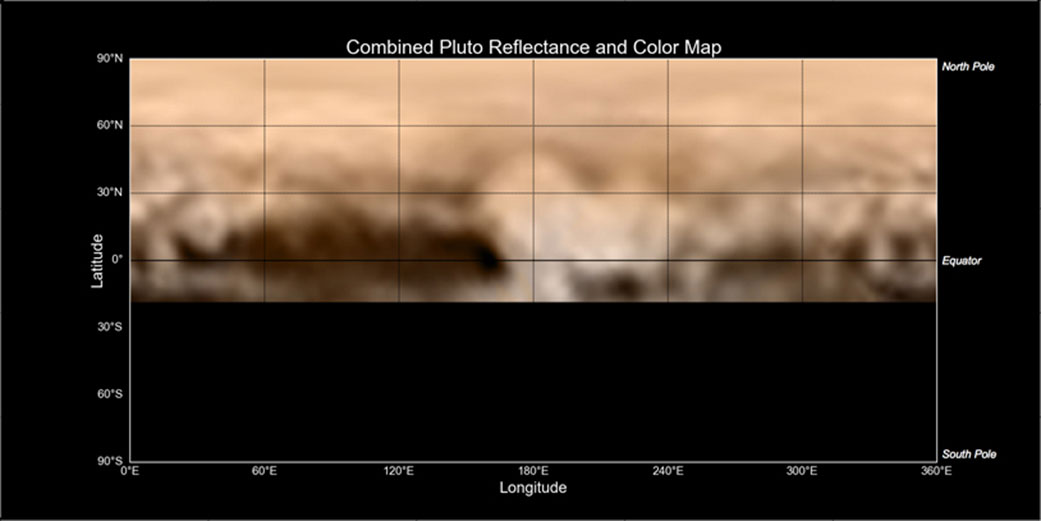
    This map of Pluto, made from images taken by the LORRI instrument aboard New Horizons, shows a wide array of bright and dark markings of varying sizes and shapes. Perhaps most intriguing is the fact that all of the darkest material on the surface lies along Pluto’s equator. The color version was created from lower-resolution color data from the spacecraft’s Ralph instrument. Credit: NASA-JHUAPL-SWRI

    This is the latest image of Pluto from the New Horizons Spacecraft – The Whale and the Donut.

    This is the latest map of Pluto created from images taken from June 27 to July 3 by the Long Range Reconnaissance Imager (LORRI) on New Horizons, combined with lower-resolution color data from the spacecraft’s Ralph instrument. The center of the map corresponds to the side of Pluto that will be seen close-up during New Horizons’ July 14 flyby.

    This map gives mission scientists an important tool to decipher the complex and intriguing pattern of bright and dark markings on Pluto’s surface. Features from all sides of Pluto can now be seen at a glance and from a consistent perspective, making it much easier to compare their shapes and sizes.

    The elongated dark area informally known as “the whale,” along the equator on the left side of the map, is one of the darkest regions visible to New Horizons. It measures some 1,860 miles (3,000 kilometers) in length.

    Directly to the right of the whale’s “head” is the brightest region visible on the planet, which is roughly 990 miles (1,600 kilometers) across. This may be a region where relatively fresh deposits of frost—perhaps including frozen methane, nitrogen, and/or carbon monoxide—form a bright coating.

    Continuing to the right, along the equator, we see the four mysterious dark spots that have so intrigued the world, each of which is hundreds of miles across. Meanwhile, the whale’s “tail,” at the left end of the dark feature, cradles a bright donut-shaped feature about 200 miles (350 kilometers) across. At first glance, it resembles circular features seen elsewhere in the solar system, from impact craters to volcanoes. But scientists are holding off on making any interpretation of this and other features on Pluto until more detailed images are in hand.

    Of course, higher-resolution images in the days to come will allow mission scientists to make more accurate maps, but this map is a tantalizing preview.

    “We’re at the ‘man in the moon’ stage of viewing Pluto,” said John Spencer of the Southwest Research Institute, Boulder, Colorado, deputy leader of the Geology, Geophysics and Imaging team. “It’s easy to imagine you’re seeing familiar shapes in this bizarre collection of light and dark features. However, it’s too early to know what these features really are.”

    Never miss a breakthrough: Join the SciTechDaily newsletter.
    Follow us on Google and Google News.

    Astronomy NASA New Horizons Planetary Science Pluto
    Share. Facebook Twitter Pinterest LinkedIn Email Reddit

    Related Articles

    New Horizons Update: One Million Miles to Go, Pluto More Intriguing Than Ever

    New Horizons Reveals Signs of Pluto’s Geology

    NASA’s New Horizons Pluto Flyby Begins

    The Latest New Horizons Images of Dwarf Planet Pluto

    Dwarf Planet Pluto: The ‘Other’ Red Planet

    New Horizons Spacecraft Reveals Series of Spots on Pluto That Fascinate

    New Horizons Spacecraft Awakens for Encounter with Pluto System

    New ScienceCast Video Previews What New Horizons May See on Pluto

    New ScienceCast Video – Countdown to Pluto

    Leave A Reply Cancel Reply

    • Facebook
    • Twitter
    • Pinterest
    • YouTube

    Don't Miss a Discovery

    Subscribe for the Latest in Science & Tech!

    Trending News

    Breakthrough Parkinson’s Drug Targets Disease at Its Genetic Roots

    Just 4 Weeks of Simple Diet Changes Reversed Signs of Aging in Older Adults

    Scientists May Have Finally Solved Why Humans Are Right-Handed

    NASA’s Hubble Accidentally Witnesses a Comet Shattering in Space

    Researchers Discover the Body’s Hidden “Off Switch” for Inflammation

    Scientists Discover Metformin Doesn’t Work the Way We Thought

    Tea or Coffee? Your Daily Choice Could Affect Osteoporosis Risk

    Vitamin C May Fight Cancer in a Surprising Way

    Follow SciTechDaily
    • Facebook
    • Twitter
    • YouTube
    • Pinterest
    • Newsletter
    • RSS
    SciTech News
    • Biology News
    • Chemistry News
    • Earth News
    • Health News
    • Physics News
    • Science News
    • Space News
    • Technology News
    Recent Posts
    • New Research Uncovers Lithium’s Surprising Effect on Alzheimer’s
    • New Anti-Clotting Medication Prevents Strokes Without the Usual Bleeding Risk
    • Simple Fiber Supplement Cuts Knee Arthritis Pain in Just 6 Weeks, Study Finds
    • Scientists Discover the Secret Bacteria Behind Artisan Cheeses – and They May Be Good for Your Health
    • Banned Antibiotic Discovered in Fish Raises Food Safety Concerns
    Copyright © 1998 - 2026 SciTechDaily. All Rights Reserved.
    • Science News
    • About
    • Contact
    • Editorial Board
    • Privacy Policy
    • Terms of Use

    Type above and press Enter to search. Press Esc to cancel.