

Close Menu
    Facebook X (Twitter) Instagram
    SciTechDaily
    • Biology
    • Chemistry
    • Earth
    • Health
    • Physics
    • Science
    • Space
    • Technology
    Facebook X (Twitter) Pinterest YouTube RSS
    SciTechDaily
    Home»Space»New Horizons Update: One Million Miles to Go, Pluto More Intriguing Than Ever
    Space

    New Horizons Update: One Million Miles to Go, Pluto More Intriguing Than Ever

    By NASAJuly 13, 20151 Comment2 Mins Read
    Facebook Twitter Pinterest Telegram LinkedIn WhatsApp Email Reddit
    Share
    Facebook Twitter LinkedIn Pinterest Telegram Email Reddit
    Pluto is More Intriguing Than Ever
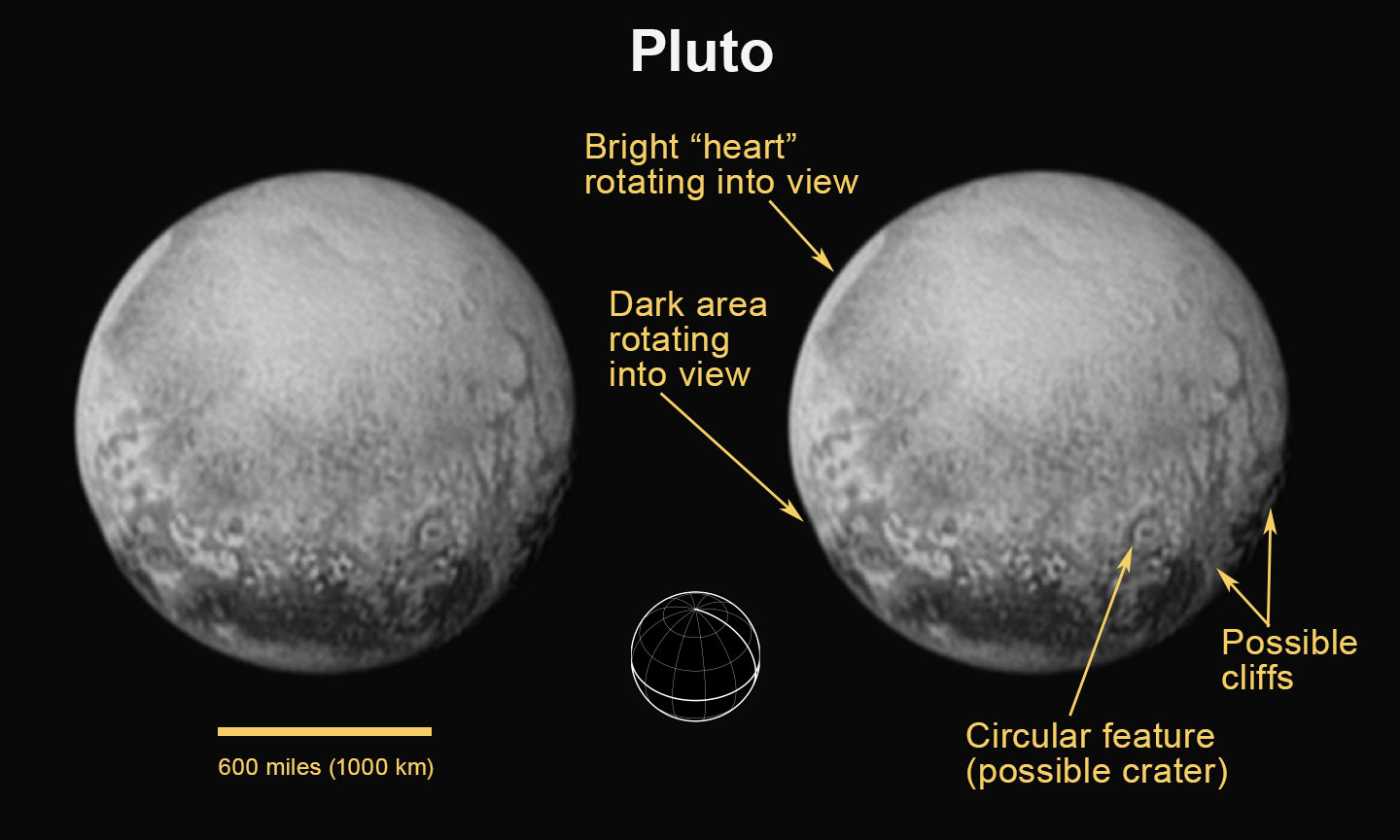
    Pluto as seen from New Horizons on July 11, 2015. Credit: NASA/JHUAPL/SWRI

    As the New Horizons Spacecraft speeds closer to its July 14 flyby of Pluto, it’s continuing to producing images and record data on an icy world that’s growing more fascinating and complex every day.

    On July 11, 2015, New Horizons captured this image, which suggests some new features that are of keen interest to the Geology, Geophysics and Imaging (GGI) team now assembled at the Johns Hopkins University Applied Physics Lab in Laurel, Maryland. For the first time on Pluto, this view reveals linear features that may be cliffs, as well as a circular feature that could be an impact crater. Just starting to rotate into view on the left side of the image is the bright heart-shaped feature that will be seen in more detail during New Horizons’ closest approach.
    New Horizons Nears Pluto
    On July 11, 2015, New Horizons captured a world that is growing more fascinating by the day. For the first time on Pluto, this view reveals linear features that may be cliffs, as well as a circular feature that could be an impact crater. Rotating into view is the bright heart-shaped feature that will be seen in more detail during New Horizons’ closest approach on July 14. The annotated version includes a diagram indicating Pluto’s north pole, equator, and central meridian. Credit: NASA/JHUAPL/SWRI

    The New Horizons spacecraft is now approaching a milestone – only one million miles (1.6 million kilometers) to Pluto – which will occur at 11:23 p.m. EDT tonight, Sunday, July 12. It’s approaching Pluto after a more than nine-year, three-billion-mile (4.8-billion-kilometer) journey. At 7:49 AM EDT on Tuesday, July 14 the unmanned spacecraft will zip past Pluto at 30,800 miles per hour (49,600 kilometers per hour), with a suite of seven science instruments busily gathering data. The mission will complete the initial reconnaissance of the solar system with the first-ever look at the icy dwarf planet.

    Never miss a breakthrough: Join the SciTechDaily newsletter.
    Follow us on Google and Google News.

    Astronomy NASA New Horizons Planetary Science Pluto
    Share. Facebook Twitter Pinterest LinkedIn Email Reddit

    Related Articles

    New Horizons Reveals Signs of Pluto’s Geology

    NASA’s New Horizons Pluto Flyby Begins

    New Horizons Reflectance and Color Map of Pluto

    The Latest New Horizons Images of Dwarf Planet Pluto

    Dwarf Planet Pluto: The ‘Other’ Red Planet

    New Horizons Spacecraft Reveals Series of Spots on Pluto That Fascinate

    New Horizons Spacecraft Awakens for Encounter with Pluto System

    New ScienceCast Video Previews What New Horizons May See on Pluto

    New ScienceCast Video – Countdown to Pluto

    1 Comment

    1. Peter on July 13, 2015 4:30 pm

      Is it going to get ANY pics of Charon or the other three moonlets??? It IS a double dwarf planet system! Pluto’s centre of rotation isn’t even within the planetoid! (I think)

      Reply
    Leave A Reply Cancel Reply

    • Facebook
    • Twitter
    • Pinterest
    • YouTube

    Don't Miss a Discovery

    Subscribe for the Latest in Science & Tech!

    Trending News

    Wasp Colonies Explode Into Violence After Losing Their Queen

    Scientists Create “Living Plastic” That Self-Destructs in Just Six Days

    Your Blood May Carry a 700-Million-Year-Old Secret

    Scientists Discover Some “Zombie Cells” May Actually Help You Live Longer

    Earth May Be Seeding Venus With Life, According to New Research

    What Scientists Found Inside a 117-Year-Old Woman Reveals New Clues to Long Life

    Scientists Discover Mysterious Creature Living in the Great Salt Lake – and It Exists Nowhere Else on Earth

    It’s Alive? Surprising Discovery Changes What We Know About Fog

    Follow SciTechDaily
    • Facebook
    • Twitter
    • YouTube
    • Pinterest
    • Newsletter
    • RSS
    SciTech News
    • Biology News
    • Chemistry News
    • Earth News
    • Health News
    • Physics News
    • Science News
    • Space News
    • Technology News
    Recent Posts
    • Scientists Crack Major Ammonia Problem With a Platinum Catalyst Breakthrough
    • MIT Engineers Solve a Major Lidar Problem That Has Stumped Researchers for Years
    • NASA’s X-59 Sonic Boom Killer Is Ready for Its Biggest Test Yet
    • Why Some Cancers Turn Deadly: Researchers Uncover a Hidden Trigger
    • The Best Exercise Combination for Longevity, According to a 30-Year Study
    Copyright © 1998 - 2026 SciTechDaily. All Rights Reserved.
    • Science News
    • About
    • Contact
    • Editorial Board
    • Privacy Policy
    • Terms of Use

    Type above and press Enter to search. Press Esc to cancel.