

Close Menu
    Facebook X (Twitter) Instagram
    SciTechDaily
    • Biology
    • Chemistry
    • Earth
    • Health
    • Physics
    • Science
    • Space
    • Technology
    Facebook X (Twitter) Pinterest YouTube RSS
    SciTechDaily
    Home»Technology»Revolutionizing Tech With a Simple Equation: New Predictive Tool Will Speed Up Battery and Superconductor Research
    Technology

    Revolutionizing Tech With a Simple Equation: New Predictive Tool Will Speed Up Battery and Superconductor Research

    By Institute of Industrial Science, The University of TokyoApril 3, 2024No Comments3 Mins Read
    Facebook Twitter Pinterest Telegram LinkedIn WhatsApp Email Reddit
    Share
    Facebook Twitter LinkedIn Pinterest Telegram Email Reddit
    Superconductor Superconduction Abstract Physics
    A new study from the University of Tokyo offers a simple yet effective formula for predicting the stability of intercalated materials, key to next-gen electronics and batteries. This breakthrough could significantly reduce R&D time and costs, speeding up the arrival of innovative technologies in the marketplace.

    The performance of numerous cutting-edge technologies, from lithium-ion batteries to the next wave of superconductors, hinges on a physical characteristic called intercalation. Predicting which intercalated materials will be stable poses a significant challenge, leading to extensive trial-and-error experimentation in the development of new products.

    Now, in a study recently published in ACS Physical Chemistry Au, researchers from the Institute of Industrial Science, The University of Tokyo, and collaborating partners have devised a straightforward equation that correctly predicts the stability of intercalated materials. The systematic design guidelines enabled by this work will speed up the development of upcoming high-performance electronics and energy-storage devices.

    Understanding the Research and its Context

    To appreciate the research team’s achievement, we need to understand the context of this research. Intercalation is the reversible insertion of guests (atoms or molecules) into hosts (for example, 2D-layered materials). The purpose of intercalation is commonly to modify the host’s properties or structure for improved device performance, as seen in, for example, commercial lithium-ion batteries. Although many synthetic methods are available for preparing intercalated materials, researchers have had no reliable means of predicting which host–guest combinations are stable. Therefore, much lab work has been needed to devise new intercalated materials for imparting next-generation device functionalities. Minimizing this lab work by proposing a straightforward predictive tool for host–guest stability was the goal of the research team’s study.
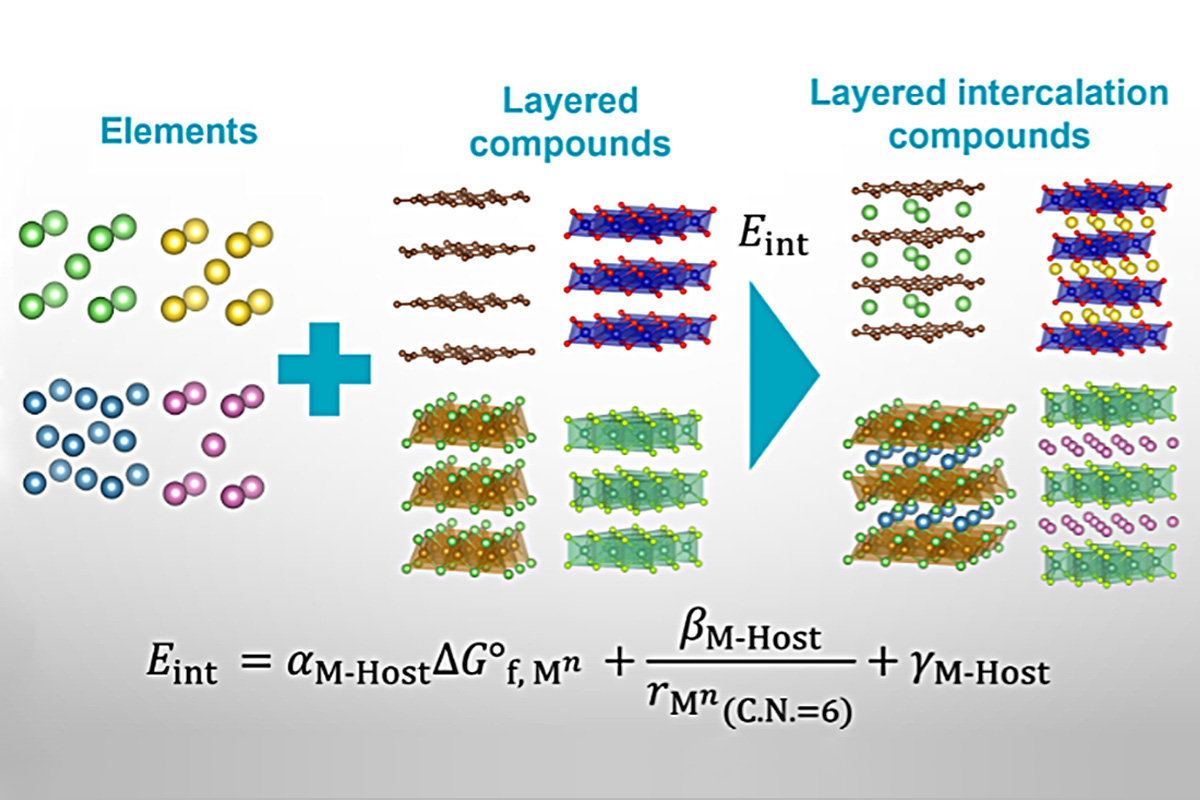
    Guidelines for the Design of Intercalated Materials
    Researchers from the Institute of Industrial Science, The University of Tokyo and collaborating partners have created guidelines for the design of intercalated materials, which will accelerate research on energy storage, electronics, and more. Credit: Institute of Industrial Science, The University of Tokyo

    “We are the first to develop accurate predictive tools for host–guest intercalation energies, and the stability of intercalated compounds,” explains Naoto Kawaguchi, lead author of the study. “Our analysis, based on a database of 9,000 compounds, uses straightforward principles from undergraduate first-year chemistry.”

    A particular highlight of the work is that only two guest properties and eight host-derived descriptors were necessary for the researchers’ energy and stability calculations. In other words, initial ‘best guesses’ weren’t necessary; only the underlying physics of the host–guest systems. Furthermore, the researchers validated their model against nearly 200 sets of regression coefficients.

    “We’re excited because our regression model formulation is straightforward and physically reasonable,” says Teruyasu Mizoguchi, senior author. “Other computational models in the literature lack a physical basis or validation against unknown intercalated compounds.”

    This work is an important step forward in minimizing the laborious lab work that’s typically required to prepare intercalated materials. Given that many current and upcoming energy storage and electronic devices depend on such materials, the time and expense required for corresponding research and development will be minimized. Consequently, products with advanced functionalities will reach the market faster than what has been previously possible.

    Reference: “Unraveling the Stability of Layered Intercalation Compounds through First-Principles Calculations: Establishing a Linear Free Energy Relationship with Aqueous Ions” by Naoto Kawaguchi, Kiyou Shibata and Teruyasu Mizoguchi, 7 March 2024, ACS Physical Chemistry Au.
    DOI: 10.1021/acsphyschemau.3c00063

    Never miss a breakthrough: Join the SciTechDaily newsletter.
    Follow us on Google and Google News.

    Battery Technology Popular Superconductor University of Tokyo
    Share. Facebook Twitter Pinterest LinkedIn Email Reddit

    Related Articles

    ‘Jenga Chemistry’ Creates Superconductivity in a Nickel Oxide Material

    Texas A&M Chemists Develop Powerful New Type of Battery

    New Aluminum Batteries Increase the Range of UUVs Tenfold

    New Battery Could Overcome Key Drawbacks of Lithium-Air Batteries

    Solid Electrolyte Paves the Way for Rechargeable Batteries with Almost Indefinite Lifetimes

    Half Price Lithium-ion Batteries With Improved Performance and Recyclability

    Tin Nanocrystals Enable More Power to be Stored in Lithium Ion Batteries

    Spray Paint Battery Can be Painted on Virtually Any Surface

    Double-Walled Silicon Nanotube Battery Shows Promise

    Leave A Reply Cancel Reply

    • Facebook
    • Twitter
    • Pinterest
    • YouTube

    Don't Miss a Discovery

    Subscribe for the Latest in Science & Tech!

    Trending News

    Aging’s “Zombie Cell” Problem May Have a Solution, Scientists Discover

    Scientists Discover a Surprising Dental Benefit of Cranberry Juice

    Scientists Discover That Eating Peanuts Every Day May Help Protect the Aging Brain

    Scientists Discover Mysterious 150,000-Year-Old Bone From an Extinct Human Relative in Chinese Cave

    Why Do We Have Necks? Scientists Uncover a 380-Million-Year-Old Evolutionary Twist

    “Strangest of Its Kind”: Scientists Uncover a Bizarre Bacterial Self-Destruct Switch

    Scientists Reverse 60 Years of Aging in Human Cells, Turning 80-Year-Old Cells Into 20-Year-Olds

    A Solar Storm Heading Toward Earth Suddenly Changed in Ways Scientists Didn’t Predict

    Follow SciTechDaily
    • Facebook
    • Twitter
    • YouTube
    • Pinterest
    • Newsletter
    • RSS
    SciTech News
    • Biology News
    • Chemistry News
    • Earth News
    • Health News
    • Physics News
    • Science News
    • Space News
    • Technology News
    Recent Posts
    • Scientists Use Light To Build a New Generation of Drug Molecules
    • Scientists Unlock a 1,000-Year-Old Mystery Buried Inside Ancient Melon Seeds
    • Scientists Create Stunning, Car-Quality Paint Without Using a Single Pigment
    • New Treatment Strategy Makes Cancer Cells Run Out of Energy and Die
    • A Promising Way To Reverse Cognitive Decline Just Failed a Major Clinical Test
    Copyright © 1998 - 2026 SciTechDaily. All Rights Reserved.
    • Science News
    • About
    • Contact
    • Editorial Board
    • Privacy Policy
    • Terms of Use

    Type above and press Enter to search. Press Esc to cancel.