
Close Menu
    Facebook X (Twitter) Instagram
    SciTechDaily
    • Biology
    • Chemistry
    • Earth
    • Health
    • Physics
    • Science
    • Space
    • Technology
    Facebook X (Twitter) Pinterest YouTube RSS
    SciTechDaily
    Home»Earth»Satellite Images Capture Extraordinary Flooding in the United Arab Emirates
    Earth

    Satellite Images Capture Extraordinary Flooding in the United Arab Emirates

    By Emily Cassidy, NASA Earth ObservatoryApril 22, 2024No Comments3 Mins Read
    Facebook Twitter Pinterest Telegram LinkedIn WhatsApp Email Reddit
    Share
    Facebook Twitter LinkedIn Pinterest Telegram Email Reddit
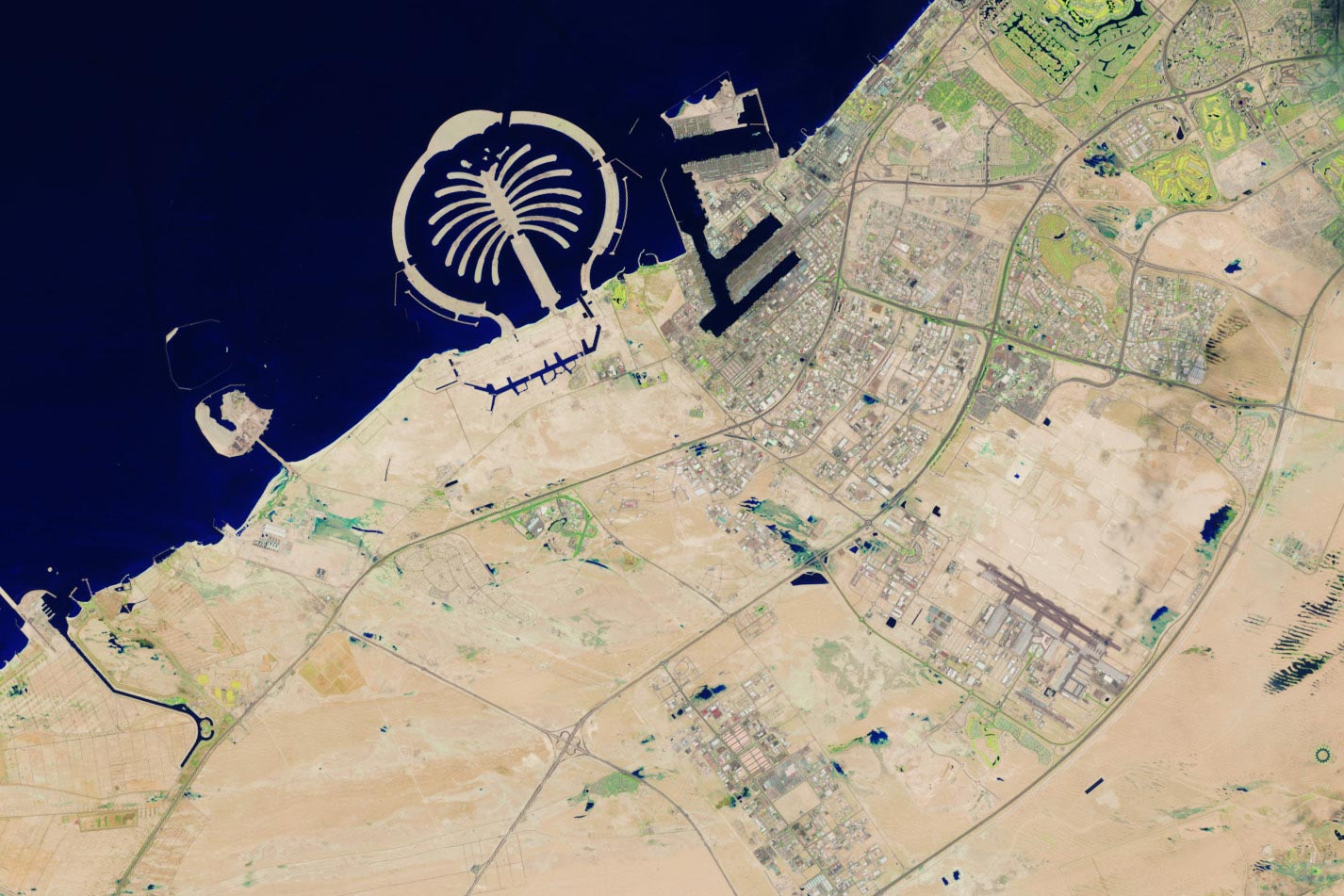
    United Arab Emirates Before Flood Annotated
    Satellite image of the United Arab Emirates before the storms, captured on April 3, 2024, by the Operational Land Imager 2 on Landsat 9.
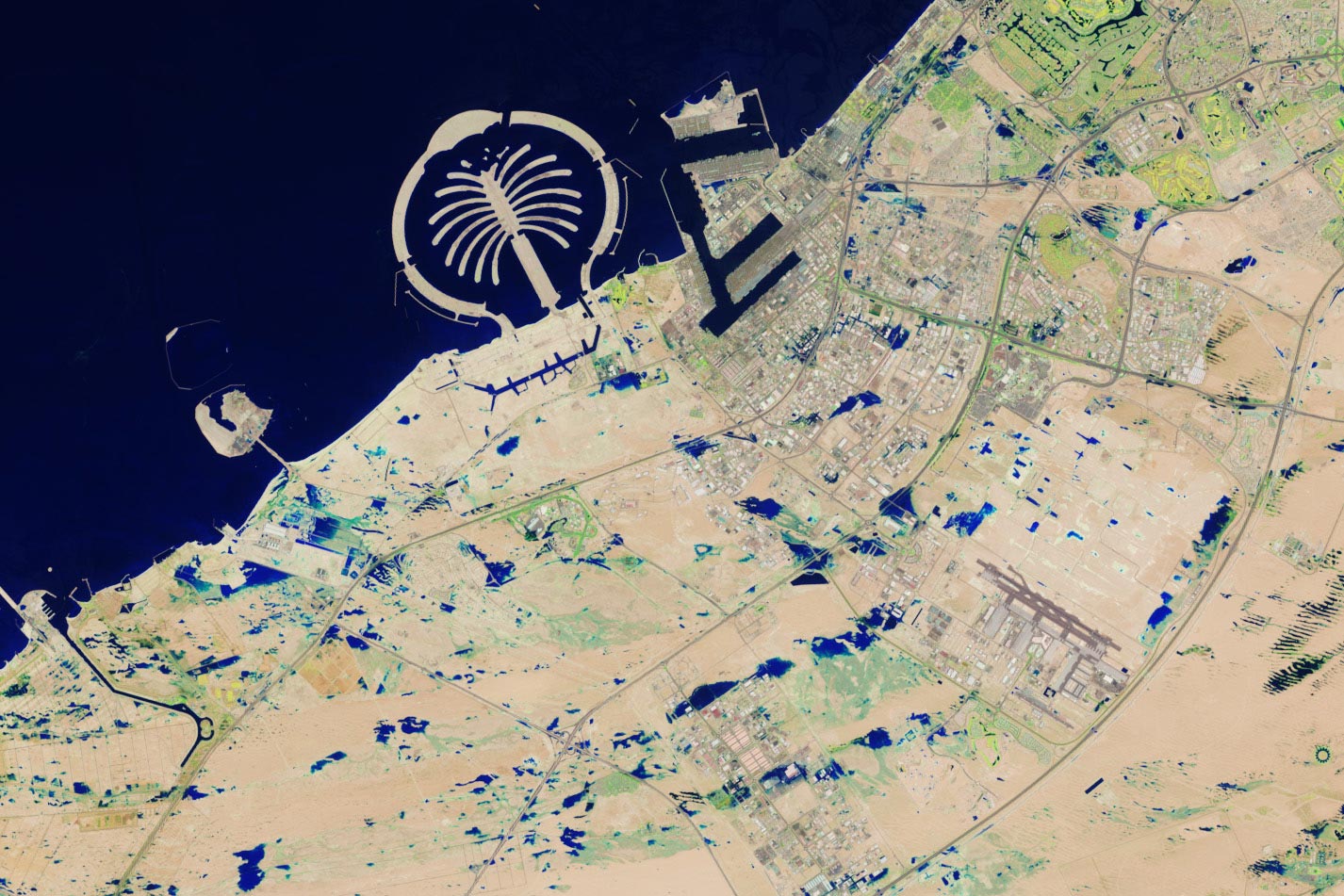
    United Arab Emirates After Flood Annotated
    Satellite image of the United Arab Emirates after the storms, captured on April 19, 2024, by the Operational Land Imager 2 on Landsat 9.

    A powerful storm system battered major cities in the Arabian Peninsula. This slow-moving storm system brought extraordinary rainfall to the UAE, causing widespread flooding, disrupting transport, and overwhelming areas like Dubai and Abu Dhabi with water levels far above annual averages.

    A slow-moving storm system pummeled the United Arab Emirates and dropped more than a year’s worth of rain on some cities in April 2024. Heavy rain triggered flash flooding across eastern parts of the country, inundating roads and disrupting transportation.

    The system first hit Oman on April 14 and continued to batter the UAE through most of the day on April 16. Michael Mann, a climate scientist at the University of Pennsylvania, told the Associated Press that three low-pressure systems formed a train of storms slowly moving along the jet stream—the river of air that moves weather systems—toward the Persian Gulf. The strong low-pressure system delivered multiple rounds of high winds and heavy rain to the northern and eastern parts of the country.

    Some areas remained flooded on April 19, when Landsat 9 passed over the region for the first time since the storms. The image above (lower), acquired that day with the satellite’s OLI-2 (Operational Land Imager 2), shows flooding in Jebel Ali, a town 35 kilometers (22 miles) southwest of Dubai. The image is false color (bands 6-5-3) to emphasize the presence of water, which appears blue. Flooding can be seen in the industrial area of Jebel Ali just south of the port and near the green resorts and parks south of Palm Jebel Ali.
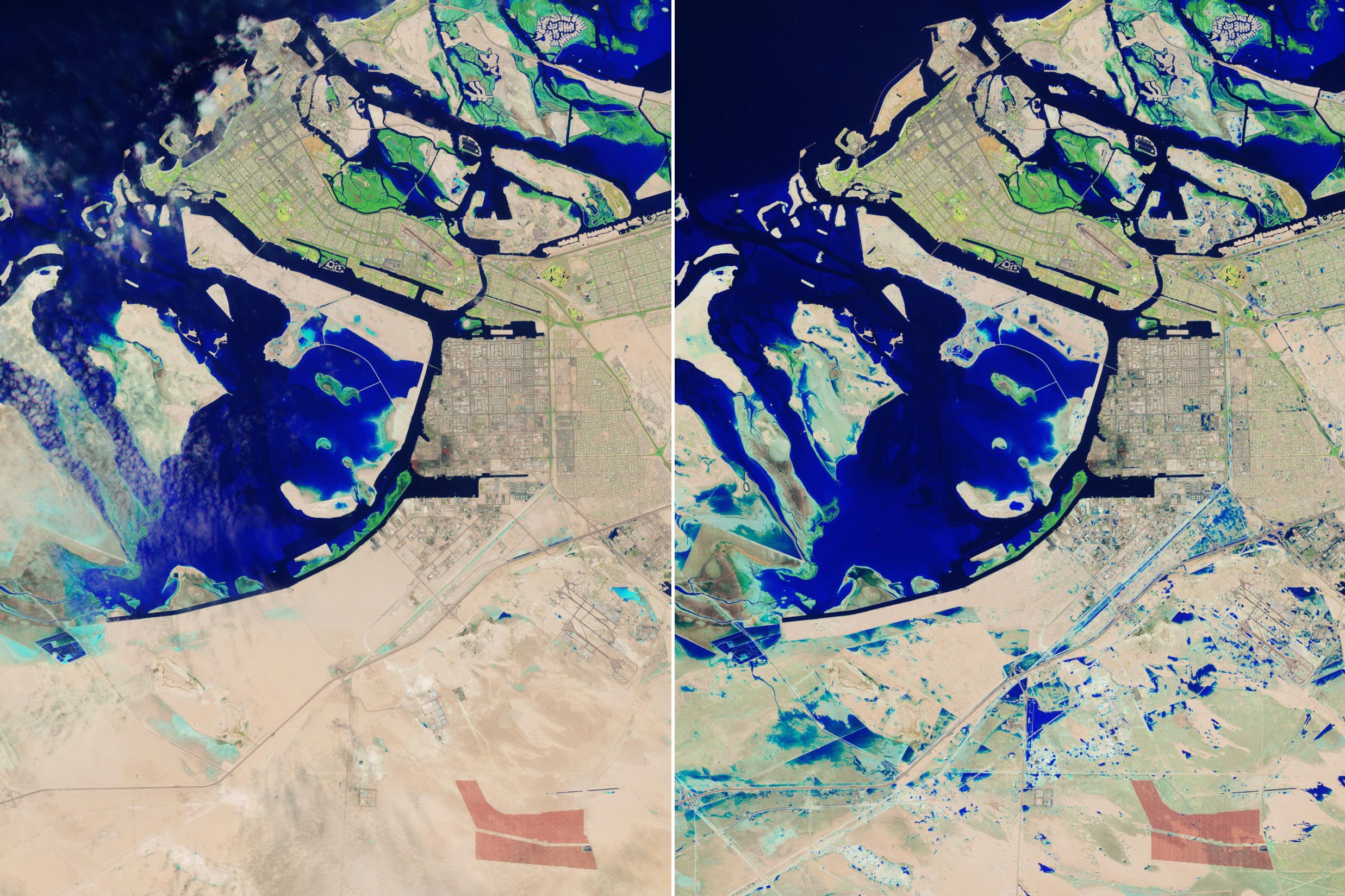
    Abu Dhabi April 2024 Flood Annotated
    Landsat 9 images of Abu Dhabi captured on April 3 and April 19, 2024, show the city and surrounding area before and after the storm.

    Parts of Abu Dhabi, the UAE’s capital city, were also inundated by the storms. The Landsat 9 images above show the city and surrounding area on April 3 (left) and April 19 (right), before and after the storms. On April 19, water can be seen covering the Sheikh Zayed Road, a major thoroughfare that runs through Dubai and Abu Dhabi. Patches of flooded areas are also visible in Khalifa City and Zayed City, residential areas southeast of Abu Dhabi’s downtown.

    The UAE’s National Center for Meteorology reported that eastern parts of the country measured up to 250 millimeters (10 inches) of rain in less than 24 hours. UAE, known for its dry desert climate, receives only about 140 to 200 millimeters (5.5 to 8 inches) of rainfall per year.

    Dubai International Airport (northeast of these images) recorded 119 millimeters on April 16, which is 1.5 times its typical annual rainfall. The deluge temporarily halted flights at the airport, which is among the world’s busiest for international travel.

    As of April 18, some of the UAE was working to recover from the flooding, according to news reports. Dubai’s international airport was reportedly still experiencing delays.

    NASA Earth Observatory images by Wanmei Liang, using Landsat data from the U.S. Geological Survey.

    Never miss a breakthrough: Join the SciTechDaily newsletter.
    Follow us on Google and Google News.

    Geography NASA NASA Earth Observatory Popular Storms Weather
    Share. Facebook Twitter Pinterest LinkedIn Email Reddit

    Related Articles

    3 Feet of Rain in 4 Days: Torrential Rains Unleash Widespread Flooding in Central Greece

    Hilary’s Fury: Rapid Transformation to Category 4 Hurricane

    Unprecedented Wonder: Tropical Cyclone Freddy’s Record-Breaking Month-Long Journey Across the Indian Ocean

    Typhoon Muifa Lands Near Shanghai – Near China’s Largest Metropolitan Area and Major Shipping Ports

    Lake Mead Keeps Dropping: Water Levels Are at Their Lowest Since 1937

    Catastrophic Flooding in Yellowstone – Historic Destruction of Homes, Roads, and Bridges

    Deluge in South Africa: Deadly Flooding and Landslides

    Lake Powell – The Second Largest Reservoir in the United States – Reaches New Low

    Flash Floods From Ida Swamp the Northeast – Areas Hit With 6-10″ of Rain Fall in Just a Few Hours

    Leave A Reply Cancel Reply

    • Facebook
    • Twitter
    • Pinterest
    • YouTube

    Don't Miss a Discovery

    Subscribe for the Latest in Science & Tech!

    Trending News

    Giant Crocodylians Ruled South America’s Ancient Food Chain

    Breakthrough in a Bizarre Galaxy Could Help Unlock the Mystery of Dark Matter

    Just 4 Minutes of Daily Strength Training Can Quadruple Fitness in Older Adults

    Almost All Plant-Based Meat Alternatives Contain Mycotoxins, Study Finds

    Astronomers Detect a Record-Breaking “Cosmic Laser” From 8 Billion Light-Years Away

    A 47-Year-Old Scientist Tracked Himself for Months – His Biological Age Fell to 32

    Construction Crew Uncovers Giant 20-Meter Dinosaur in Brazil

    30 Years of Hurricane Data Reveal 4 Warning Signs Before Storms Strengthen

    Follow SciTechDaily
    • Facebook
    • Twitter
    • YouTube
    • Pinterest
    • Newsletter
    • RSS
    SciTech News
    • Biology News
    • Chemistry News
    • Earth News
    • Health News
    • Physics News
    • Science News
    • Space News
    • Technology News
    Recent Posts
    • A 20-Year Study Finds Preschool Can Influence Success for Years
    • 55-Million-Year-Old Penguin Fossils Preserve Clues to a Warmer Antarctica
    • A 35,000-Year-Old Neanderthal Pelvis May Explain Why Men and Women Walk Differently
    • Hidden Brain Wiring May Help Preserve Thinking As Gray Matter Shrinks
    • Dual Stem Cell Treatment Restores Vision in First Human Trial
    Copyright © 1998 - 2026 SciTechDaily. All Rights Reserved.
    • Science News
    • About
    • Contact
    • Editorial Board
    • Privacy Policy
    • Terms of Use

    Type above and press Enter to search. Press Esc to cancel.