
Close Menu
    Facebook X (Twitter) Instagram
    SciTechDaily
    • Biology
    • Chemistry
    • Earth
    • Health
    • Physics
    • Science
    • Space
    • Technology
    Facebook X (Twitter) Pinterest YouTube RSS
    SciTechDaily
    Home»Earth»Hilary’s Fury: Rapid Transformation to Category 4 Hurricane
    Earth

    Hilary’s Fury: Rapid Transformation to Category 4 Hurricane

    By Emily Cassidy, NASA Earth ObservatoryAugust 19, 2023No Comments3 Mins Read
    Facebook Twitter Pinterest Telegram LinkedIn WhatsApp Email Reddit
    Share
    Facebook Twitter LinkedIn Pinterest Telegram Email Reddit
    Hurricane Hilary Annotated
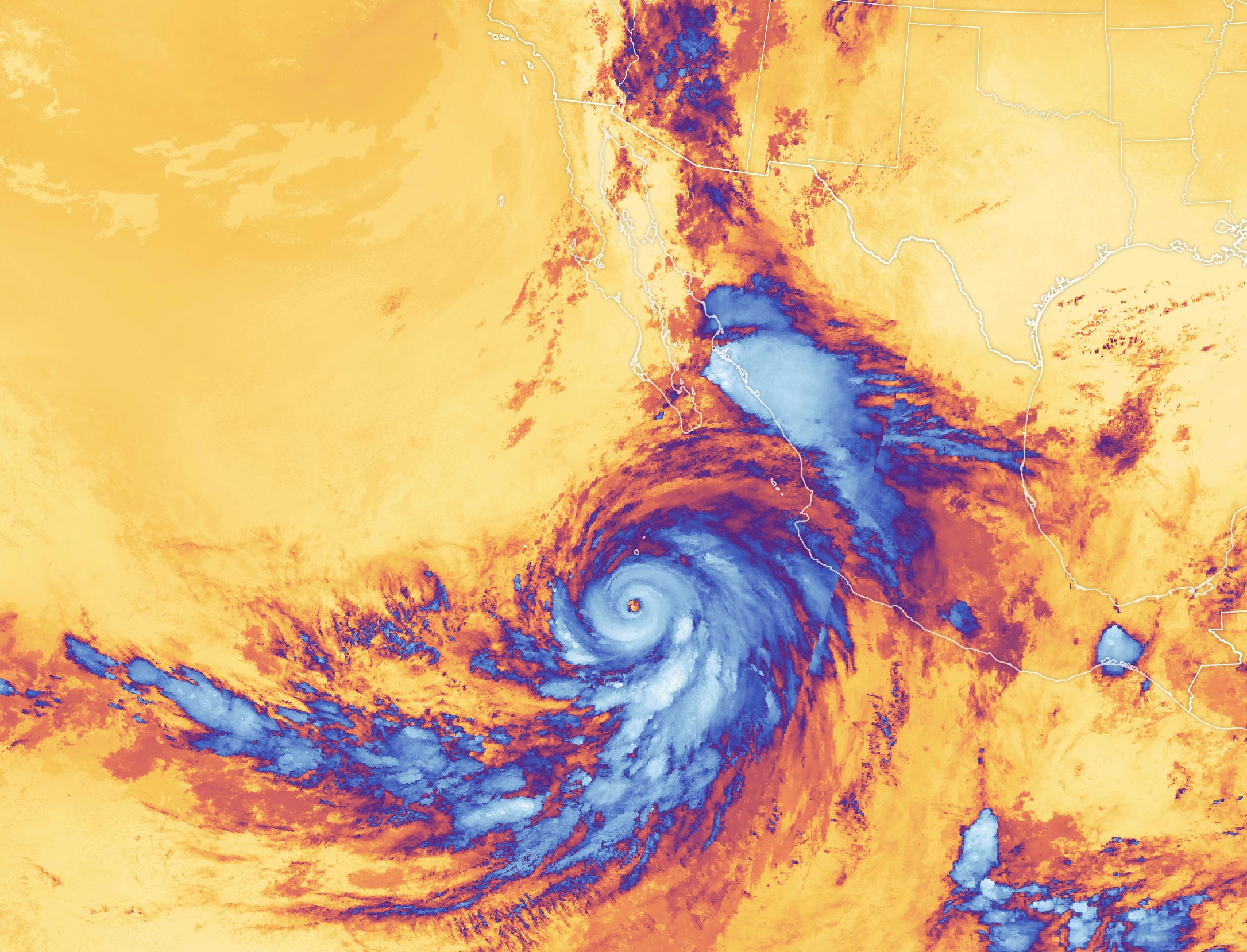
    Satellite image of Hurricane Hilary on August 18, 2023, captured by the Visible Infrared Imaging Radiometer Suite (VIIRS) on NOAA-20. Category 4 Hurricane Hilary is nearing the Baja California peninsula and is predicted to bring heavy rain to Southern California. Warnings have been issued in Mexico and parts of the U.S.

    The major hurricane was expected to weaken before delivering heavy rain to Mexico and Southern California.

    Hurricane Hilary, a category 4 storm in the Pacific Ocean, approached the Baja California peninsula on August 18, 2023.

    This image of Hilary was acquired by the Visible Infrared Imaging Radiometer Suite (VIIRS) on the NOAA-20 satellite in the predawn hours of August 18 (09:25 Universal Time), when the eye of the storm was about 400 miles (640 kilometers) off the coast of the peninsula. The image shows infrared brightness temperature data, which is useful for distinguishing cooler cloud structures (white and blue) from warmer surfaces below (yellow). Generally, the coolest temperatures are associated with the tallest clouds.

    Hilary’s Development and Predicted Path

    As of 9 a.m. Mountain Time (15:00 Universal Time) on August 18, Hilary had maximum sustained winds of nearly 145 miles (230 kilometers) per hour, according to the National Hurricane Center, making it a category 4 hurricane on the Saffir-Simpson wind scale. Hilary formed as a tropical storm off the coast of Manzanillo, Mexico, on August 16. Between August 17 and August 18, Hilary intensified quickly from a tropical storm to a forceful category 4 hurricane.

    The National Hurricane Center expects Hilary to continue moving north-northwest and weaken before reaching the center of the peninsula by the evening of August 19. Then, by the evening of August 20, the storm is forecast to move inland over Southern California and drench cities such as San Diego and Los Angeles with heavy rain. Scientists at NASA’s Short-term Prediction Research and Transition Center (SPoRT) expected that the heavy rain could saturate soils in the region for several days after the storm.

    Warnings and Precautions

    The Government of Mexico issued a hurricane warning for the Baja California peninsula, spanning from Punta Abreojos to Punta Eugenia. The U.S. National Hurricane Center issued a tropical storm watch for portions of Southern California, including San Diego and north up to Huntington Beach. This is the first time the center has issued a watch for that region.

    NASA Earth Observatory image by Lauren Dauphin, using VIIRS data from NASA EOSDIS LANCE, GIBS/Worldview, and the Joint Polar Satellite System (JPSS).

    Never miss a breakthrough: Join the SciTechDaily newsletter.
    Follow us on Google and Google News.

    Geography Hurricane NASA NASA Earth Observatory Storms Weather
    Share. Facebook Twitter Pinterest LinkedIn Email Reddit

    Related Articles

    Typhoon Muifa Lands Near Shanghai – Near China’s Largest Metropolitan Area and Major Shipping Ports

    Catastrophic Flooding in Yellowstone – Historic Destruction of Homes, Roads, and Bridges

    Deluge in South Africa: Deadly Flooding and Landslides

    Hurricane Ida Leaves a Trail of Oil in the Gulf of Mexico

    A Changed Landscape in Southern Louisiana After Hurricane Ida: Large New Patches of Open Water

    Flash Floods From Ida Swamp the Northeast – Areas Hit With 6-10″ of Rain Fall in Just a Few Hours

    NASA Satellite Observes Massive Power Outages in New Orleans

    Hurricane Ida Batters Louisiana: 5th-Strongest Storm Ever To Make Landfall in the Continental U.S.

    Incredible View of Tropical Storm Elsa Captured From Space

    Leave A Reply Cancel Reply

    • Facebook
    • Twitter
    • Pinterest
    • YouTube

    Don't Miss a Discovery

    Subscribe for the Latest in Science & Tech!

    Trending News

    Scientists Call for a Complete Rethink of Alzheimer’s Treatment

    Scientists Identify Molecular Switch That Lets Exercise Reverse Muscle Aging

    Why Your Most Vivid Dreams Might Be the Key to Deep, Restful Sleep

    A Bright Star Hid a Massive Secret for 50 Years: Mystery of Gamma Cassiopeiae Finally Solved

    Scientists Identify Protein That Slows Key Effects of Aging

    Revolutionary Submarine Mysteriously Disappears Without a Trace – Scientists Are Now Preparing for a Bold Return

    Why Drinking More Water Isn’t Enough To Stop Kidney Stones

    New Study Reveals Surprising Effect of Drinking Coffee at Night

    Follow SciTechDaily
    • Facebook
    • Twitter
    • YouTube
    • Pinterest
    • Newsletter
    • RSS
    SciTech News
    • Biology News
    • Chemistry News
    • Earth News
    • Health News
    • Physics News
    • Science News
    • Space News
    • Technology News
    Recent Posts
    • Mountain Mutation Could Unlock a Natural Treatment for Nerve Damage
    • Microscopic Medicines That Work Inside Human Cells Unlock New Treatments for Alzheimer’s Disease
    • New Study Reveals Hidden Trade-Off in Popular Weight Loss Treatments
    • AI Uncovers Hidden Signals, Discovering Dozens of New Alien Planets
    • New Discovery Challenges 80-Year-Old Theory About Turbulence
    Copyright © 1998 - 2026 SciTechDaily. All Rights Reserved.
    • Science News
    • About
    • Contact
    • Editorial Board
    • Privacy Policy
    • Terms of Use

    Type above and press Enter to search. Press Esc to cancel.