
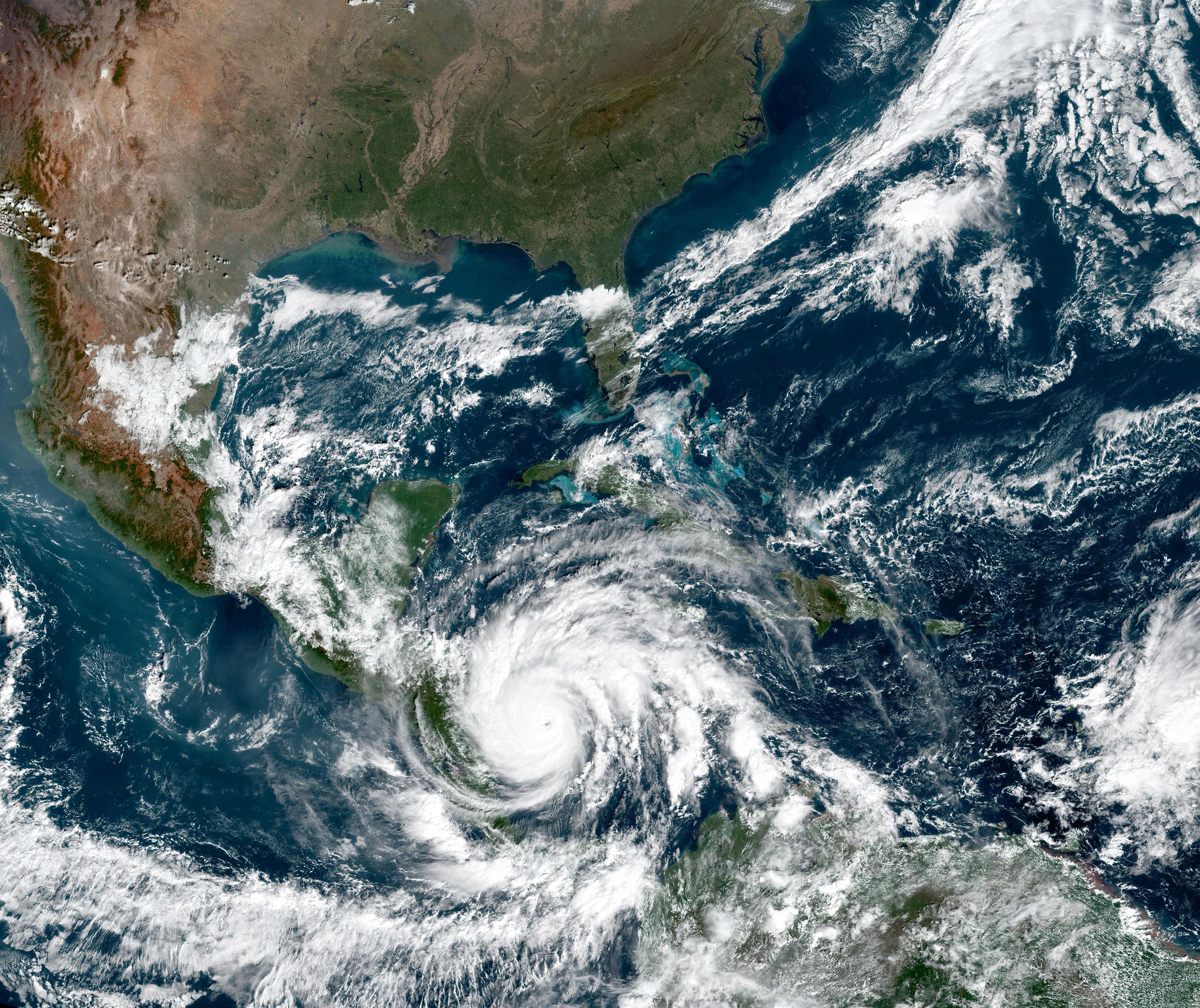
Less than two weeks after being hit by category 4 Hurricane Eta, several Central American countries braced for the arrival of category 5 Hurricane Iota. The U.S. National Hurricane Center (NHC) warned of potentially devastating storm surges and winds, along with torrential rain that will fall upon areas already coping with damaged levees and swollen lakes, reservoirs, and rivers. Iota appeared headed for landfall late on November 16 in northern Nicaragua, likely within tens of kilometers from where Eta hit on November 3, 2020.
Iota is the strongest hurricane and 30th named storm of the 2020 Atlantic season, the most since modern record-keeping began. (The previous record of 28 was set in 2005.) It also marked the first time that two hurricanes have formed in the Atlantic in any November. Iota is the 13th storm to reach hurricane strength this year; the average hurricane year brings 11.5 named storms and six hurricanes.
As of 1 p.m. U.S. Eastern Time on November 16, the NHC had issued hurricane warnings for large portions of coastal Nicaragua and Honduras. Iota had strengthened to a category 5 storm, with sustained winds of 260 kilometers (160 miles) per hour. Forecasters warned of coastal storm surges as high as 4.5 to 6 meters (15 to 20 feet) and rainfall amounts between 250 to 750 millimeters (10 to 30 inches) across parts of Nicaragua, Honduras, Guatemala, and Belize.
The natural-color image above was acquired at 10 a.m. local time (1500 Universal Time) on November 16 by the Advanced Baseline Imager (ABI) on GOES-16. The satellite is operated by the National Oceanic and Atmospheric Administration (NOAA), which includes the National Hurricane Center. NASA helps develop and launch the GOES series of satellites.
Tropical storm Iota reached hurricane strength early on November 15. Over the course of 36 hours, wind speeds increased by 160 kilometers (100 miles) per hour—well beyond the threshold of 55 kilometers (35 miles) per hour that meteorologists refer to as “rapid intensification.” The storm grew over particularly warm Caribbean waters, which are known to fuel hurricanes. La Niña conditions in the eastern Pacific may also have played a role, as such events typically reduce wind shear that can break up storms. Iota is the tenth storm to undergo rapid intensification in 2020.

The map above shows the tracks of Hurricane Iota and Hurricane Eta overlaid on a map of sea surface temperatures (SSTs) in the Caribbean Sea and the Gulf of Mexico as measured on November 15, 2020. A rule of thumb among scientists is that ocean temperatures should be at or above 27° Celsius (deep orange and red on the map) to sustain a hurricane. The SST data come from the Multiscale Ultrahigh Resolution Sea Surface Temperature (MUR SST) project, based at NASA’s Jet Propulsion Laboratory. MUR SST blends measurements of sea surface temperatures from multiple NASA, NOAA, and international satellites, as well as ship and buoy observations.
Research meteorologist Philip Klotzbach of Colorado State University, who is also a hurricane historian, noted on Twitter that Iota is just the second Atlantic hurricane to ever reach category 5 intensity in November. It is also the fifth Atlantic hurricane to form after October 1, 2020. The first 24 named storms of the year produced two major hurricanes; the last six storms have produced four major hurricanes.
Klotzbach also noted that before 2020, only four category 4 or 5 hurricanes had ever made landfall in Nicaragua. Now two are going to land in the span of two weeks.
NASA Earth Observatory images by Joshua Stevens, using GOES 16 imagery courtesy of NOAA and the National Environmental Satellite, Data, and Information Service (NESDIS), data from the Multiscale Ultrahigh Resolution (MUR) project, and Black Marble data from NASA/GSFC. Story by Michael Carlowicz, with scientific interpretation from Timothy Hall, NASA Goddard Institute for Space Studies.
Never miss a breakthrough: Join the SciTechDaily newsletter.
Follow us on Google and Google News.