
Close Menu
    Facebook X (Twitter) Instagram
    SciTechDaily
    • Biology
    • Chemistry
    • Earth
    • Health
    • Physics
    • Science
    • Space
    • Technology
    Facebook X (Twitter) Pinterest YouTube RSS
    SciTechDaily
    Home»Space»Unlocking Cosmic Secrets: Astronomers Develop New Technique To Extract Information From Galaxies
    Space

    Unlocking Cosmic Secrets: Astronomers Develop New Technique To Extract Information From Galaxies

    By Chinese Academy of SciencesJuly 23, 2024No Comments3 Mins Read
    Facebook Twitter Pinterest Telegram LinkedIn WhatsApp Email Reddit
    Share
    Facebook Twitter LinkedIn Pinterest Telegram Email Reddit
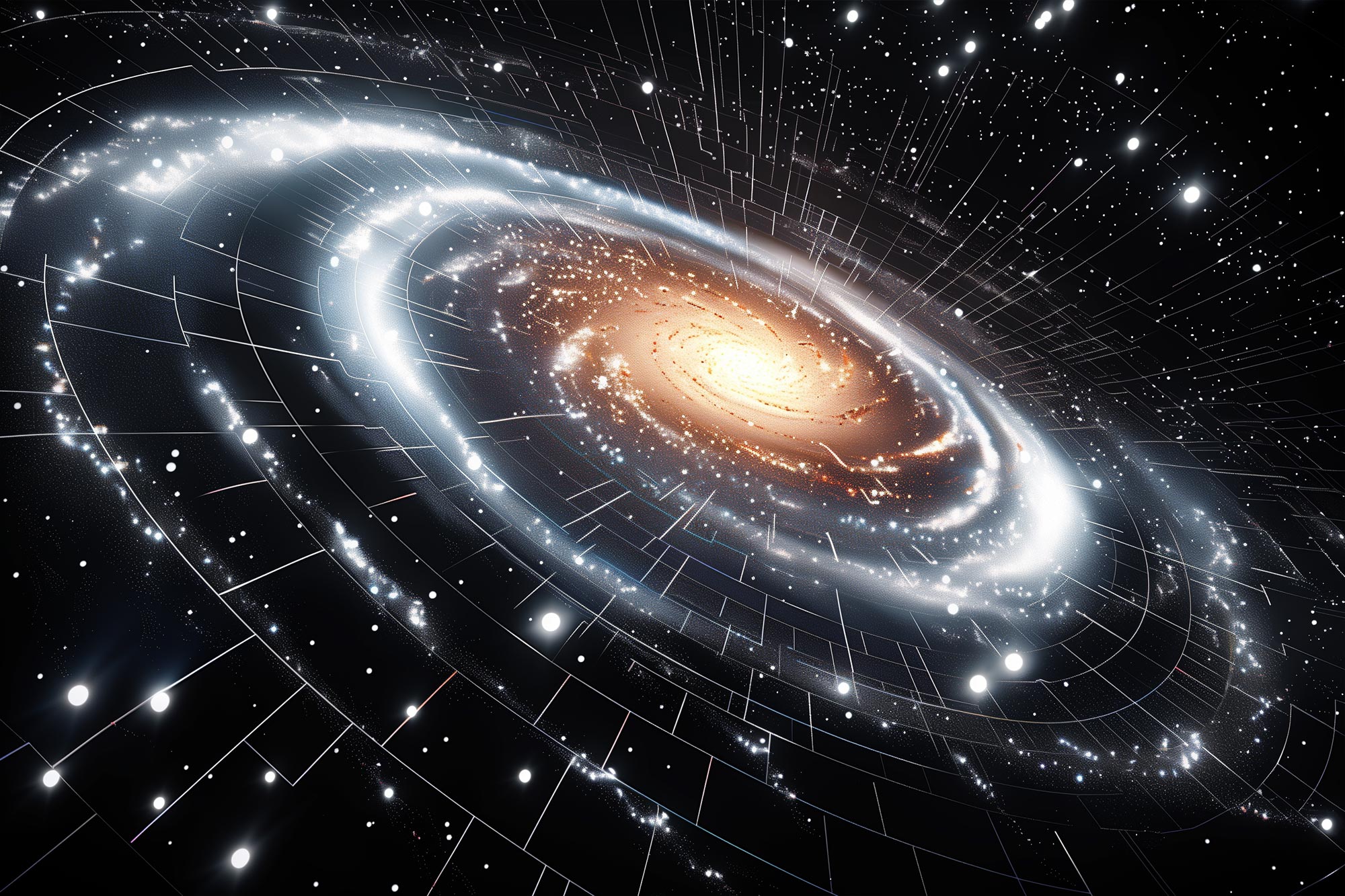
    Galaxy Gravity Dark Matter Art
    Researchers from the National Astronomical Observatories of the Chinese Academy of Sciences and their international partners have introduced a novel method to more effectively harness information from galaxy surveys, particularly for extracting intricate data from N-point correlation functions, which detail galaxy clustering. This breakthrough leverages a technique called density reconstruction to derive higher-order data from basic two-point analyses, potentially enhancing the scope and accuracy of cosmic research in upcoming projects like the DESI, PFS, and CSST.

    A new research method developed by NAOC scientists improves the extraction of complex galaxy data, paving the way for future cosmic explorations and surveys.

    Scientists at the National Astronomical Observatories of the Chinese Academy of Sciences (NAOC), in collaboration with international partners, have recently devised an innovative technique for efficiently extracting information from galaxy surveys.

    Their research results were published online in the latest issue of Communications Physics.

    Massive galaxy redshift surveys are powerful tools for probing the Universe in this era of precision cosmology. By observing a great number of spectra from distant galaxies, astronomers are able to create density fields of galaxies at different epochs of the Universe. These density fields carry crucial information about the clustering of galaxies, which is quantified by two-point and N-point (N>2) correlation functions.

    “The information content in the N-point functions is highly complementary to that in the two-point functions,” said Gongbo Zhao, lead author of the study and a researcher at NAOC. “The N-point functions play an important role in studies of the nature of dark energy, dark matter, and gravity.”
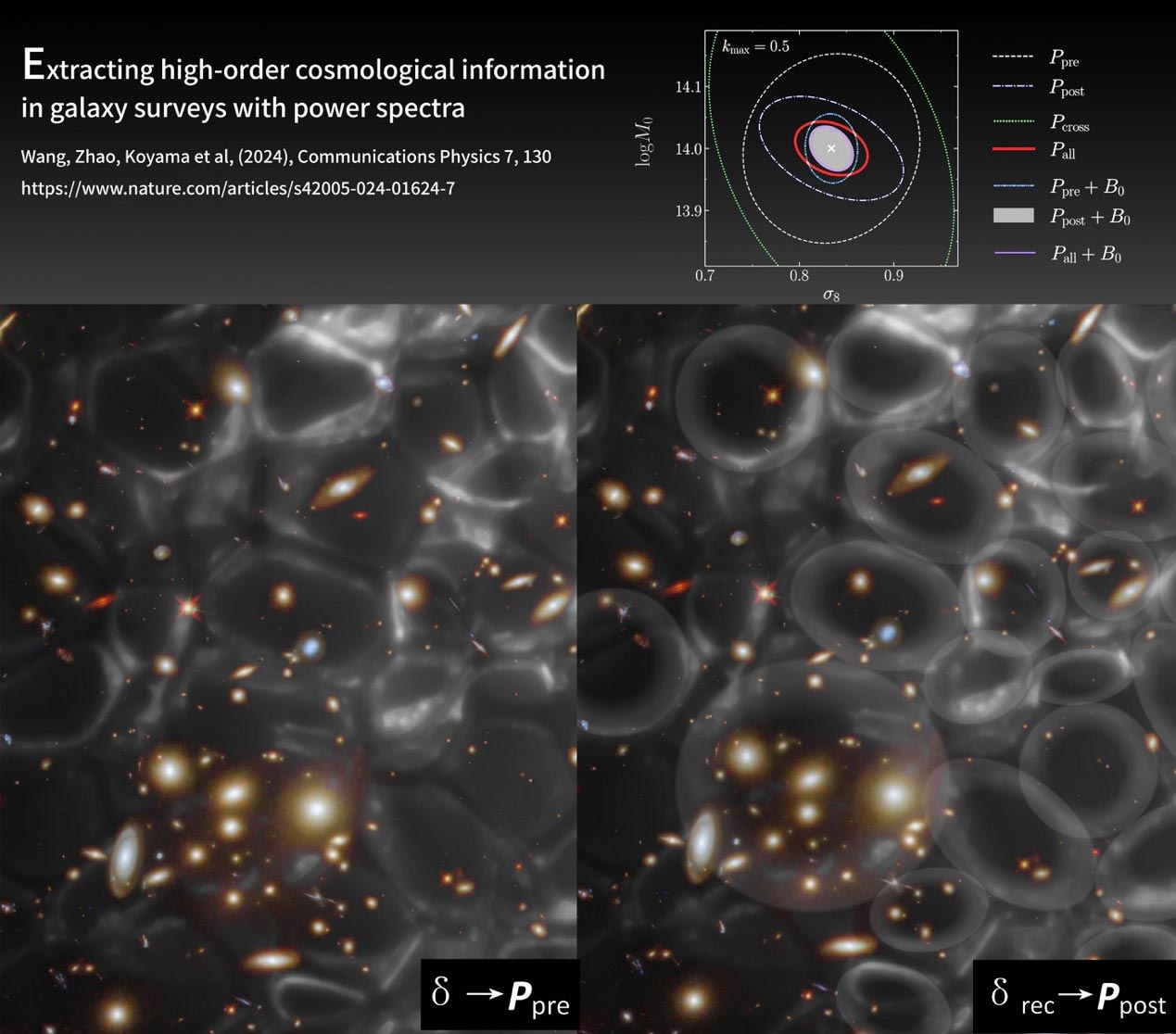
    New Way To Extract Cosmological Information From Galaxy Surveys
    An illustration of the main idea and results from Wang et al., Commun. Phys. 7, 130 (2024). Credit: NAOC

    Challenges in Utilizing N-Point Functions

    However, it is difficult to make use of the N-point functions in practice due to various complexities, including the measurement and modeling of these quantities.

    After working on this challenging task for a few years, Zhao and his collaborators have developed a new method for extracting information in the N-point functions from the two-point functions.

    This new method, which is based on a technology called density reconstruction, makes it possible to extract the primary information in the three-point and four-point functions by a joint analysis of the two-point functions measured from the pre- and post-reconstructed density fields, respectively.

    “This opens a new window for using the high-order information in galaxy surveys in an efficient way,” said Zhao. “and that’s important for cosmological implications for forthcoming galaxy surveys including Dark Energy Spectroscopic Instrument (DESI), Prime Focus Spectrograph (PFS) and China Space Station Telescope (CSST).”

    Reference: “Extracting high-order cosmological information in galaxy surveys with power spectra” by Yuting Wang, Gong-Bo Zhao, Kazuya Koyama, Will J. Percival, Ryuichi Takahashi, Chiaki Hikage, Héctor Gil-Marín, ChangHoon Hahn, Ruiyang Zhao, Weibing Zhang, Xiaoyong Mu, Yu Yu, Hong-Ming Zhu and Fei Ge, 18 April 2024, Communications Physics.
    DOI: 10.1038/s42005-024-01624-7

    This work was funded by the Natural Science Foundation of China (NSFC), China’s Ministry of Science and Technology (MOST), and the Chinese Academy of Sciences (CAS).

    Never miss a breakthrough: Join the SciTechDaily newsletter.
    Follow us on Google and Google News.

    Astronomy Astrophysics Chinese Academy of Sciences Galaxy
    Share. Facebook Twitter Pinterest LinkedIn Email Reddit

    Related Articles

    From the Dawn of Time: Astronomers Discover Six Ancient Galaxies With Unprecedented Gas Masses

    Mysterious Dimming of Red Supergiant Betelgeuse Explained by New Theory

    Astrophysicists Discover Energetic Hot Wind from Low-luminosity Active Galactic Nucleus

    Cause of Jupiter’s X-Ray Aurora Revealed – Mystery Has Puzzled Scientists for 40 Years

    New Breakthrough Towards Understanding Dark Energy

    Chinese Solar Telescope Reveals Acceleration of Magnetic Reconnection From a Nearby Filament Eruption

    New Observations of First Black Hole Ever Detected Leads to Questions About the Universe’s Most Mysterious Objects

    Giant 2D Atlas of the Universe Created – Helps Dark Energy Spectroscopic Survey

    Chinese Astronomers Discover 591 High Velocity Stars – 43 of Them Can Even Escape From the Galaxy

    Leave A Reply Cancel Reply

    • Facebook
    • Twitter
    • Pinterest
    • YouTube

    Don't Miss a Discovery

    Subscribe for the Latest in Science & Tech!

    Trending News

    FDA-Approved Drug Shows Promise for Reversing Osteoarthritis Damage

    11,000-Year-Old Grains Reveal a Surprise About the Origins of Agriculture

    This Common Type of Medication Is Linked to Slower Cognitive Decline

    Quantum Computer Solves a Problem in 15 Minutes That Classical Methods Can’t Practically Compute

    Taking the Stairs Could Cut Your Risk of Heart-Related Death by 39%

    Scientists Uncover a Surprising New Route for Stonehenge’s Most Mysterious Stone

    A Star Near the Milky Way’s Black Hole Is Losing Mass at an Astonishing Rate

    Scientists Solve a Vitamin B12 Mystery With an Unexpected Culprit

    Follow SciTechDaily
    • Facebook
    • Twitter
    • YouTube
    • Pinterest
    • Newsletter
    • RSS
    SciTech News
    • Biology News
    • Chemistry News
    • Earth News
    • Health News
    • Physics News
    • Science News
    • Space News
    • Technology News
    Recent Posts
    • Common Supplements Show Antibiotic-Like Benefits Against Severe Gum Disease
    • Scientists Warn of a Nearly 400% Increase in Toxic Liver Injuries – One Common Drug Leads the List
    • Earth-Like Worlds Could Have Formed Billions of Years Earlier Than Scientists Thought
    • “I Jumped From My Chair” – Astronomers Discover a Hidden Star Orbiting Betelgeuse
    • JWST Finds a “Star” 100 Billion Times Brighter Than Any Star Should Be
    Copyright © 1998 - 2026 SciTechDaily. All Rights Reserved.
    • Science News
    • About
    • Contact
    • Editorial Board
    • Privacy Policy
    • Terms of Use

    Type above and press Enter to search. Press Esc to cancel.