
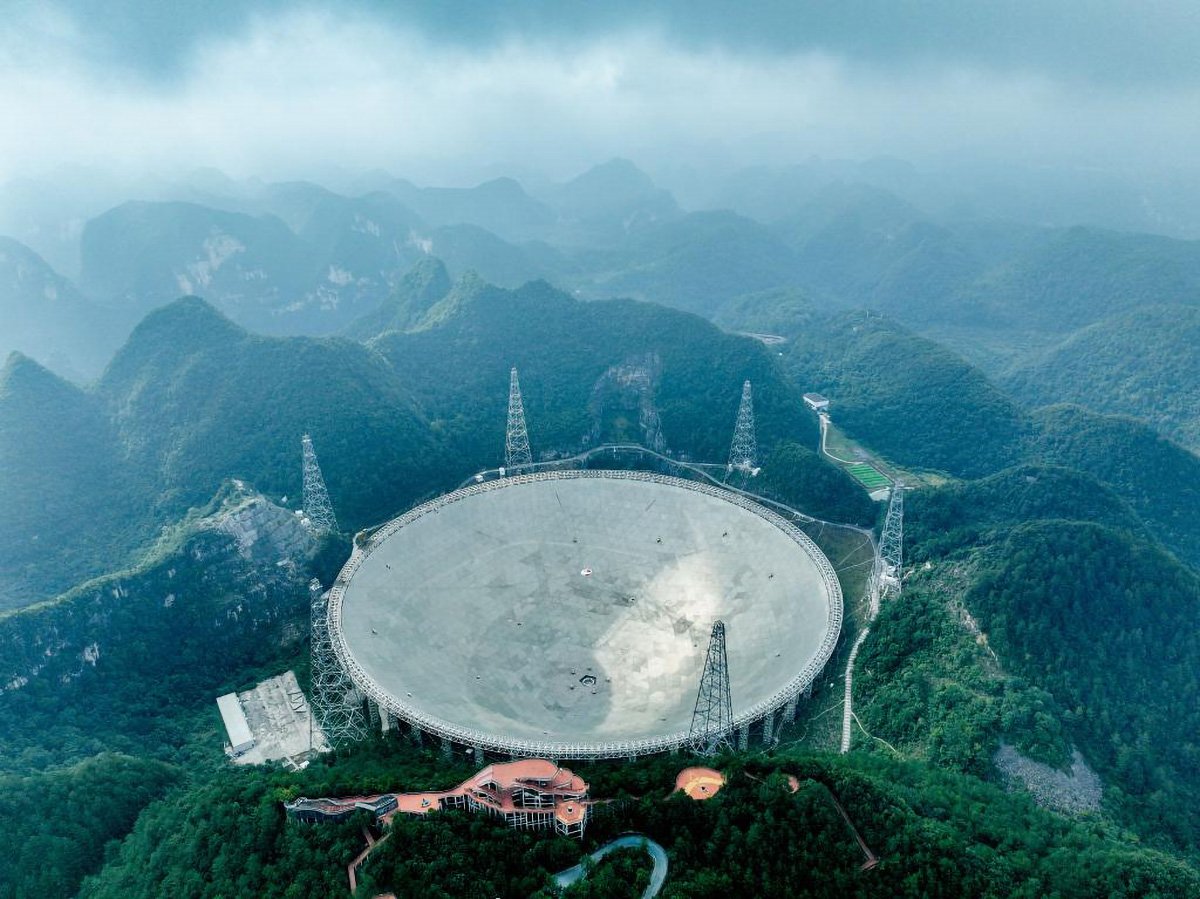
Researchers using China’s FAST telescope have uncovered six distant galaxies rich in hydrogen and star-forming potential, significantly advancing our understanding of the early universe.
Dr. Hongwei Xi from the National Astronomical Observatories of the Chinese Academy of Sciences (NAOC) and his team have discovered the characteristics of six newly identified high-redshift galaxies. This discovery was made using the Five-hundred-meter Aperture Spherical radio Telescope (FAST) located in Guizhou Province, China. Their findings were published in The Astrophysical Journal Letters.
These remarkable galaxies, whose radio wave emissions have taken almost the age of the solar system to reach us, contain amounts of atomic hydrogen gas that are more than that of the tens of thousands of galaxies previously surveyed in the local universe using other radio telescopes.
The researchers concluded that galaxies four billion years ago had much more star-forming gas than current-day galaxies, and distant galaxies have much greater gas reservoirs than previously believed.
The Importance of FAST and International Collaboration
“These discoveries are part of the ongoing FAST Ultra Deep Survey, showing the tremendous sensitivity of the world’s largest radio telescope,” said Prof. Bo Peng from NAOC, a corresponding author. “The new FAST survey has so far discovered over 100 new galaxies at distances up to five billion light-years, with the final number expected to reach over 1000.”
Finding the optical counterparts to the new radio discoveries has turned into a detective story because galaxies are very faint at such large distances. In addition, due to the wavelength difference, the localization accuracy of FAST is not as good as that of optical telescopes.
However, using the largest optical telescopes in the U.S. and Russia, the counterparts were eventually identified by experts from the collaborative team. The counterparts were found to contain 2–3 times more stars than the Milky Way, yet contain about 10 times the mass of hydrogen gas.
“This collaborative work between Chinese and Australian radio astronomers demonstrates the tremendous potential of the new generation of radio telescopes that, later this decade, will also include the international Square Kilometre Array Observatory (SKAO),” said Prof. Lister Staveley-Smith from the University of Western Australia node of the International Centre for Radio Astronomy research, the other corresponding author.
Reference: “The Most Distant H i Galaxies Discovered by the 500 m Dish FAST” by Hongwei Xi, Bo Peng, Lister Staveley-Smith, Bi-Qing For, Bin Liu, Ru-Rong Chen, Lei Yu, Dejian Ding, Wei-Jian Guo, Hu Zou, Suijian Xue, Jing Wang, Thomas G. Brink, WeiKang Zheng, Alexei V. Filippenko, Yi Yang, Jianyan Wei, Y. Sophia Dai, Zi-Jian Li, Zizhao He, Chengzi Jiang, Alexei Moiseev and Sergey Kotov, 9 May 2024, The Astrophysical Journal Letters.
DOI: 10.3847/2041-8213/ad4357
Never miss a breakthrough: Join the SciTechDaily newsletter.
Follow us on Google and Google News.
2 Comments
Interesting label: Dawn of Time.
Who invented time? Was it created? If time is an assigned meter of observations, then
Is there a point before “time”?
Man has defined what he observes. But is unable to describe the initial process and implementation of what man observed. Man is a part of existence observed from man’s point of existence. Man can not see outside of time because his science imprisoned him. Science becomes his god.
The supply of gas would explain modern large galaxies.
@Samuel Bess: It’s a metaphor. And exactly the increased ability of science observation, which earlier limited people to use metaphors instead of facts, show that there is no magic. We now know robustly and beyond reasonable doubt that the universe is produced by an entirely natural process of space expansion.