
Close Menu
    Facebook X (Twitter) Instagram
    SciTechDaily
    • Biology
    • Chemistry
    • Earth
    • Health
    • Physics
    • Science
    • Space
    • Technology
    Facebook X (Twitter) Pinterest YouTube RSS
    SciTechDaily
    Home»Space»Chinese Astronomers Discover 591 High Velocity Stars – 43 of Them Can Even Escape From the Galaxy
    Space

    Chinese Astronomers Discover 591 High Velocity Stars – 43 of Them Can Even Escape From the Galaxy

    By National Astronomical Observatories of ChinaJanuary 4, 2021No Comments3 Mins Read
    Facebook Twitter Pinterest Telegram LinkedIn WhatsApp Email Reddit
    Share
    Facebook Twitter LinkedIn Pinterest Telegram Email Reddit
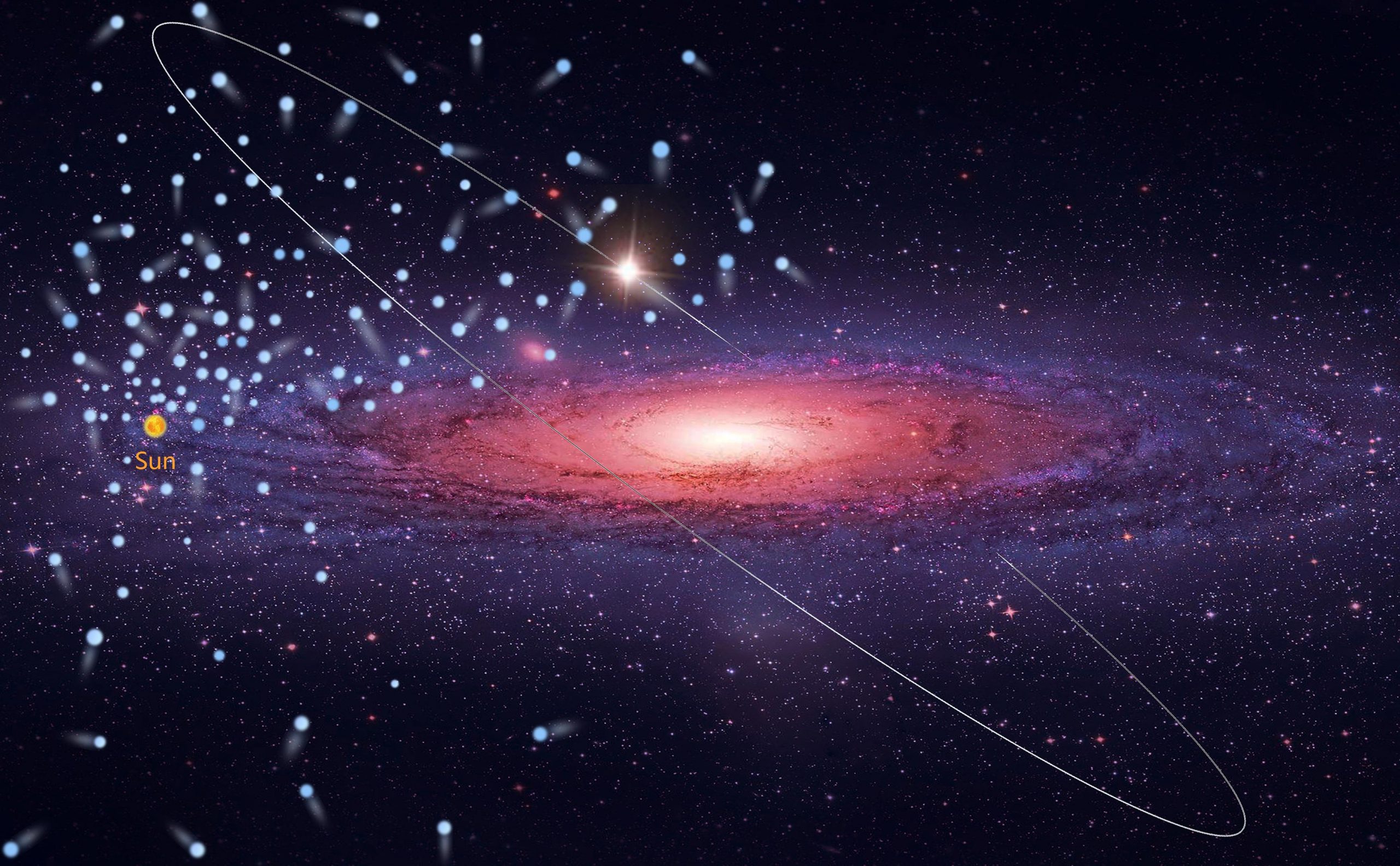
    591 High Velocity Stars
    591 high velocity stars’ positions and orbits. Credit: Kong Xiao of NAOC

    A joint effort using LAMOST and Gaia has uncovered hundreds of high velocity stars, shedding light on the Milky Way’s formation and future discoveries.

    A research team, led by astronomers from National Astronomical Observatories of Chinese Academy of Sciences (NAOC), has discovered 591 high velocity stars from the Large Sky Area Multi-Object Fiber Spectroscopic Telescope (LAMOST) and Gaia, and 43 of them can even escape from the Galaxy. After the first high velocity star was discovered in 2005, there are in total of over 550 high velocity stars have been found with multiple telescopes in 15 years. “The 591 high velocity stars discovered this time doubled the total number of high velocity stars previously discovered, bringing the total number exceeding 1000,” said Dr. Yin-Bi Li, the lead author of the research.

    High velocity stars are kind of fast-moving stars, and they can even escape from the Galaxy. “Though rare in the Milky Way, high velocity stars, with unique kinematics, can provide deep insight into a wide range of Galactic science, from the central supermassive black hole to distant Galactic halo,” said Prof. You-Jun Lu from NAOC, co-author of this research.

    Powerful Telescopes Behind the Discovery

    As mentioned above, these high velocity stars were discovered with LAMOST and Gaia. LAMOST is the largest optical telescope in China, which has the highest spectral acquisition rate in the world and can observe about 4,000 celestial targets in one single exposure, and it began the regular surveys in 2012, which established the largest spectra database in the world. Gaia is a space-based mission in the science program of the European Space Agency (ESA) launched in 2013, and it provided astrometric parameters for over 1.3 billion sources, which is the largest database of astrometric parameters. “The two massive databases provide us unprecedented opportunity to find more high velocity stars, and we did it,” said Prof. A-Li Luo from NAOC, co-author of this research.

    From the kinematics and chemistries, research team found that the 591 high velocity stars are inner halo stars. “Their low metallicities indicate that the bulk of the stellar halo formed as a consequence of the accretion and tidal disruption of dwarf galaxies,” said Prof. Gang Zhao from NAOC, co-author of this research.

    The discovery of these high velocity stars tells us that the combination of multiple large surveys in the future will help us to discover more high velocity stars and other rare stars, which will be used to study the unsolved mystery about our Galaxy.

    This work has been recently published online in The Astrophysical Journal Supplement Series.

    Reference: “591 High-velocity Stars in the Galactic Halo Selected from LAMOST DR7 and Gaia DR2” by Yin-Bi Li, A-Li Luo, You-Jun Lu, Xue-Sen Zhang, Jiao Li, Rui Wang, Fang Zuo, Maosheng Xiang, Yuan-Sen Ting, Tommaso Marchetti, Shuo Li, You-Fen Wang, Shuo Zhang, Kohei Hattori, Yong-Heng Zhao, Hua-Wei Zhang and Gang Zhao, 17 December 2020, The Astrophysical Journal.
    DOI: 10.3847/1538-4365/abc16e

    Never miss a breakthrough: Join the SciTechDaily newsletter.
    Follow us on Google and Google News.

    Astronomy Astrophysics Chinese Academy of Sciences ESA Gaia Spacecraft Popular Stars
    Share. Facebook Twitter Pinterest LinkedIn Email Reddit

    Related Articles

    Our Sun May Have Escaped the Milky Way’s Dangerous Center Billions of Years Ago

    Harmonizing the Cosmos: How Scientists Measure Stellar Distances Through Star Music

    Magnetic Monster? NASA’s Hubble Sees Unexplained Brightness from Colossal Explosion

    Ultrabright Radio Flashes Detected Coming From Inside Our Own Galaxy

    Finding Lost Star Siblings: Star Clusters Are Only the Tip of the Iceberg

    Extreme Magnetic Fields and Temperature Variation of Distant Magnetars

    Death by Spaghettification: Telescopes Record Last Moments of Star Devoured by a Black Hole

    Astronomers Turn Up the Heavy Metal to Shed Light on Star Formation – “It’s Absolutely Mind-Blowing Stuff”

    A White Dwarf’s Surprise Planetary Companion: First-of-Its-Kind Exoplanet Detected Around Dead Star

    Leave A Reply Cancel Reply

    • Facebook
    • Twitter
    • Pinterest
    • YouTube

    Don't Miss a Discovery

    Subscribe for the Latest in Science & Tech!

    Trending News

    Breakthrough Bowel Cancer Trial Leaves Patients Cancer-Free for Nearly 3 Years

    Natural Compound Shows Powerful Potential Against Rheumatoid Arthritis

    100,000-Year-Old Neanderthal Fossils in Poland Reveal Unexpected Genetic Connections

    Simple “Gut Reset” May Prevent Weight Gain After Ozempic or Wegovy

    2.8 Days to Disaster: Scientists Warn Low Earth Orbit Could Suddenly Collapse

    Common Food Compound Shows Surprising Power Against Superbugs

    5 Simple Ways To Remember More and Forget Less

    The Atomic Gap That Could Cost the Semiconductor Industry Billions

    Follow SciTechDaily
    • Facebook
    • Twitter
    • YouTube
    • Pinterest
    • Newsletter
    • RSS
    SciTech News
    • Biology News
    • Chemistry News
    • Earth News
    • Health News
    • Physics News
    • Science News
    • Space News
    • Technology News
    Recent Posts
    • Scientists Print Artificial Neurons That Can Talk to the Brain
    • Bowel and Ovarian Cancers Are Dramatically Rising in Young Adults and Scientists Aren’t Sure Why
    • Alzheimer’s May Begin Decades Earlier Than You Think, New Mayo Clinic Study Finds
    • The Hidden Risk of Taking Breaks From Weight-Loss Drugs Like Ozempic
    • Total Solar Eclipse Made Cities Go Eerily Quiet Beneath the Surface
    Copyright © 1998 - 2026 SciTechDaily. All Rights Reserved.
    • Science News
    • About
    • Contact
    • Editorial Board
    • Privacy Policy
    • Terms of Use

    Type above and press Enter to search. Press Esc to cancel.