
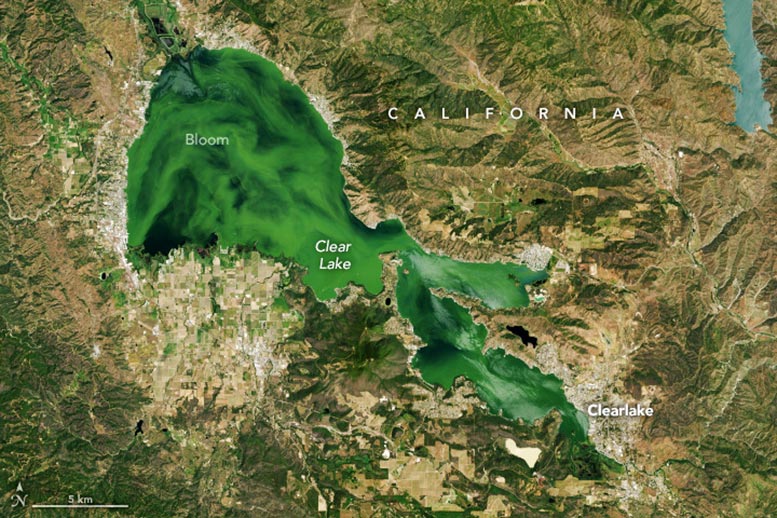
In mid-May 2024, California’s Clear Lake experienced a significant algal bloom, likely including harmful cyanobacteria, which was captured by satellite imagery. This eutrophic lake, enriched with nutrients from various sources, faces increased occurrences of harmful algal blooms, affecting both human and aquatic life.
An algal bloom clouded the waters of California’s Clear Lake in mid-May 2024. Bright green swirls were visible across most of the lake’s area when the Landsat 9 satellite’s OLI-2 (Operational Land Imager-2) acquired this image on May 15.
Nature and Impact of Cyanobacteria
The bloom may contain blue-green algae, also known as cyanobacteria, as well as other types of phytoplankton; only a direct sample can determine the exact composition of a bloom. Cyanobacteria are single-celled organisms that rely on photosynthesis to turn sunlight into food, and some produce microcystin, a potent toxin that can irritate the skin and cause liver and kidney damage.
Historical Context and Nutrient Enrichment
Clear Lake is a naturally nutrient-rich, eutrophic lake that supports the growth of algae and aquatic plants. Located about 60 miles (100 kilometers) north of San Francisco Bay, it has long contained large algal populations, possibly since the end of the last ice age about 10,000 years ago, according to sediment cores.
In recent years, however, people have increased nutrient inputs to the lake, and the number of harmful blooms has increased. Out of the more than 130 algal species that have been identified in Clear Lake, three species of blue-green algae can cause adverse human health effects under certain conditions. Blooms of these harmful algae tend to occur in spring and late summer, according to Lake County officials.
Sources of Nutrients and Environmental Concerns
Nutrients such as phosphorus enter the lake through its tributaries and drive the growth of excess algae. Runoff from nearby farms, vineyards, faulty septic systems, gravel mines, and an abandoned open-pit mercury mine contributes to water quality issues in the lake. Some bloom-inducing nutrients reside in lakebed sediments, only to be stirred up by wave action and the foraging and spawning behavior of nonnative carp.
Monitoring and Effects on Aquatic Life
A water quality analysis tool showed that levels of chlorophyll-a, the sunlight-harvesting pigment in plants and phytoplankton (including algae), and an index estimating cyanobacteria concentration increased throughout early May. These estimates, derived from an ocean color instrument on Sentinel-3 with additional processing by the NOAA National Ocean Service, reached some of their highest values of the month by May 15, the date of the image above.
As of May 25, measurements of microcystin concentrations for this bloom were not yet available from local water quality monitors. Even if toxins were not present, the abundance of algae could still harm aquatic life; bacteria consume oxygen as they break down dead phytoplankton, which can cause hypoxia and dead zones.
NASA Earth Observatory image by Wanmei Liang, using Landsat data from the U.S. Geological Survey.
Never miss a breakthrough: Join the SciTechDaily newsletter.
Follow us on Google and Google News.
1 Comment
Removing the phosphorus from the stream would seem to be a small profitable endeavor for someone; or, if there’s a ten thousand year accumulation of phosphorus at the bottom of the lake, mining it as is done ocean sea beds, could be highly profitable in a world where current mining sources are drying up, supposedly.