
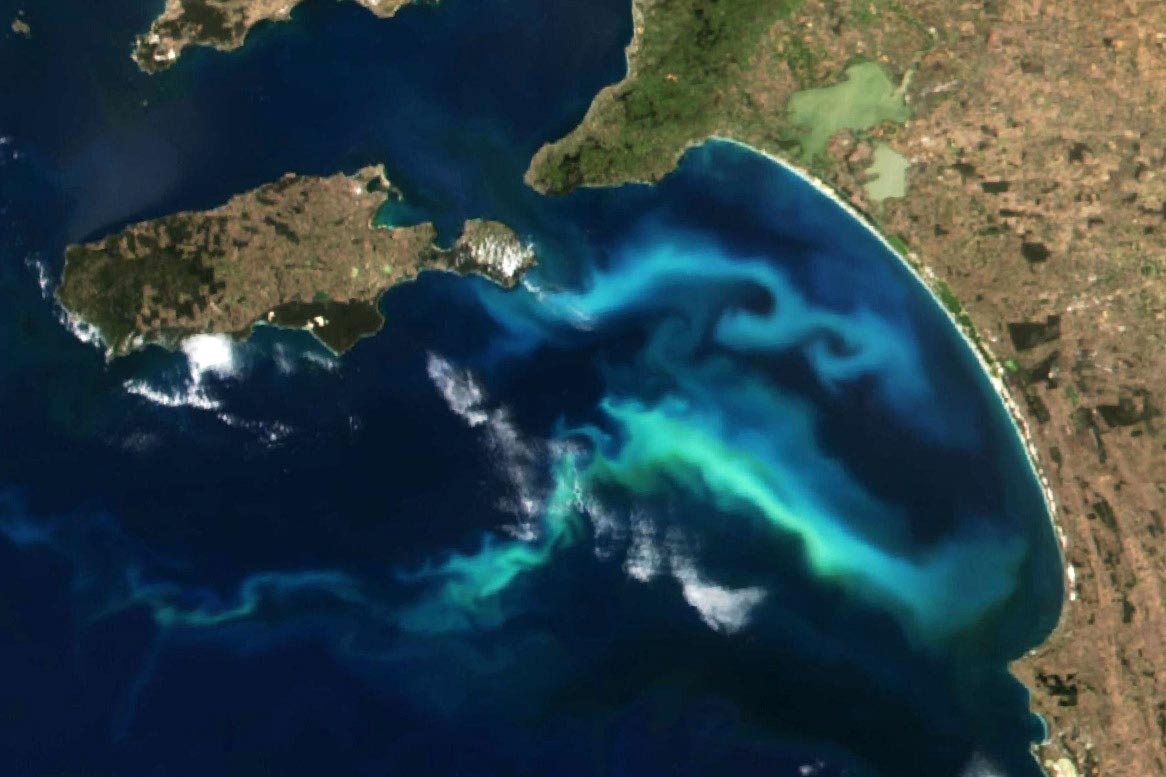
Cool, upwelling water supports an array of marine life and draws the occasional filmmaker to the Bonney Coast region.
When satellites passed over South Australia’s Bonney Coast in January 2024, they captured images showing splotches of blue and green swirling through surface waters. These colorful filaments of phytoplankton were blooming right on time. The microscopic plant-like organisms thrive here in the summer, when cold, nutrient-rich water wells up from deep in the ocean.
This image, captured by the VIIRS (Visible Infrared Imaging Radiometer Suite) sensor aboard the Suomi NPP satellite, shows an elongated bloom on January 10, 2024. Images collected by NASA’s Terra and Aqua satellite shows the bloom first becoming visible from space in late December 2023.
Scientific Analysis of the Phytoplankton Blooms
“The green filament is definitely a phytoplankton bloom extending along the shelf break, which is around 150 meters deep,” said Jochen Kaempf, a Flinders University oceanographer who has published several studies about phytoplankton in this area. “The bluer signal could be sediment located in very shallow water or perhaps a different phytoplankton species.”
Waters samples collected from the surface would be needed to confirm the phytoplankton species. However, one of Kaempf’s recent studies indicates that diatoms often dominate the larger blooms in this area.
Temperature Anomalies and Upwelling Events
Signs of cool water upwelling were also apparent in satellite observations. Sea surface temperature data from NASA’s MUR SST (Multi-scale Ultra-high Resolution) project indicated that water temperatures on January 10 in much of Long Bay were about 3 degrees Celsius (5.4 degrees Fahrenheit) cooler than the long-term average temperature (2003–2014) for that date.
The cool water is the result of the Great South Australian Coastal Upwelling System, a seasonal phenomenon that spans from Ceduna, South Australia, to Portland, Victoria—a distance of about 800 kilometers (500 miles). Upwelling events in this area occur in the summer (December to May), when seasonal winds from the southeast blow parallel to the shoreline. These winds push coastal surface waters offshore, via a process called Ekman transport, and draw up cold water from a depth of about 300 meters.
The Importance of Upwelling for Marine Life
Water from deep in the ocean is typically rich with nutrients because the remains of dead sea life constantly sink to the ocean floor and decompose. The nutrients released, especially nitrogen and phosphorous, are critical for the growth of phytoplankton. When nutrient-rich water reaches the upper layer of the ocean that receives abundant light (the photic zone), it can fuel the growth of phytoplankton populations, leading to blooms like this one and causing surface concentrations of chlorophyll-a, one type of green pigment involved in photosynthesis, to increase by tenfold.
Phytoplankton blooms nourish an array of marine life. Marine biologists estimate that the Bonney Coast upwelling attracts roughly 80 blue whales each year to graze on diatoms. Many species of filter feeders and crabs, as well as robust populations of sardines, anchovies, tuna, and other types of fish thrive here due to the abundance of phytoplankton.
According to one estimate from NOAA, upwelling zones cover just 1 percent of the ocean’s area but are the source of about 50 percent of all fish caught. The abundance of marine life in this area even draws large numbers of great white sharks—so much so that parts of the original “Jaws” movie was filmed in nearby Dangerous Reef.
NASA Earth Observatory image by Wanmei Liang, using VIIRS data from NASA EOSDIS LANCE, GIBS/Worldview, and the Suomi National Polar-orbiting Partnership.
Never miss a breakthrough: Join the SciTechDaily newsletter.
Follow us on Google and Google News.