
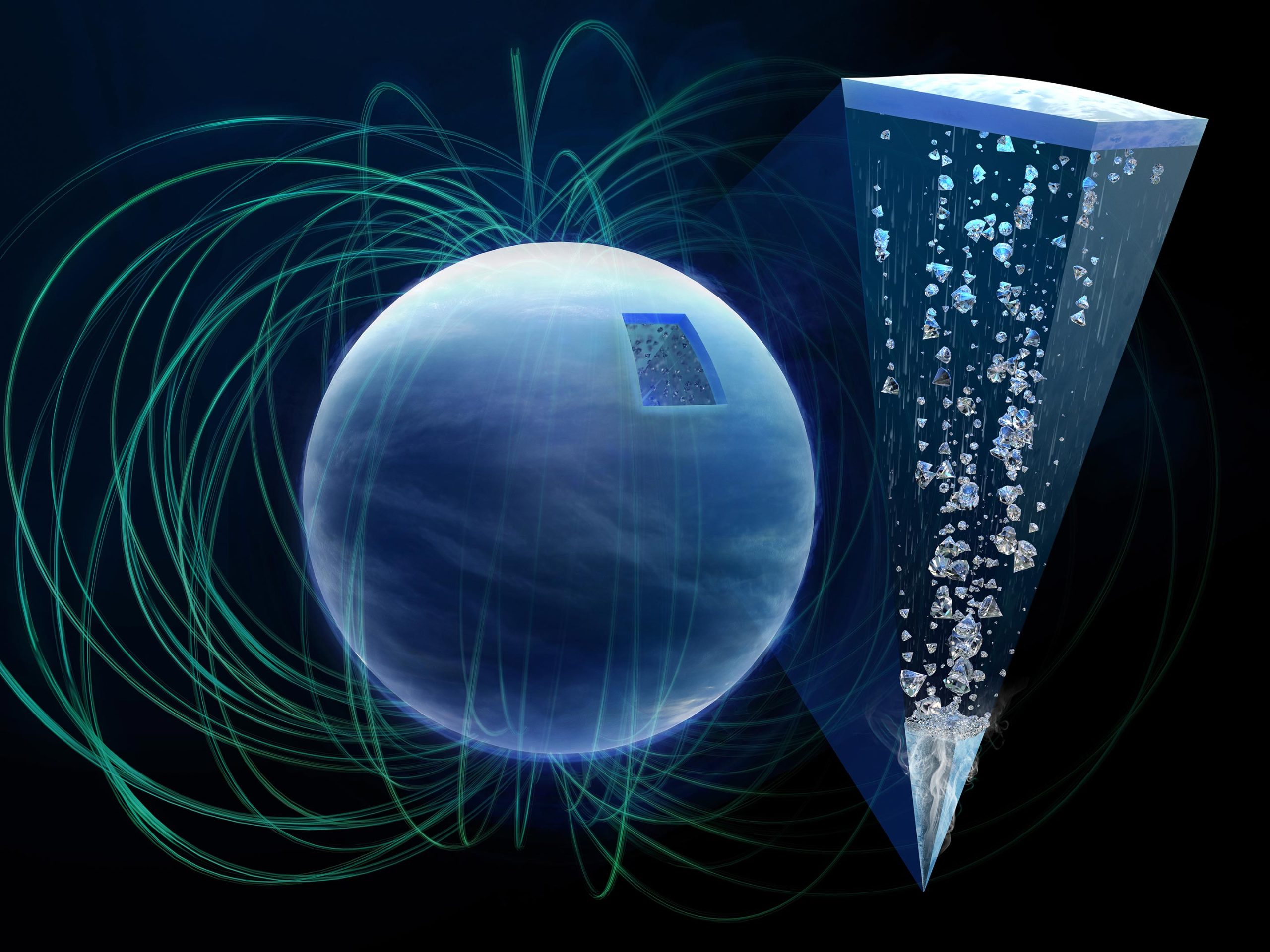
A new study reveals that “diamond rain” on icy planets like Neptune and Uranus forms under less extreme conditions than previously believed. This phenomenon influences the planets’ internal dynamics and magnetic fields and could also occur on smaller exoplanets.
A new experiment suggests that this exotic precipitation forms at even lower pressures and temperatures than previously thought and could influence the unusual magnetic fields of Neptune and Uranus.
An international team of researchers led by researchers from the Department of Energy’s SLAC National Accelerator Laboratory gained new insights into the formation of diamonds on icy planets such as Neptune and Uranus. Scientists believe that, following their formation, these diamonds would slowly sink deeper into the planetary interior in response to gravitational forces, resulting in a ‘rain’ of precious stones from higher layers.
The results, published on January 8 in Nature Astronomy, suggest that this “diamond rain” forms at even lower pressures and temperatures than previously thought and provide clues into the origin of the complex magnetic fields of Neptune and Uranus.
Insights Into Planetary Magnetic Fields
“‘Diamond rain’ on icy planets presents us with an intriguing puzzle to solve,” said SLAC scientist Mungo Frost, who led the research. “It provides an internal source of heating and transports carbon deeper into the planet, which could have a significant impact on their properties and composition. It might kick off movements within the conductive ices found on these planets, influencing the generation of their magnetic fields.”

Experimentation and Observations
In earlier work conducted at SLAC’s Linac Coherent Light Source (LCLS) X-ray free-electron laser (XFEL), scientists were able to observe “diamond rain” as it formed in high-pressure conditions, confirming the possibility of diamond formation on icy planets, which are primarily composed of water, ammonia, and hydrocarbons. They later discovered that the presence of oxygen makes diamond formation more likely, allowing diamonds to form and grow at a wider range of conditions and throughout more planets.
Previously, the high pressures and temperatures were generated by shock compressing the hydrocarbons with high-power lasers, which only allows the conditions to be maintained for a few nanoseconds. In this new experiment, conducted at the European X-ray free-electron laser in Germany, the team studied the reaction over much longer timescales than other experiments using a different approach.
In this experiment, the researchers subjected a plastic film, made from the hydrocarbon compound polystyrene as a carbon source, to the extreme pressures and temperatures found deep in the interior of these icy planets. The high pressures were generated by squeezing the film between the tips of two diamonds using a ‘diamond anvil cell’ in which the anvils function like a mini-vice that can maintain pressure almost indefinitely. The film was then exposed to multiple doses of high-energy X-rays generated by the European XFEL to heat it to more than 2200 degrees Celsius, imitating the extreme conditions found deep inside these planets. Under these extreme conditions, diamonds form from the film, a process that takes place in the same way as in the interior of planets.
Next, the researchers used X-ray pulses produced by the European XFEL to observe when and how the diamonds formed during their experiments. The pressure and temperature at which diamonds were observed allowed researchers to predict the depth they would be expected to form inside the planet.
Magnetic Field Mysteries
By studying the heated hydrocarbons over longer timescales, the researchers found that the formation of diamonds occurs at even lower pressures and temperatures than previously assumed. In the case of Uranus and Neptune, this means that diamond rain can form at a shallower depth than initially thought and could have a stronger influence on the formation of their unusual magnetic fields.
Unlike Earth’s magnetic field, the fields around these icy planets are not symmetrical and don’t extend from each pole. These properties suggest that the fields aren’t generated in the planetary core but in a thin layer of conducting material.
After their formation, diamond particles can drag gas and ice with them as they descend from the outer to the inner layers of the planet, causing currents of ice. The new results show that diamonds form above a layer of conductive ice, which the diamonds stir as they fall. The currents that result act as a kind of dynamo driving the planets’ magnetic fields.
Implications for Exoplanets
The results also suggest that diamond rain would be possible on gas planets that are smaller than Neptune and Uranus – so-called “mini-Neptunes” – one of the most common types of exoplanets found outside of the solar system.
Next, the researchers are planning similar experiments which will bring them even closer to understanding exactly how diamond rain forms on and impacts the properties of other planets.
“This groundbreaking discovery not only deepens our knowledge of our local icy planets, but also holds implications for understanding similar processes in exoplanets beyond our solar system,” said SLAC’s High Energy Density Director Siegfried Glenzer.
Reference: “Diamond precipitation dynamics from hydrocarbons at icy planet interior conditions” by Mungo Frost, R. Stewart McWilliams, Elena Bykova, Maxim Bykov, Rachel J. Husband, Leon M. Andriambariarijaona, Saiana Khandarkhaeva, Bernhard Massani, Karen Appel, Carsten Baehtz, Orianna B. Ball, Valerio Cerantola, Stella Chariton, Jinhyuk Choi, Hyunchae Cynn, Matthew J. Duff, Anand Dwivedi, Eric Edmund, Guillaume Fiquet, Heinz Graafsma, Huijeong Hwang, Nicolas Jaisle, Jaeyong Kim, Zuzana Konôpková, Torsten Laurus, Yongjae Lee, Hanns-Peter Liermann, James D. McHardy, Malcolm I. McMahon, Guillaume Morard, Motoaki Nakatsutsumi, Lan Anh Nguyen, Sandra Ninet, Vitali B. Prakapenka, Clemens Prescher, Ronald Redmer, Stephan Stern, Cornelius Strohm, Jolanta Sztuk-Dambietz, Monica Turcato, Zhongyan Wu, Siegfried H. Glenzer and Alexander F. Goncharov, 8 January 2024, Nature Astronomy.
DOI: 10.1038/s41550-023-02147-x
This research was supported by DOE’s Office of Science and the National Nuclear Security Administration. LCLS is a DOE Office of Science user facility.
Never miss a breakthrough: Join the SciTechDaily newsletter.
Follow us on Google and Google News.