
Researchers have found that even modest amounts of desert dust can improve the health of the ocean’s microscopic, plant-like organisms.
A new study reveals that land-based mineral dust plays a crucial role in fertilizing oceanic phytoplankton, which are essential to Earth’s climate, carbon cycle, and marine food web.
For the past few decades, scientists have been observing natural ocean fertilization events—episodes when plumes of volcanic ash, glacial flour, wildfire soot, and desert dust blow out onto the sea surface and spur massive blooms of phytoplankton. But beyond these extreme events, there is a steady, long-distance rain of dust particles onto the ocean that promotes phytoplankton growth just about all year and in nearly every basin.
In a new study published May 5 in the journal Science, a team of researchers from Oregon State University, the University of Maryland Baltimore County, and NASA combined satellite observations with an advanced computer model to home in on how mineral dust from land fertilizes the growth of phytoplankton in the ocean. Phytoplankton are microscopic, plant-like organisms that form the center of the marine food web.
Phytoplankton float near the ocean surface primarily subsisting on sunlight and mineral nutrients that well up from the depths or float out to sea in coastal runoff. But mineral-rich desert dust—borne by strong winds and deposited in the ocean—also plays an important role in the health and abundance of phytoplankton.
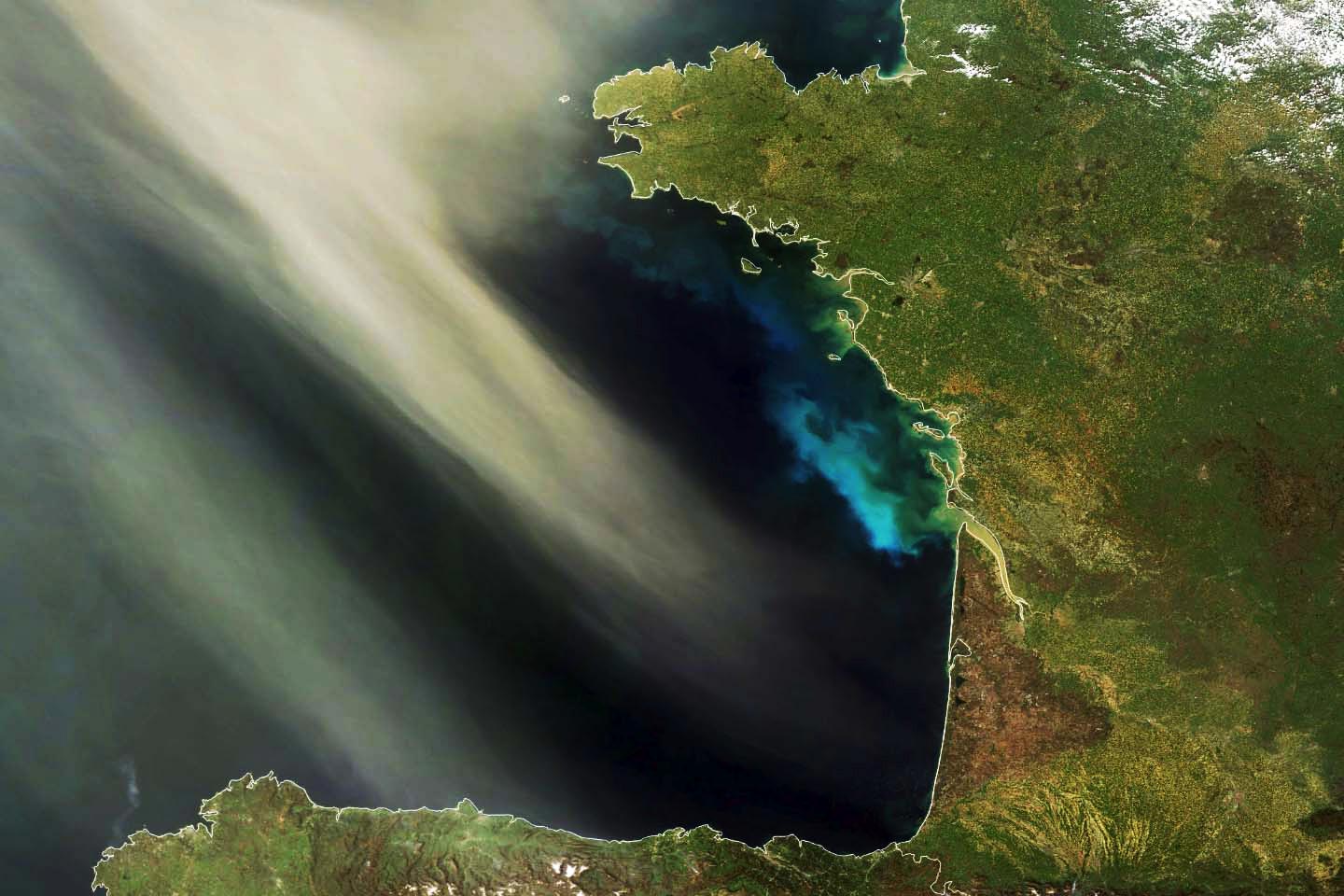
This image, acquired on April 8, 2011, by the Moderate Resolution Imaging Spectroradiometer (MODIS) on NASA’s Terra satellite, shows Saharan dust over the Bay of Biscay. A phytoplankton bloom in the bay makes the water appear bright green and blue. Sediment is likely contributing to some of the color, especially in areas closer to the shore.
The Impact of Dust on Global Carbon Cycling
According to the new study, dust deposition onto the ocean supports about 4.5 percent of yearly global export production—a measure of how much of the carbon phytoplankton take up during photosynthesis sinks into the deep ocean. However, this contribution approaches 20 percent to 40 percent in some ocean regions at middle and higher latitudes.
Phytoplankton play a large role in Earth’s climate and carbon cycle. Like land plants, they contain chlorophyll and derive energy from sunlight through photosynthesis. They produce oxygen and sequester a tremendous amount of carbon dioxide in the process, potentially on a scale comparable to rainforests. And they are at the bottom of an ocean-wide food pecking order that ranges from tiny zooplankton to fish to whales.
Dust particles can travel thousands of miles before falling into the ocean, where they nourish phytoplankton long distances from the dust source, said study coauthor Lorraine Remer, a research professor at the University of Maryland Baltimore County. “We knew that atmospheric transport of desert dust is part of what makes the ocean ‘click,’ but we didn’t know how to find it,” she said.
To find out how scientists tracked ocean biology from 400 miles above the surface of Earth, read the full story here.
Reference: “Atmospheric nourishment of global ocean ecosystems” by T. K. Westberry, M. J. Behrenfeld, Y. R. Shi, H. Yu, L. A. Remer and H. Bian, 4 May 2023, Science.
DOI: 10.1126/science.abq5252
NASA Earth Observatory image by Wanmei Liang, using MODIS data from NASA EOSDIS LANCE and GIBS/Worldview. Story by Sally Younger/NASA’s Earth Science News Team, with Michael Carlowicz.
Never miss a breakthrough: Join the SciTechDaily newsletter.
Follow us on Google and Google News.
1 Comment
Eh,let’s just follow darwin,dawson,et al…its all just by chance…whats the big deal that nature is such a beautiful thing to behold…
Found nowhere else…as far as webb can see….
Just as an afterthought: isn’t God good!?!