
Recent findings unlock the potential of high-pixel-resolution single-photon avalanche diode cameras in multispeckle diffuse correlation spectroscopy.
Assessing the circulation of blood to the brain can provide significant insights into its functioning. A surge in blood flow often corresponds to neuronal activity, while a reduction could signify various irregularities, such as a potential precursor to stroke. State-of-the-art optical technologies like diffuse correlation spectroscopy (DCS) allow scientists to noninvasively gauge the brain’s blood flow by directing a laser onto the scalp and examining the scattered light.
More precisely, devices based on DCS function by determining statistical attributes of the scattered light, which results in a speckle pattern. This is a random arrangement of luminous and dim spots produced when laser light scatters off a rough surface. Given that blood flow influences this pattern in a statistically foreseeable manner, DCS can be utilized as a surrogate measurement method.
Moreover, the recent rise of single-photon avalanche diode (SPAD) cameras has made it possible to capture many independent speckles at the same time, as opposed to capturing only a single speckle mode in traditional DCS instruments.
This development promises multispeckle DCS instruments with much higher sensitivity. However, handling the extremely high data rates of modern SPAD cameras, which exceed the maximum data transfer rates of commonly used communication protocols, is quite challenging. This bottleneck has limited the scalability of SPAD cameras to higher pixel resolutions, hindering the development of better multispeckle DCS techniques.
Innovative Data Compression with FPGA
To tackle this issue, a team of scientists led by Professor Robert K. Henderson of the University of Edinburgh has recently presented a novel data compression scheme in which most calculations involving SPAD data are performed directly on a commercial programmable circuit called a field-programmable gate array (FPGA). Their work is sponsored by Meta Platforms Inc., and is published in the Journal of Biomedical Optics (JBO).
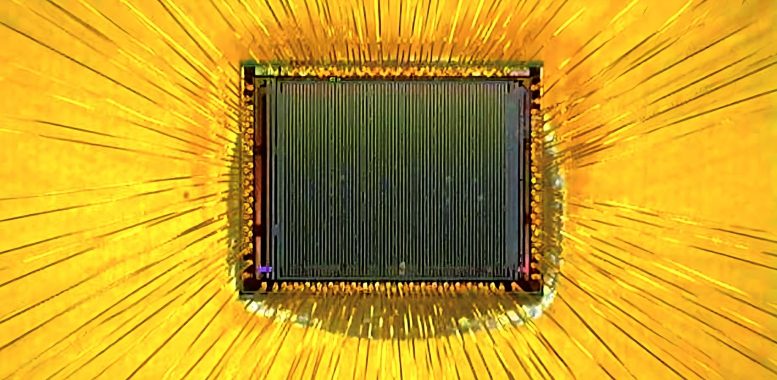
The researchers connected a SPAD sensor array, composed of 192 by 128 pixels and packaged into a camera module called Quanticam, to an FPGA, upon which they implemented an autocorrelation algorithm.
It calculated 12,288 autocorrelations — one of the most time-consuming computations involved in multispeckle DCS — in real time, from the SPAD array output. In this way, the team managed to shift the computational burden from the host computing system to the hardware directly connected to the SPAD sensors. This alleviated the need for high computational power and extremely fast data transfer rates between the multispeckle DSC system and the host system upon which the data is visualized.
Achieving Higher Sensitivity in Multispeckle DCS
Thanks to this innovative data compression scheme, the team could successfully utilize a large number of pixels in the SPAD array for developing multispeckle DSC technique with improved sensitivity and usability. Discussing their achievement, Henderson remarked, “Our proposed system achieved a significant gain in the signal-to-noise ratio, which is 110 times higher than that possible on a single-speckle DSC implementation and 3 times higher than other state-of-the-art multispeckle DSC systems.”
In the future, the proposed FPGA-based design will help researchers adopt SPAD arrays with high pixel resolution without the need for powerful computers, hence democratizing the use of SPAD cameras in the biomedical research community. This may hopefully expand the horizons of multispeckle DCS to more areas of biomedical research.
Reference: “Field programmable gate array compression for large array multispeckle diffuse correlation spectroscopy” by Francesco Mattioli Della Rocca, Edbert J. Sie, Ryan Catoen, Francesco Marsili and Robert K. Henderson, 8 May 2023, Journal of Biomedical Optics.
DOI: 10.1117/1.JBO.28.5.057001
Never miss a breakthrough: Join the SciTechDaily newsletter.
Follow us on Google and Google News.