
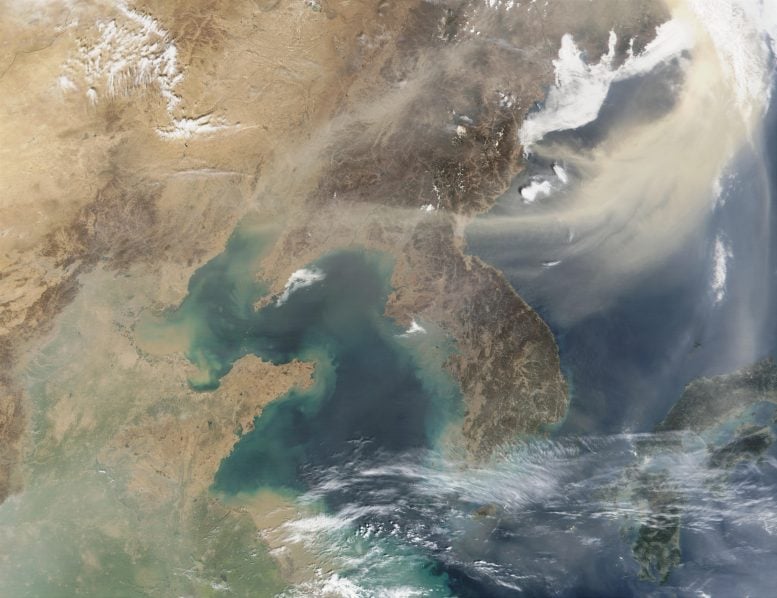
Atmospheric dust sustains ocean ecosystems by delivering nutrients that boost phytoplankton health and growth, aiding carbon sequestration.
An Oregon State University scientist is leading new research aimed at uncovering the role of dust in sustaining global ocean ecosystems and controlling atmospheric carbon dioxide levels.
Researchers have long been aware that phytoplankton, which are plant-like organisms that reside in the top layer of the ocean and serve as the basis of the marine food chain, depend on dust from terrestrial sources for essential nutrients. However, globally quantifying the extent and magnitude of the impact of this dust – particles from sources such as soil that are carried by the wind and affect the Earth’s climate – has proven to be challenging.
“This is really the first time it has been shown, using the modern observational record and at the global scale, that the nutrients carried by dust being deposited on the ocean are creating a response in the surface ocean biology,” said Toby Westberry, an oceanographer at Oregon State and lead author of the just-published paper in Science.
Phytoplankton and the Biological Carbon Pump
The ocean plays an important role in the carbon cycle; carbon dioxide from the atmosphere dissolves in surface waters, where phytoplankton turns the carbon into organic matter through photosynthesis. Some of the newly formed organic matter sinks from the surface ocean to the deep sea, where it is locked away, a pathway known as the biological pump.
In the new paper, Westberry and other scientists from Oregon State; the University of Maryland, Baltimore County; and NASA Goddard Space Flight Center estimate deposition of dust supports 4.5% of the global annual export production, or sink, of carbon. Regional variation in this contribution can be much higher, approaching 20% to 40%, they found.
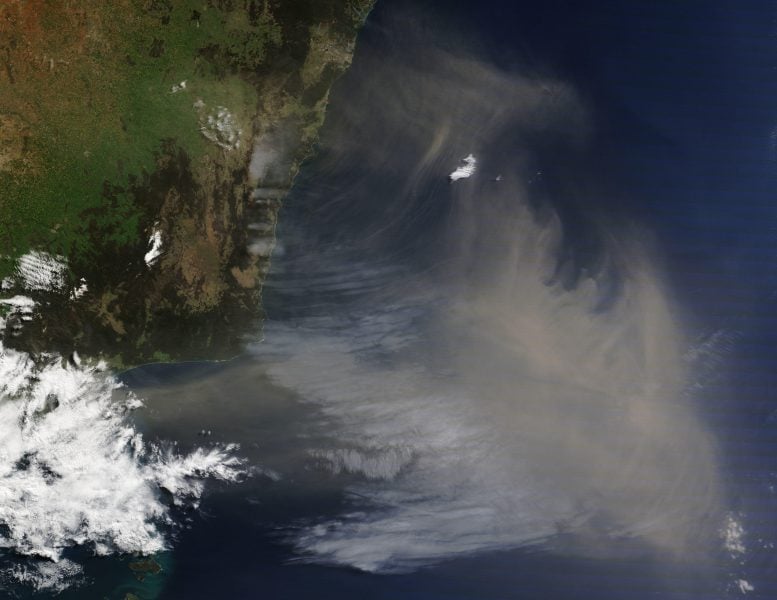
“That’s important because it’s a pathway to get carbon out of the atmosphere and down into the deep ocean,” Westberry said. “The biological pump is one of the key controls on atmospheric carbon dioxide, which is a dominant factor driving global warming and climate change.”
In the ocean, vital nutrients for phytoplankton growth are largely provided through the physical movement of those nutrients from deep waters up to the surface, a process known as mixing or upwelling. But some nutrients are also provided through atmospheric dust.
To date, the understanding of the response by natural marine ecosystems to atmospheric inputs has been limited to singularly large events, such as wildfires, volcanic eruptions, and extreme dust storms. In fact, previous research by Westberry and others examined ecosystem responses following the 2008 eruption on Kasatochi Island in southwestern Alaska.
In the new paper, Westberry and Michael Behrenfeld, an Oregon State professor in the Department of Botany and Plant Pathology, along with scientists from UMBC and NASA built on this past research to look at phytoplankton response worldwide.
Westberry and Behrenfeld focused their efforts on using satellite data to examine changes in ocean color following dust inputs. Ocean color imagery is collected across the global ocean every day and reports changes in the abundance of phytoplankton and their overall health. For example, greener water generally corresponds to abundant and healthy phytoplankton populations, while bluer waters represent regions where phytoplankton are scarce and often undernourished.
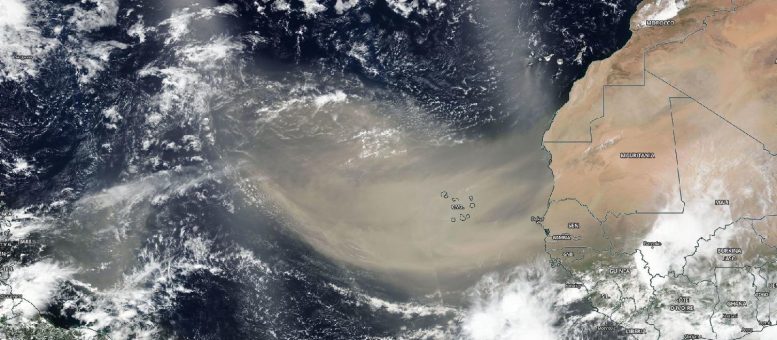
The scientists at UMBC and NASA focused their efforts on modeling dust transport and deposition to the ocean surface.
“Determining how much dust is deposited into the ocean is hard because much of the deposition occurs during rainstorms when satellites cannot see the dust. That is why we turned to a model,” said UMBC’s Lorraine Remer, research professor at the Goddard Earth Sciences Technology and Research Center II, a consortium led by UMBC. The UMBC team used observations to confirm a NASA global model before incorporating its results into the study.
Working together, the research team found that the response of phytoplankton to dust deposition varies based on location.
Differing Effects Across Ocean Latitudes
In low-latitude ocean regions, the signature of dust input is predominately seen as an improvement in phytoplankton health, but not abundance. In contrast, phytoplankton in higher-latitude waters often show improved health and increased abundance when dust is provided. This contrast reflects differing relationships between phytoplankton and the animals that eat them.
Lower latitude environments tend to be more stable, leading to a tight balance between phytoplankton growth and predation. Thus, when dust improves phytoplankton health, or growth rate, this new production is rapidly consumed and almost immediately transferred up the food chain.
At higher latitudes, the link between phytoplankton and their predators is weaker because of constantly changing environmental conditions. Accordingly, when dust stimulates phytoplankton growth, the predators are a step behind, and the phytoplankton populations exhibit both improved health and increased abundance.
The research team is continuing this research, bringing in improved modeling tools and preparing for more advanced satellite data from NASA’s upcoming Plankton, Aerosol, Cloud, ocean Ecosystem (PACE) satellite mission, some of which will be collected by the UMBC-designed and -built HARP2 instrument.
“The current analysis demonstrates measurable ocean biological responses to an enormous dynamic range in atmospheric inputs,” Westberry said. “We anticipate that, as the planet continues to warm, this link between the atmosphere and oceans will change.”
Reference: “Atmospheric nourishment of global ocean ecosystems” by T. K. Westberry, M. J. Behrenfeld, Y. R. Shi, H. Yu, L. A. Remer and H. Bian, 4 May 2023, Science.
DOI: 10.1126/science.abq5252
Never miss a breakthrough: Join the SciTechDaily newsletter.
Follow us on Google and Google News.