
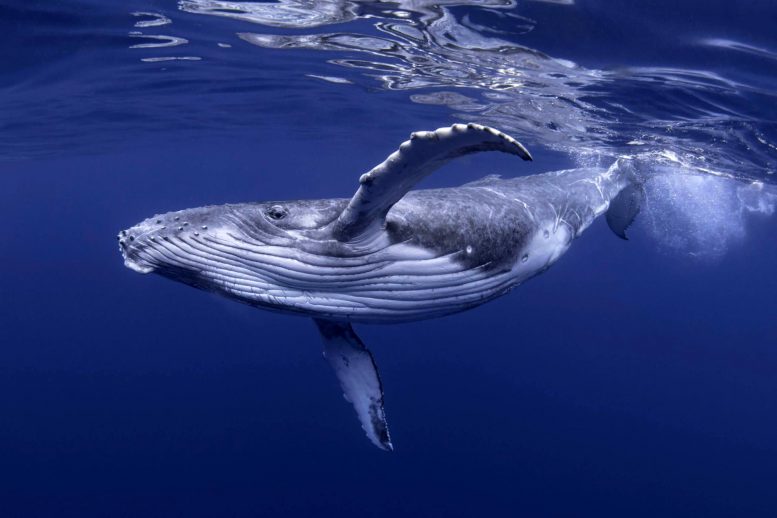
Whale Songs: A Surprising Tool for Seismic Research
The songs of fin whales can be used for seismic imaging of the oceanic crust, providing scientists a novel alternative to conventional surveying, a new study published this week in Science shows.
Fin whale songs contain signals that are reflected and refracted within the crust, including the sediment and the solid rock layers beneath. These signals, recorded on seismometers on the ocean bottom, can be used to determine the thickness of the layers as well as other information relevant to seismic research, said John Nabelek, a professor in Oregon State University’s College of Earth, Ocean, and Atmospheric Sciences and a co-author of the paper.
“People in the past have used whale calls to track whales and study whale behavior. We thought maybe we can study the Earth using those calls,” Nabelek said. “What we discovered is that whale calls may serve as a complement to traditional passive seismic research methods.”
The paper serves as a proof of concept that could provide new avenues for using data from whale calls in research, Nabelek said.
“This expands the use of data that is already being collected,” he said. “It shows these animal vocalizations are useful not just for understanding the animals, but also understanding their environment.”
The study’s lead author is Vaclav M. Kuna, who worked on the project as a doctoral student at Oregon State and has since completed his Ph.D.
Kuna and Nabelek were studying earthquakes from a network of 54 ocean-bottom seismometers placed along the Blanco transform fault, which at its closest is about 100 miles (160 kilometers) off Cape Blanco on the Oregon Coast.
They noted strong signals on the seismometers that correlated with whales’ presence in the area.
Seismic Echoes from Whale Calls
“After each whale call, if you look closely at the seismometer data, there is a response from the Earth,” Nabelek said.
Whale calls bounce between the ocean surface and the ocean bottom. Part of the energy from the calls transmits through the ground as a seismic wave. The wave travels through the oceanic crust, where it is reflected and refracted by the ocean sediment, the basalt layer underneath it and the gabbroic lower crust below that.
When the waves are recorded at the seismometer, they can provide information that allows researchers to estimate and map the structure of the crust.
Using a series of whale songs that were recorded by three seismometers, the researchers were able to pinpoint the whale’s location and use the vibrations from the songs to create images of the Earth’s crust layers.
Researchers use information from these layers to learn more about the physics of earthquakes in the region, including how sediment behaves and the relationship between its thickness and velocity. Earthquakes shake up the sediment, expelling water and speeding up the settlement of the sediment.
A Complement to Traditional Methods
The current traditional method for imaging of the crust can be expensive and permits can be difficult to obtain because the work involves deploying air guns, Nabelek said. The imaging created using the whale songs is less invasive, though overall it is of lower resolution.
Future research could include using machine learning to automate the process of identifying whale songs and developing images of their surroundings, Nabelek said.
“The data from the whale songs is useful but it doesn’t completely replace the standard methods,” he said. “This method is useful for investigating the Earth’s oceanic crust where standard science survey methods are not available.”
Reference: “Seismic crustal imaging using fin whale songs” by Václav M. Kuna and John L. Nábělek, 12 February 2021, Science.
DOI: 10.1126/science.abf3962
Never miss a breakthrough: Join the SciTechDaily newsletter.
Follow us on Google and Google News.