

On February 6, 2020, weather stations recorded the hottest temperature on record for Antarctica. Thermometers at the Esperanza Base on the northern tip of the Antarctic Peninsula reached 18.3°C (64.9°F)—around the same temperature as Los Angeles that day. The warm spell caused widespread melting on nearby glaciers.
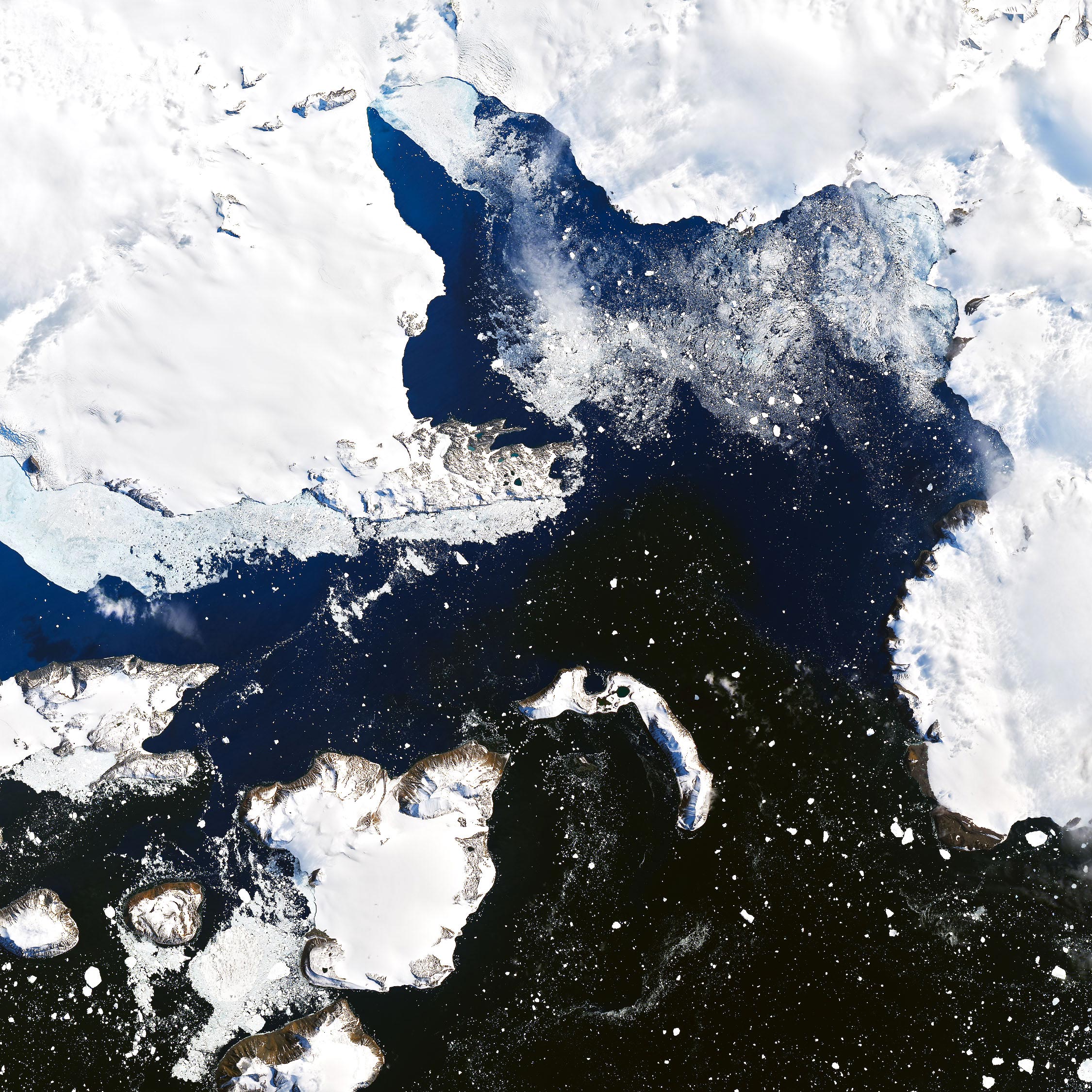
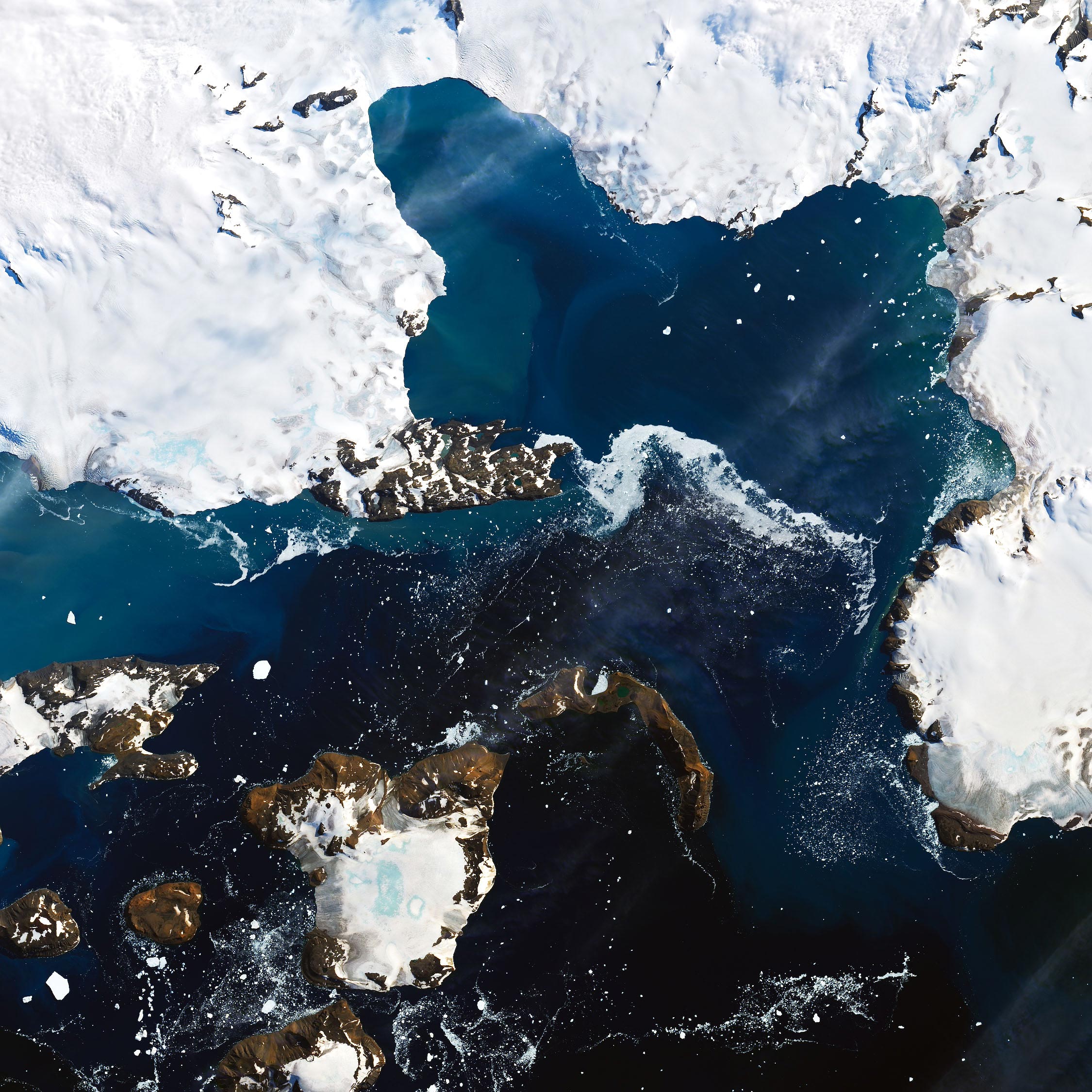
The warm temperatures arrived on February 5 and continued until February 13, 2020. The images above show melting on the ice cap of Eagle Island and were acquired by the Operational Land Imager (OLI) on Landsat 8 on February 4 and February 13, 2020.
The heat is apparent on the map below, which shows temperatures across the Antarctic Peninsula on February 9, 2020. The map was derived from the Goddard Earth Observing System (GEOS) model, and represents air temperatures at 2 meters (about 6.5 feet) above the ground. The darkest red areas are where the model shows temperatures surpassing 10°C (50°F).
Mauri Pelto, a glaciologist at Nichols College observed that during the warming event, around 1.5 square kilometers (0.9 square miles) of snowpack became saturated with meltwater (shown in blue above). According to climate models, Eagle Island experienced peak melt—30 millimeters (1 inch)—on February 6. In total, the snowpack on Eagle Island melted 106 millimeters (4 inches) from February 6- February 11. About 20 percent of seasonal snow accumulation in the region melted in this one event on Eagle Island.
“I haven’t seen melt ponds develop this quickly in Antarctica,” said Pelto. “You see these kinds of melt events in Alaska and Greenland, but not usually in Antarctica.” He also used satellite images to detect widespread surface melting nearby on Boydell Glacier.
Pelto noted that such rapid melting is caused by sustained high temperatures significantly above freezing. Such persistent warmth was not typical in Antarctica until the 21st century, but it has become more common in recent years.

The warm temperatures of February 2020 were caused by a combination of meteorological elements. A ridge of high pressure was centered over Cape Horn at the beginning of the month, and it allowed warm temperatures to build. Typically, the peninsula is shielded from warm air masses by the Southern Hemisphere westerlies, a band of strong winds that circle the continent. However, the westerlies were in a weakened state, which allowed the extra-tropical warm air to cross the Southern Ocean and reach the ice sheet. Sea surface temperatures in the area were also higher than average by about 2-3°C (3.6-5.4°F).
Dry, warm foehn winds also could have played a part. Foehn winds are strong, gusty winds that cause downslope windstorms on mountains, often bringing warm air with them. In February 2020, westerly winds ran into the Antarctic Peninsula Cordillera. As such winds travel up the mountains, the air typically cools and condenses to form rain or snow clouds. As that water vapor condenses into liquid water or ice, heat is released into the surrounding air. This warm, dry air travels downslope on the other side of the mountains, bringing blasts of heat to parts of the peninsula. The drier air means fewer low-lying clouds and potentially more direct sunlight east of the mountain range.
“Two things that can make a foehn-induced melt event stronger are stronger winds and higher temperatures,” said Rajashree Tri Datta, an atmospheric researcher at NASA’s Goddard Space Flight Center. With warmer air in the surrounding atmosphere and ocean, the conditions were conducive this month for a foehn wind event.
This February heatwave was the third major melt event of the 2019-2020 summer, following warm spells in November 2019 and January 2020. “If you think about this one event in February, it isn’t that significant,” said Pelto. “It’s more significant that these events are coming more frequently.“
Image Credits: NASA Earth Observatory images by Joshua Stevens, using Landsat data from the U.S. Geological Survey and GEOS-5 data from the Global Modeling and Assimilation Office at NASA GSFC.
Never miss a breakthrough: Join the SciTechDaily newsletter.
Follow us on Google and Google News.
31 Comments
Cape Town (almost closest point to Antarctica in Africa), has had a very weird summer. My chilli tree flushed fruit twice (never done that before), and it has been widely swinging between hot and cold, 3 or 4 times in a row, where usually it is just one long stretch of hot in summer. Weather all screwy.
What a load of bulls#!t.
Yeah, your silly comment was definitely a big load of bulls#!t.
It’s too bad we’re all affected, not just the idiot denialists who suck a tailpipe religion.
I wouldn’t call them “shocking” images…”frightening” maybe, or “proof that something is going on that will have major global impacts, ya moron with a snowball on the floor of Congress.” Something along those lines.
Satellite imagery is bulls#!t? Inbred much?
Every weather story is “shocking,” “an existential threat,” “catastrophic,” “irreversible.” It is CHANGE, nothing more, nothing less. That’s what weather does. This is an infinitesimally small SPECK of time in the 4-billion year existence of the Earth. Similar melts may have occurred 10×10^6 way before we showed up. It was in the -40’s in the Yukon last week, I suppose another Ice Age is just around the corner too.
So, you are a science denier. Got it. Do you believe in Gravity? Why?
Terminal cancer is also CHANGE.
If you took ariel photos of my yard over that same period you’d see the same amount melting so what’s your point?
Is your yard a continent that’s been covered with ice for millennia? No? Small mind or nothing actually interesting to say?
As if the “Little Mermaid” was in your backyard.
Love the deniers. I hope for their sake Canada doesn’t build a wall to stop them from moving away from the drought, unbearable heat and flooding in the southeast. Actually that’d be pretty dang funny.
Just to show how ridiculous they are and willing to go down with the ship, tangier island is a home to fiercely conservative crab fishermen. Their island is going underwater from sea level rise. They literally have to walk through salt water pools in their front yard.
What are they going to do? Nothing. Its all a “liberal hoax started by Al Gore” and its just “erosion”, that somehow didn’t happen for millennia but is just showing up now.
Maroons.
“Antarctic Volcano Maps”
tangier island “chesapeake bay isostatic rebound”
https://www.google.com/maps/@-63.6692404,-57.54004,26521m/data=!3m1!1e3?hl=en
to the left of Beak Island
Isn’t Earth just going back to the tropical climate we had before the asteroids smacked us 2 or 3 times?
Volcanism? Now that’s what I call a Vulcan Mine Melting. Seriously, though you kind of left out the good stuff like temperatures under the surface rising due to magmatic upwellings and such. In udda woids: Is da heat rising from unda da soiface like momma’s simmering spaghetti sauce or is da heat falling down from the sky, all magikky an such? Hunh, boss? Splain it to me so even I can understand it.
I guess somebody shouldn’t have left all them cows on Eagle Island. They shoulda left eagles on Eagle Island, so when the volcanoes break through, the eagles could fly high like an eagle. Farting cows can’t fly high like eagles when the volcanoes finally erupt. It’s a really bad idea to leave cows on Eagle Island.
Come on. Climate change is real and at this point unstoppable and humans will all be dead in a century or less. Who cares? Get over it.
Eagle Island is not in Antarctica, and the temps are now back to freezing.
Are you guys blind, almost a 1/5 of the snow melted on that island in 9 days, what the f–k.
Maybe, more than a 1/5.
Im sorry, the picture was of the northern tip of the Antarctic Peninsula, not an island.
How much ice is in Antarctica? It’s odd they never say. They mention how many giga tons have melted over last 30 years? That is the numerator. But how much is the denominator. They never say. I’m going with a number like something x 10 ^ 19. You know what you get when you divide a 10^9 number by a 10^19 number. A decimal place, a lot of zeros, and a number. That is pretty teeny tiny amount of melting – over last 30 years. Just sayin.
No surprise, it was prophesied. “… the elements shall melt with fervent heat …” Says so twice in the same passage.
Well im just glad the damn thing is finally melting. now we can find out if its really atlantis down there and those silly flat earthers will be toast with their whole wall of ice theory. and more importantly lets get this sea rise issue resolved once and for all. greeenland has just about given up the ghost on its ice and now the antarctic too. If the sea dont rise will you promise to stop the raving?
Climate change denial is the biggest conspiracy of them all. Americon Petroleum Institute, Heartland Institute and their ilk, all funded by the fossil fools, spew out disproven talking points and you fools eat it right up and parrot it right out like you researched it yourselves. You must be bored. Well, I’ve got some advice to keep you all occupied; Learn to swim.
The human population explosion is ruining Mommy Earth the most.
Anti-intellectualism includes anti-science as a subset. It doesn’t matter that the ignorant watch TV, drive cars, use cell phones, or make use of any piece of technology that was built in large part by application of the scientific method.
They hate ‘eggheads’ and being told what to do. Their ignorance is way better than your ‘facts’ or ‘science’.
They’re a hopeless drag on our collective future.
Some of these comments are hilarious! You should do Stand-Up. Others invokes a “WTF”?
Does Climate Change exist? Of course it does (duh). But the theories that it’s human related do not conclude of facts. Once a theory is proven to be indisputably true, it then becomes a fact.
Therefore, the question of is this a natural occurring event, or one by humans, remains unproven.
Two levels of comments here: the unhappy educated, and the propaganda-parroting deniers. “Of course, it’s changing but what FROM” has become the new “it’s a liberal conspiracy.” If you find yourself compelled to trot out this already tired piece of dogma, you should 1) count yourself among the ignorant deniers, and 2) never enter a science based forum to comment ever again. Try reading without talking, it’s much better for your intellect.