
Close Menu
    Facebook X (Twitter) Instagram
    SciTechDaily
    • Biology
    • Chemistry
    • Earth
    • Health
    • Physics
    • Science
    • Space
    • Technology
    Facebook X (Twitter) Pinterest YouTube RSS
    SciTechDaily
    Home»Biology»Biologists Identify a New Approach to Cancer Immunotherapy
    Biology

    Biologists Identify a New Approach to Cancer Immunotherapy

    By Ziba Kashef, Yale UniversityAugust 27, 2015No Comments2 Mins Read
    Facebook Twitter Pinterest Telegram LinkedIn WhatsApp Email Reddit
    Share
    Facebook Twitter LinkedIn Pinterest Telegram Email Reddit
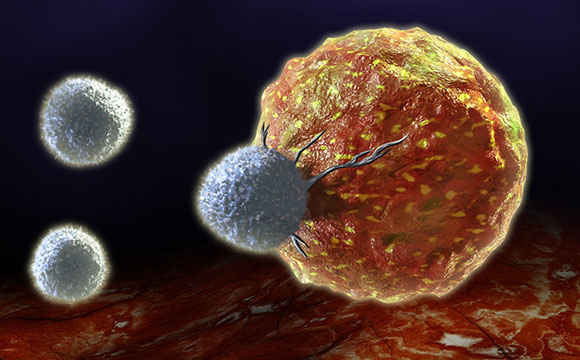
    A New Approach to Cancer Immunotherapy
    Yale researchers have found a way to boost immune response by “rewiring” immune cells that metabolize the most glucose, giving them an advantage in the battle against cancer cells inside tumors.

    Scientists from Yale University have identified a new way to boost immune response by metabolically “rewiring” immune cells.

    Inside a tumor, immune cells and cancer cells battle for survival. The advantage may go to the cells that metabolize the most glucose, say Yale researchers who have identified a new way to boost immune response by metabolically “rewiring” immune cells.

    Their research, published August 27 online in Cell, may provide a novel approach to cancer immunotherapy.

    Researchers have long known that specific immune cells known as T cells infiltrate tumors. But tumor-infiltrating T cells fail to destroy cancer cells, in part, because inside the tumor they are deprived of glucose, a nutrient essential to T cell function. The research team, led by professor of immunobiology Susan Kaech and postdoctoral fellow Ping-Chih Ho, theorized that metabolic reprogramming of T cells could enhance their anti-tumor response.

    When cells eat glucose, they convert it into a metabolite called phosphoenolpyruvate (PEP). Using biochemical analyses, the researchers identified a new role for PEP in fine-tuning the anti-tumor response of T cells. They genetically reprogrammed the T cells to increase PEP production, restoring cell function and slowing tumor growth.

    The research reveals a potential new form of cancer immunotherapy. “Knowing how the metabolic state of T cells is affected in tumors, we may find new ways of altering their metabolism to make them more efficiently kill tumor cells,” says Kaech. These types of approaches could be directly applied to clinical trials using adoptive T cell therapy, she notes.

    The study results may also apply to conditions other than cancer. “Understanding how immune cell metabolism affects their function could lead to novel approaches to adjust immune responses in a variety of diseases,” says Ho.

    Reference: “Phosphoenolpyruvate Is a Metabolic Checkpoint of Anti-tumor T Cell Responses” by Ping-Chih Ho, Jessica Dauz Bihuniak, Andrew N. Macintyre, Matthew Staron, Xiaojing Liu, Robert Amezquita, Yao-Chen Tsui, Guoliang Cui, Goran Micevic, Jose C. Perales, Steven H. Kleinstein, E. Dale Abel, Karl L. Insogna, Stefan Feske, Jason W. Locasale, Marcus W. Bosenberg, Jeffrey C. Rathmell and Susan M. Kaech, 27 August 2015, Cell.
    DOI: 10.1016/j.cell.2015.08.012

    Never miss a breakthrough: Join the SciTechDaily newsletter.
    Follow us on Google and Google News.

    Cancer Cell Biology Disease Immunobiology Immunotherapy Yale University
    Share. Facebook Twitter Pinterest LinkedIn Email Reddit

    Related Articles

    Scientists Finally Reveal How Cancer-Fighting T Cells Switch On

    MIT Develops a Synthetic Gene Circuit to Trigger Immune System Attack on Cancer

    Scientists Reveal Four Genes Linked to Cystic Diseases of the Kidney and Liver

    Yale Research Provides New Clues to How Cancer Cells Spread

    A Promising New Form of Immunotherapy for Cancer

    Yale Scientists Reveal Underlying Cause of Myeloma

    Yale Study Shows Protein IL-18 Contributes to Colitis

    Combination of Immune Stimulating Antibodies Shows Promising Results Against Advanced Melanoma

    Immune System May Trigger Melanoma Growth

    Leave A Reply Cancel Reply

    • Facebook
    • Twitter
    • Pinterest
    • YouTube

    Don't Miss a Discovery

    Subscribe for the Latest in Science & Tech!

    Trending News

    The Universe Is Expanding Too Fast and Scientists Can’t Explain Why

    “Like Liquid Metal”: Scientists Create Strange Shape-Shifting Material

    Early Warning Signals of Esophageal Cancer May Be Hiding in Plain Sight

    Common Blood Pressure Drug Shows Surprising Power Against Deadly Antibiotic-Resistant Superbug

    Scientists Uncover Dangerous Connection Between Serotonin and Heart Valve Disease

    Scientists Discover a “Protector” Protein That Could Help Reverse Hair Loss

    Bone-Strengthening Discovery Could Reverse Osteoporosis

    Scientists Uncover Hidden Trigger Behind Stem Cell Aging

    Follow SciTechDaily
    • Facebook
    • Twitter
    • YouTube
    • Pinterest
    • Newsletter
    • RSS
    SciTech News
    • Biology News
    • Chemistry News
    • Earth News
    • Health News
    • Physics News
    • Science News
    • Space News
    • Technology News
    Recent Posts
    • A Common Diabetes Drug May Hold the Key to Stopping HIV From Coming Back
    • Ancient “Syphilis-Like” Disease in Vietnam Challenges Key Scientific Assumptions
    • Drinking Alcohol To Cope in Your 20s Could Damage Your Brain for Life
    • Scientists Crack Alfalfa’s Chromosome Mystery After Decades of Debate
    • Ancient Ant-Plant Alliance Collapses As Predatory Wasps Move In
    Copyright © 1998 - 2026 SciTechDaily. All Rights Reserved.
    • Science News
    • About
    • Contact
    • Editorial Board
    • Privacy Policy
    • Terms of Use

    Type above and press Enter to search. Press Esc to cancel.