
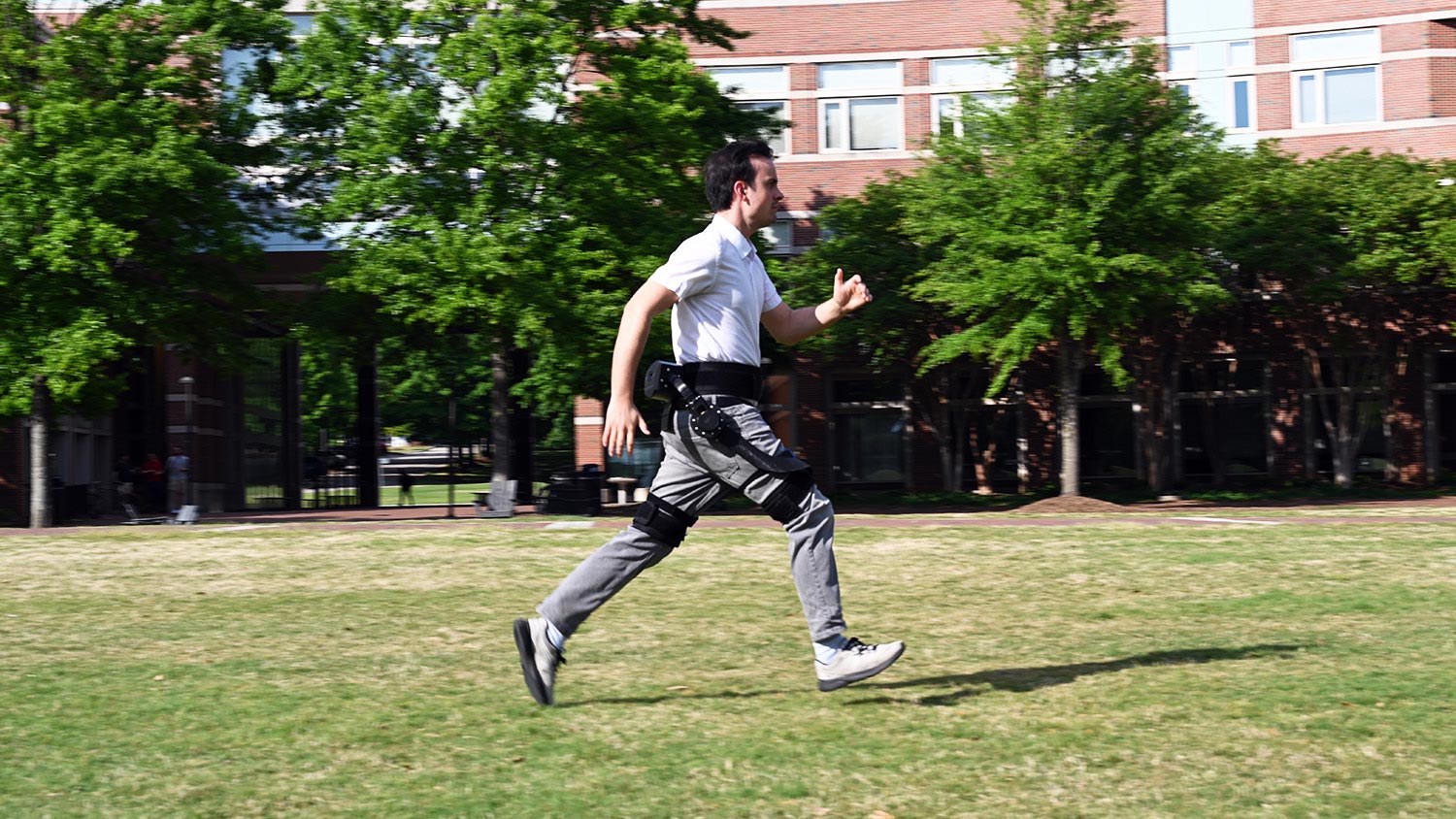
A new training method for robotic exoskeletons using AI and simulations has been shown to decrease energy expenditure in walking, running, and climbing stairs.
North Carolina State University researchers have developed an innovative new technique that leverages artificial intelligence (AI) and computer simulations to train robotic exoskeletons to autonomously help users save energy while walking, running, and climbing stairs.
“This work proposes and demonstrates a new machine-learning framework that bridges the gap between simulation and reality to autonomously control wearable robots to improve mobility and health of humans,” says Hao Su, corresponding author of a paper on the work which will be published today (June 12) in the journal Nature.
Enhancing Locomotive Performance
“Exoskeletons have enormous potential to improve human locomotive performance,” says Su, who is an associate professor of mechanical and aerospace engineering at North Carolina State University. “However, their development and broad dissemination are limited by the requirement for lengthy human tests and handcrafted control laws.
“The key idea here is that the embodied AI in a portable exoskeleton is learning how to help people walk, run or climb in a computer simulation, without requiring any experiments,” says Su.
Specifically, the researchers focused on improving autonomous control of embodied AI systems – which are systems where an AI program is integrated into a physical robot technology. This work focused on teaching robotic exoskeletons how to assist able-bodied people with various movements. Normally, users have to spend hours “training” an exoskeleton so that the technology knows how much force is needed – and when to apply that force – to help users walk, run or climb stairs. The new method allows users to utilize the exoskeletons immediately.
Energy Efficiency Through Robotics
“This work is essentially making science fiction reality – allowing people to burn less energy while conducting a variety of tasks,” says Su.
“We have developed a way to train and control wearable robots to directly benefit humans,” says Shuzhen Luo, first author of the paper and a former postdoctoral researcher at NC State. Luo is now an assistant professor at Embry-Riddle Aeronautical University.
For example, in testing with human subjects, the researchers found that study participants used 24.3% less metabolic energy when walking in the robotic exoskeleton than without the exoskeleton. Participants used 13.1% less energy when running in the exoskeleton, and 15.4% less energy when climbing stairs.
“It’s important to note that these energy reductions are comparing the performance of the robotic exoskeleton to that of a user who is not wearing an exoskeleton,” Su says. “That means it’s a true measure of how much energy the exoskeleton saves.”
While this study focused on the researchers’ work with able-bodied people, the new method also applies to robotic exoskeleton applications aimed at helping people with mobility impairments.
Future Applications and Studies
“Our framework may offer a generalizable and scalable strategy for the rapid development and widespread adoption of a variety of assistive robots for both able-bodied and mobility-impaired individuals,” Su says.
“We are in the early stages of testing the new method’s performance in robotic exoskeletons being used by older adults and people with neurological conditions, such as cerebral palsy. And we are also interested in exploring how the method could improve the performance of robotic prosthetic devices for amputee populations.”
For more on this work, see AI and Exoskeletons Team Up to Transform Human Performance on Earth and in Space.
Reference: “Experiment-free exoskeleton assistance via learning in simulation” by Shuzhen Luo, Menghan Jiang, Sainan Zhang, Junxi Zhu, Shuangyue Yu, Israel Dominguez Silva, Tian Wang, Elliott Rouse, Bolei Zhou, Hyunwoo Yuk, Xianlian Zhou and Hao Su, 12 June 2024, Nature.
DOI: 10.1038/s41586-024-07382-4
The paper was co-authored by Menghan Jiang, Junxi Zhu and Israel Dominguez Silva, who are Ph.D. students at NC State; Sainan Zhang and Shuangyue Yu, postdoctoral researchers at NC State; Tian Wang, a graduate student at NC State; Elliott Rouse of the University of Michigan; Bolei Zhou of the University of California, Los Angeles; Hyunwoo Yuk of the Korea Advanced Institute of Science and Technology; and Xianlian Zhou of the New Jersey Institute of Technology.
This research was done with support from the National Science Foundation under awards 1944655 and 2026622; the National Institute on Disability, Independent Living, and Rehabilitation Research, under award 90DPGE0019 and Switzer Research Fellowship SFGE22000372; and the National Institutes of Health, under award 1R01EB035404.
Shuzhen Luo and Hao Su are co-inventors on intellectual property related to the controller discussed in this work. Su is also a co-founder of, and has a financial interest in, Picasso Intelligence, LLC, which develops exoskeletons.
Never miss a breakthrough: Join the SciTechDaily newsletter.
Follow us on Google and Google News.