
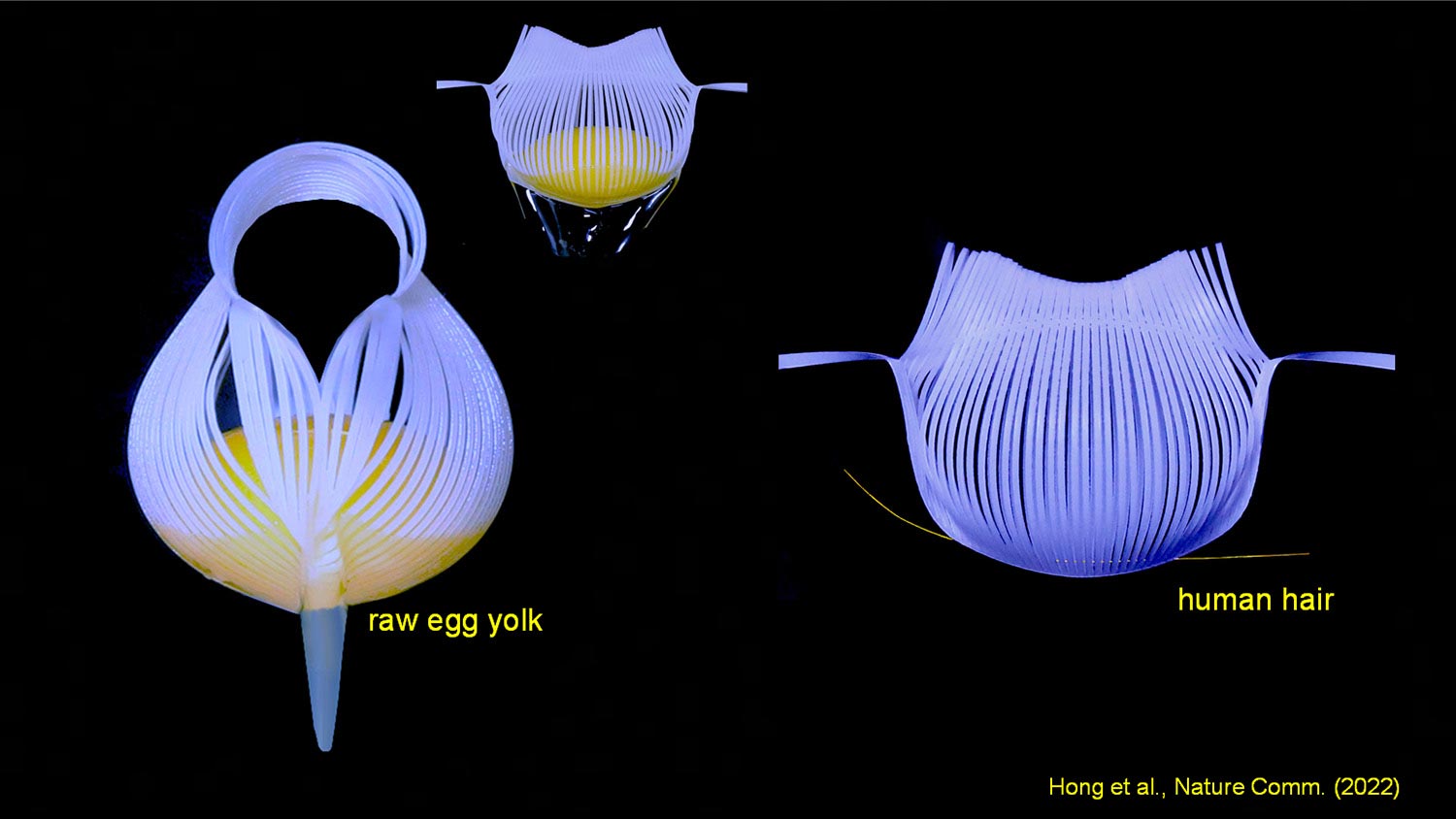
North Carolina State University engineers have developed kirigami-inspired robotic grippers that gently lift delicate objects.
This new approach allows for the transformation of 2D sheets into versatile 3D structures, paving the way for advances in soft robotics and potential biomedical applications like joint-conforming therapeutic devices.
Innovative Robotic Grippers Based on Kirigami Art
Engineering researchers from North Carolina State University have demonstrated a new type of flexible, robotic grippers that are able to lift delicate egg yolks without breaking them, and that are precise enough to lift a human hair. The work has applications for both soft robotics and biomedical technologies.
The work draws on the art of kirigami, which involves both cutting and folding two-dimensional (2D) sheets of material to form three-dimensional (3D) shapes. Specifically, the researchers have developed a new technique that involves using kirigami to convert 2D sheets into curved 3D structures by cutting parallel slits across much of the material. The final shape of the 3D structure is determined in large part by the outer boundary of the material. For example, a 2D material that has a circular boundary would form a spherical 3D shape.
“We have defined and demonstrated a model that allows users to work backwards,” says Yaoye Hong, first author of a paper on the work and a Ph.D. student at NC State. “If users know what sort of curved, 3D structure they need, they can use our approach to determine the boundary shape and pattern of slits they need to use in the 2D material. And additional control of the final structure is made possible by controlling the direction in which the material is pushed or pulled.”
“Our technique is quite a bit simpler than previous techniques for converting 2D materials into curved 3D structures, and it allows designers to create a wide variety of customized structures from 2D materials,” says Jie Yin, corresponding author of the paper and an associate professor of mechanical and aerospace engineering at NC State.
The researchers demonstrated the utility of their technique by creating grippers capable of grabbing and lifting objects ranging from egg yolks to a human hair.
Gripping Without Pressure
“We’ve shown that our technique can be used to create tools capable of grasping and moving even extremely fragile objects,” Yin says.
“Conventional grippers grasp an object firmly – they grab things by putting pressure on them,” Yin says. “That can pose problems when attempting to grip fragile objects, such as egg yolks. But our grippers essentially surround an object and then lift it – similar to the way we cup our hands around an object. This allows us to ‘grip’ and move even delicate objects, without sacrificing precision.”
However, the researchers note that there are a host of other potential applications, such as using the technique to design biomedical technologies that conform to the shape of a joint – like the human knee.
“Think of smart bandages or monitoring devices capable of bending and moving with your knee or elbow,” Yin says.
“This is proof-of-concept work that shows our technique works,” Yin says. “We’re now in the process of integrating this technique into soft robotics technologies to address industrial challenges. We are also exploring how this technique could be used to create devices that could be used to apply warmth to the human knee, which would have therapeutic applications.
“We’re open to working with industry partners to explore additional applications and to find ways to move this approach from the lab into practical use.”
Reference: “Boundary curvature guided programmable shape-morphing kirigami sheets” by Yaoye Hong, Yinding Chi, Shuang Wu, Yanbin Li, Yong Zhu and Jie Yin, 26 January 2022, Nature Communications.
DOI: 10.1038/s41467-022-28187-x
The paper will be published in the journal Nature Communications on January 26. The paper is co-authored by Yong Zhu, the Andrew A. Adams Distinguished Professor of Mechanical and Aerospace Engineering at NC State; and by Yinding Chi, Shuang Wu, Yanbin Li, all of whom are Ph.D. students at NC State. The work was done with support from the National Science Foundation under grants 2005374 and 2013993.
Never miss a breakthrough: Join the SciTechDaily newsletter.
Follow us on Google and Google News.