
Close Menu
    Facebook X (Twitter) Instagram
    SciTechDaily
    • Biology
    • Chemistry
    • Earth
    • Health
    • Physics
    • Science
    • Space
    • Technology
    Facebook X (Twitter) Pinterest YouTube RSS
    SciTechDaily
    Home»Chemistry»Unlocking Earth’s Origins: Nitrogen Isotopes Reveal Planetary Secrets
    Chemistry

    Unlocking Earth’s Origins: Nitrogen Isotopes Reveal Planetary Secrets

    By University of Science and Technology of ChinaJune 29, 2024No Comments3 Mins Read
    Facebook Twitter Pinterest Telegram LinkedIn WhatsApp Email Reddit
    Share
    Facebook Twitter LinkedIn Pinterest Telegram Email Reddit
    Chemistry Isotope Concept
    A USTC-led study reveals that both early and late stages of planetary evolution are key to understanding nitrogen abundance in Earth’s silicate, offering new perspectives on the origin of Earth’s volatiles. Credit: SciTechDaily.com

    This research highlights that both early melting-volatilization and late accretion of volatile-rich materials are integral to understanding the distribution of nitrogen in silicate Earth. These insights open new avenues for understanding the origins of volatiles on Earth.

    A team of researchers led by Professor Wang Wenzhong from the University of Science and Technology of China’s School of Earth and Space Sciences, in partnership with international experts, examined how nitrogen isotopes fractionate during the formation and evolution of terrestrial planets. Their findings were published in Nature Communications.

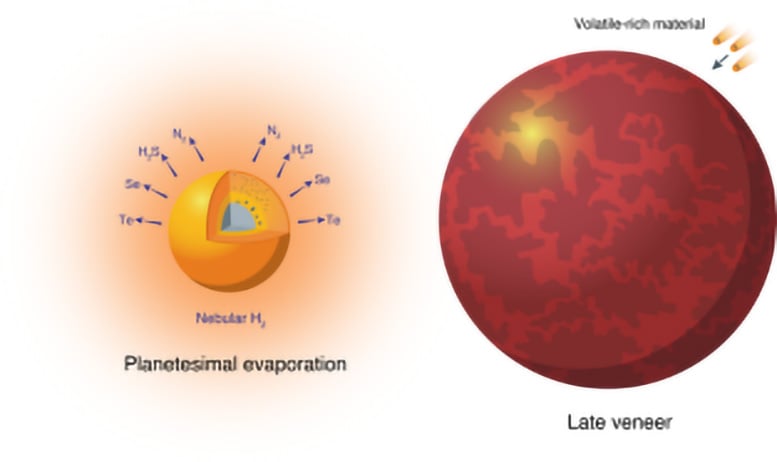
    Currently, the academic community primarily holds two models regarding the accretion of volatiles on Earth: the “Late Veneer” model and the “Early Evolution” model.

    As nitrogen is one of the fundamental building blocks of life on Earth, a thorough examination of its accretionary and evolutionary history holds immense significance in comprehending the origin of life-related elements and the evolution of habitability on our planet.
    USTC Uncovers Nitrogen's Origin and Early Evolution on Earth
    Effects of early planetesimal melting-volatilization and late-stage accretion on volatiles. Credit: Wang et al.

    Research Methodology

    Researchers employed first-principles calculation methods to delve into the fractionation mechanism of nitrogen isotopes (14N and 15N) during the condensation of nebula materials into planetary embryos. The primary focus was on the two stages of melting-volatilization and core-mantle differentiation.

    Researchers discovered that under the condition where hydrogen gas had not yet fully dissipated in the early solar nebula, melting-volatilization caused the enrichment of 14N in the planetary embryos, while core-mantle differentiation led to the enrichment of 15N in the silicate melt.

    By combining first-principles calculations and observational data, researchers found that the evolution of early planetary embryos alone cannot fully explain the nitrogen isotope composition of the silicate Earth. It is necessary to consider the late-stage addition of volatile-rich materials (such as carbonaceous chondrites). The nitrogen abundance of the silicate Earth is a result of both early evolution and late-stage accretion, but the contribution of late-stage accretion to the abundance of other volatiles is limited.

    This research sheds light on the fact that the two crucial stages of early planetesimal melting-volatilization and late accretion of volatile-rich materials jointly determine the nitrogen abundance in the silicate Earth, offering fresh perspectives on the understanding of the origin of volatiles on Earth.

    Reference: “Early planetesimal differentiation and late accretion shaped Earth’s nitrogen budget” by Wenzhong Wang, Michael J. Walter, John P. Brodholt and Shichun Huang, 16 May 2024, Nature Communications.
    DOI: 10.1038/s41467-024-48500-0

    Never miss a breakthrough: Join the SciTechDaily newsletter.
    Follow us on Google and Google News.

    Geochemistry Isotopes Life University of Science and Technology of China
    Share. Facebook Twitter Pinterest LinkedIn Email Reddit

    Related Articles

    Scientists Reveal a Game-Changer in the Evolution of Life on Earth

    Not So Random After All: Scientists Uncover Surprising New Clues to the Origin of Life

    Cracking the Mystery of Life’s Origin: Scientists Uncover How Life’s Building Blocks May Have Replicated Themselves

    Breaking Barriers in Hydrogen Science: New Techniques Promise Brighter Tomorrows

    New Insights Into the Origins of Life: How the First Molecules Survived Earth’s Primordial Conditions

    Decoding Earth’s Ancient Atmosphere: Life’s Role in Shaping Our World

    New Phosphorescent Probe Unmasks Microstructures in Water Ice

    Scientists Discover Potential Interstellar Origins of Life on Earth

    From Chaos to Life: Unraveling Nature’s Ancient Molecular Kitchen

    Leave A Reply Cancel Reply

    • Facebook
    • Twitter
    • Pinterest
    • YouTube

    Don't Miss a Discovery

    Subscribe for the Latest in Science & Tech!

    Trending News

    Why Popular Diabetes Drugs Like Ozempic Don’t Work for Everyone: The “Genetic Glitch”

    Scientists Stunned After Finding Plant Thought Extinct for 60 Years

    Scientists Discover Tiny New Spider That Hunts Prey 6x Its Size

    Natural Component From Licorice Shows Promise for Treating Inflammatory Bowel Disease

    Scientists Warn: Popular Sweetener Linked to Dangerous Metabolic Effects

    Monster Storms on Jupiter Unleash Lightning Beyond Anything on Earth

    Scientists Create “Liquid Gears” That Spin Without Touching

    The Simple Habit That Could Help Prevent Cancer

    Follow SciTechDaily
    • Facebook
    • Twitter
    • YouTube
    • Pinterest
    • Newsletter
    • RSS
    SciTech News
    • Biology News
    • Chemistry News
    • Earth News
    • Health News
    • Physics News
    • Science News
    • Space News
    • Technology News
    Recent Posts
    • Seeing the Invisible: Scientists Develop New Way To Track Particles in 3D
    • The Atomic Gap That Could Cost the Semiconductor Industry Billions
    • Earth’s Secret Advantage: Why Most Alien Worlds May Be Too Dry for Life
    • Ancient Bacteria Turned a DNA System Into a Cell Skeleton
    • Researchers Finally Solve 50-Year-Old Blood Group Mystery
    Copyright © 1998 - 2026 SciTechDaily. All Rights Reserved.
    • Science News
    • About
    • Contact
    • Editorial Board
    • Privacy Policy
    • Terms of Use

    Type above and press Enter to search. Press Esc to cancel.