

A new source of nitrogen has been discovered.
Researchers from RPTU University Kaiserslautern-Landau in southwestern Germany are unraveling the mysteries of a bygone era. As part of ongoing studies, they are investigating how life could have developed on early Earth. Contrary to previous assumptions, biologically available nitrogen does not appear to have been a limiting factor.
Living organisms require nitrogen as a central building block for protein formation, among other functions. Although our atmosphere contains abundant nitrogen, neither humans nor the vast majority of plants can absorb it directly from the air. Just like today, early life on Earth depended on nitrogen fixation by microbes—meaning the conversion of atmospheric nitrogen into nitrogen compounds that living organisms can absorb and utilize.
The details of the processes that took place on Earth billions of years ago are far from known: What were the sources of nitrogen on early Earth? How were they used? And what did this mean for the further development of life? RPTU researcher Dr. Michelle Gehringer is working on precisely these questions. She is a geomicrobiologist – and studies the interactions between microorganisms and geochemical processes.
Nitrogen fixation stable under changing environmental conditions
Under her leadership, a measurement method was recently verified that shows that biological nitrogen fixation remains stable under changing atmospheric compositions. To understand the researcher’s approach, it is important to know that nitrogen has two stable isotopes, two different states so to speak, 15N und 14N.
Michelle Gehringer explains: “Nitrogen gas is a mixture of the light atom 14N and the heavier atom 15N. When modern microbes use nitrogen in their metabolism, they use these two isotopes in a certain ratio to each other. We measure this by burning nitrogen-containing biomass and collecting the nitrogen gas produced during combustion.”
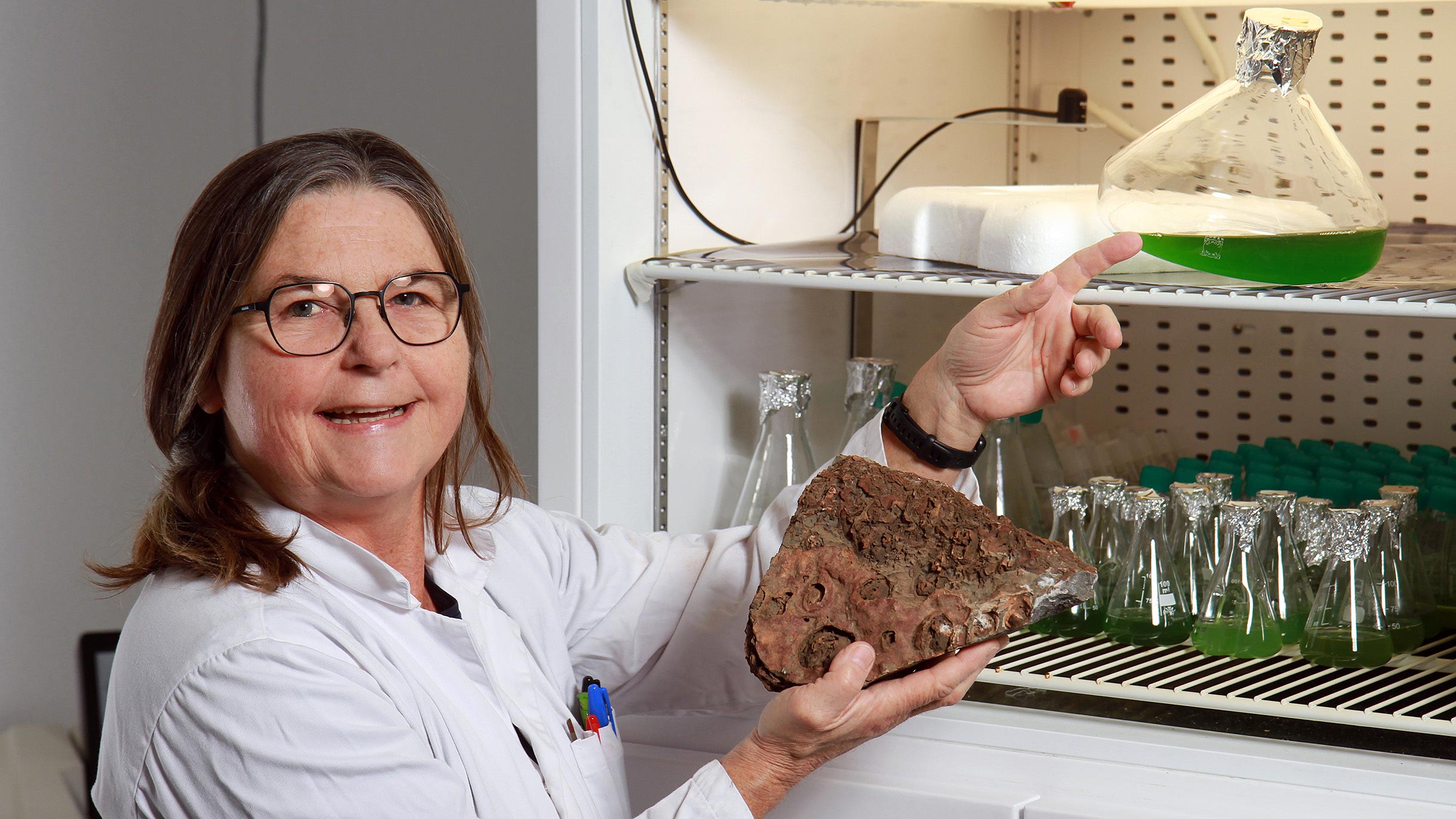
Michelle Gehringer explains: “Until now, it was always assumed that microbes have the same 15N /14N ratio, even though they live under completely different environmental conditions, without oxygen, and with a much higher carbon dioxide content. However, no one has yet tested whether this is actually true.” However, since environmental conditions influence metabolic rates, they could presumably also influence the 15N /14N ratio.
The researchers led by Gehringer cultivated cyanobacteria under environmental conditions similar to those of the early Earth, i.e. without oxygen and with a very high carbon dioxide content. “We found that the 15N /14N ratios of the cyanobacteria remain stable. Our results therefore support the assumption that this ratio was the same throughout the Earth’s history.”
Nitrogen also absorbed in the form of dissolved ammonium
Building on this, Michelle Gehringer and other researchers – under the leadership of her fellow scientist Dr. Ashley Martin from Northumbria University, UK, and Dr. Eva Stüeken from the University of St Andrews, UK – investigated the nitrogen cycle in ancient stromatolites, i.e. sedimentary rocks of organic origin. The ancient rocks, which were around 2.7 billion years old, contain the dead remains of various microorganisms and can provide the researchers with information about their ecosystems and environmental niches in past times. Michelle Gehringer: “We gained access to pristine, unweathered rock, which we ground into a fine powder and analyzed for nitrogen isotopes.”
With the help of the 15N /14N ratio measurements, the researchers discovered that in contrast to modern stromatolites, the organic material of ancient stromatolites was not solely dependent on the biological fixation of nitrogen gas by cyanobacteria. To be more precise, the results of the study point to the additional uptake of nitrogen in the form of dissolved ammonium. “And the most plausible source for this is hydrothermal activity on the sea floor,” says Gehringer.
The researchers also looked at sedimentary rocks in a volcanic basin that is also around 2.7 billion years old. Ammonium from hydrothermal sources also proved to be relevant in this system.
So would life on Mars also be possible?
“Until now, it was assumed that life on the early Earth, before the atmosphere was enriched with oxygen, was limited by a lack of biologically available nitrogen.” The current studies now prove an additional role of ammonium from deep-sea hydrothermal vents: “With the help of hydrothermal vents, nitrogen did not limit the spread of life on early Earth. Rather, life was able to flourish in both deep and shallow-water marine environments.” And according to Gehringer, this enabled the development of a great diversity of microorganisms that we still see today.
What could these findings mean for life on other planets? “Hydrothermal activity has been documented on Mars and probably also takes place on the icy moons in the outer solar system.” It is conceivable that processes similar to those on the early Earth took place or are still taking place there.
Reference: “Anomalous δ15N values in the Neoarchean associated with an abundant supply of hydrothermal ammonium” by Ashley N. Martin, Eva E. Stüeken, Michelle M. Gehringer, Monika Markowska, Hubert Vonhof, Stefan Weyer and Axel Hofmann, 22 February 2025, Nature Communications.
DOI: 10.1038/s41467-025-57091-3
Never miss a breakthrough: Join the SciTechDaily newsletter.
Follow us on Google and Google News.
9 Comments
That “IS”a hellva articke. Thank you.
“The researchers led by Gehringer cultivated cyanobacteria under environmental conditions similar to those of the early Earth, i.e. without oxygen and with a very high carbon dioxide content. ”
Life without oxygen means life without ozone. In other words, the cyanobacteria could not have evolved because of the Sun’s DNA damaging UV radiation. Their basic assumption is wrong.
Your assumption is that only life like ours is possible. Any assertion that, ‘Until I’m proven wrong, I’m right’, lacks a firm scientific basis. Beware of that rabbit hole.
Cyanobacteria were protected by the water in which they lived.
The various biological patterns that repeat what they are designed/destined to be, e.g., peas planted grow more peas as they are patterned so to do, as in other vegetables and flowers, bushes, trees, grasses, vines, etc., on this planet, are for the benefit of animated life on this planet. It took intelligence to coordinate these together, as it also did for the non-evolving privilege of procreation and as it outsmarted the non-intelligence of evolution – He and She created He them! We are because He is!
No intelligence needed, just incredibly vast amounts of time and many failures along with the successes that led to you and me. 😉
Why do you even bother reading scientific articles? Just so you can say, “Nuh-uh!! That’s not what the Bible says!”?
Real, objective, evidence-based Science seeks answers from and about the natural world without invoking The Cosmic Magician. If you’re wedded to the proposition that The Cosmic Magician is a necessary predicate to explain the Universe as we observe it, then the enterprise of objective, evidence-based Science is a waste of your time. You already [believe that you] have all the answers you need. But…
To be intellectually honest and philosophically consistent, you should also eschew the use of electricity, all electronics, all satellite services, all antibiotics, all chemotherapy, all synthetic materials, all anaesthetics, all X-ray and ultrasound imaging, etc., etc., etc.. These technologies were hard won by individuals who sought to understand the world/universe unto itself, without the necessity of or interventions by a Cosmic Magician. That does not mean that none of them were “people of faith”, only that they believed that the universe was/is mechanistically comprehensible, without invoking gods, spirits, or supernatural influences as operative agents in natural processes.
Science, as a structured human enterprise, is only about 400-600 years old (depending on what you count as scientific enquiry), and we are just, in the last 100 or so years beginning to understand how *any* cell functions, with its hundreds/thousands of proteins and biochemical mediators. It should surprise no one that teasing out *how* this process began is still a work in progress. Just because Science has not yet provided the full answer does not mean that such an answer is unattainable.
The Wright Brothers first airplane looked almost nothing like a Boeing 747, but it did embody aerodynamic lift, propulsive thrust, control systems for tilt, roll, and yaw — all of the predicate features in all modern aircraft. Their demonstrator of applied first principles was refined and improved through decades of human endeavor. It is shortsighted to assume that biological science cannot and will not undergo equivalent discoveries, refinements of understanding, and applications of intrinsic first principles.
It’s just gonna take some time.
Seems more likely the atmospheric nitrogen was turned to ammonia then ammonium.
This is part of Earth’s cycles y’all refer to as global warming, that result in extinctions & bursts of new life, and is exactly where we are headed again.
Much more likely than stable hydrothermal vents that only produced life once in all these billions of years.
Why was it only once? They continue to do so to this day…