
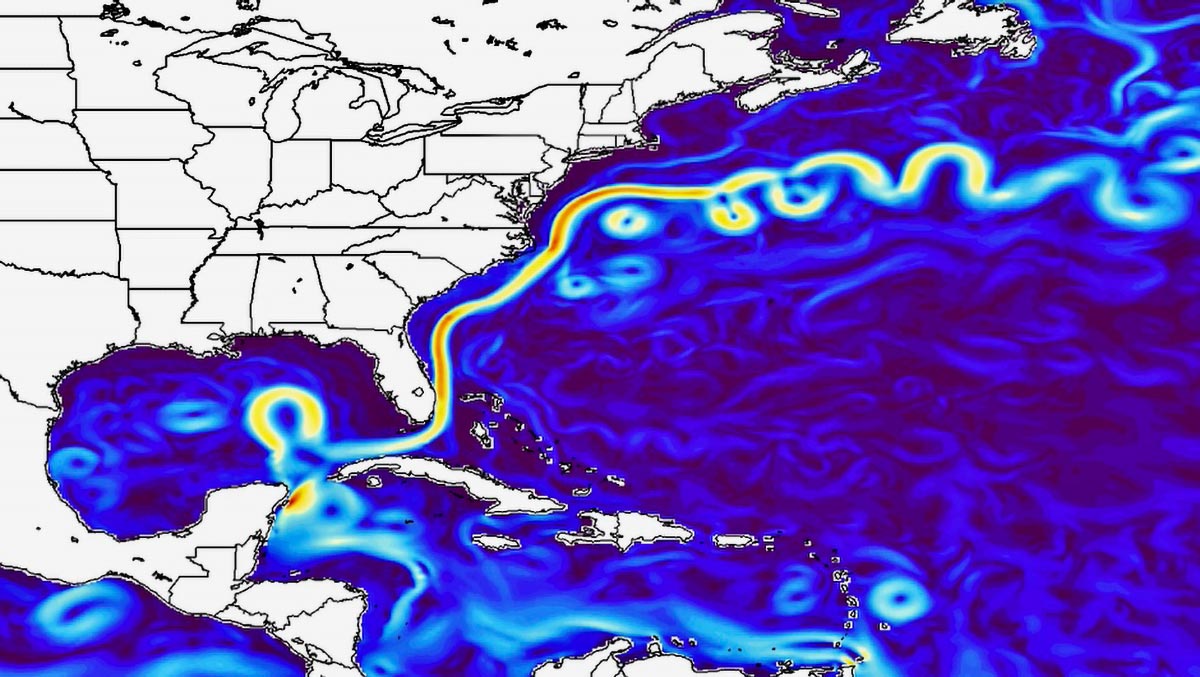
Researchers from CIMAS, University of Miami, and NOAA have confirmed the stability of the Florida Current, a vital part of the global oceanic circulation system, over the last 40 years.
Despite concerns over potential changes affecting global climate and ecosystems, updated measurements show the current remains consistent, underlining the need for ongoing monitoring to understand long-term trends.
A new study by scientists at the Cooperative Institute for Marine and Atmospheric Studies (CIMAS), the University of Miami Rosenstiel School of Marine, Atmospheric, and Earth Science, NOAA’s Atlantic Oceanographic and Meteorological Laboratory (AOML), and the National Oceanography Centre found that the strength of the Florida Current, the beginning of the Gulf Stream system and a key component of the global Atlantic Meridional Overturning Circulation, or AMOC, has remained stable for the past four decades.
Significance of the AMOC
There is growing scientific and public interest in the AMOC, a three-dimensional system of ocean currents that act as a “conveyor belt” to distribute heat, salt, nutrients, and carbon dioxide across the world’s oceans. Changes in the AMOC’s strength could impact global and regional climate, weather, sea level, precipitation patterns, and marine ecosystems.

Stability of the Florida Current
In this research, measurements of the Florida Current were corrected for the secular change in the geomagnetic field to find that the Florida Current, one of the fastest currents in the ocean and an important part of the AMOC, has remained remarkably stable over the past 40 years.
Published recently in the journal Nature Communications, the study reassessed the 40-year record of the Florida Current volume transport measured on a decommissioned submarine telecommunications cable in the Florida Straits, which spans the seafloor between Florida and the Bahamas. Due to the Earth’s magnetic field, as salt ions in the seawater are transported by the Florida Current over the cable, a measurable voltage is induced in the cable. The cable measurements were analyzed together with measurements from regular hydrographic surveys that directly measure the Florida Current volume transport and water mass properties. In addition, the transport was inferred from cross-stream sea level differences measured by altimetry satellites.
Consistency in Florida Current Observations
“This study does not refute the potential slowdown of AMOC, it shows that the Florida Current, one of the key components of the AMOC in the subtropical North Atlantic, has remained steady over the more than 40 years of observations,” said Denis Volkov, lead author of the study and a scientist at CIMAS which is based at the Rosenstiel School. “With the corrected and updated Florida Current transport time series, the negative tendency in the AMOC transport is indeed reduced, but it is not gone completely. The existing observational record is just starting to resolve interdecadal variability, and we need many more years of sustained monitoring to confirm if a long-term AMOC decline is happening.”
Understanding the state of the Florida Current is very important for developing coastal sea level forecast systems, assessing local weather and ecosystem and societal impacts.
Long-Term Observation Efforts
Since 1982, NOAA’s Western Boundary Time Series (WBTS) project and its predecessors have monitored the transport of the Florida Current between Florida and the Bahamas at 27°N using a 120-km long submarine cable paired with regular hydrographic cruises in the Florida Straits. This nearly continuous monitoring has provided the longest observational record of a boundary current in existence. Beginning in 2004, NOAA’s WBTS project partnered with the United Kingdom’s Rapid Climate Change program (RAPID) and the University of Miami’s Meridional Overturning Circulation and Heatflux Array (MOCHA) programs to establish the first trans basin AMOC observing array at about 26.5N.
Reference: “Florida Current transport observations reveal four decades of steady state” by Denis L. Volkov, Ryan H. Smith, Rigoberto F. Garcia, David A. Smeed, Ben I. Moat, William E. Johns and Molly O. Baringer, 5 September 2024, Nature Communications.
DOI: 10.1038/s41467-024-51879-5
The study was supported by NOAA ‘s Global Ocean Monitoring and Observing program (grant #100007298), NOAA’s Climate Variability and Predictability program (grant #NA20OAR4310407), Natural Environment Research Council (grants #NE/Y003551/1 and NE/Y005589/1) and the National Science Foundation (grants #OCE-1332978 and #OCE-1926008).
Never miss a breakthrough: Join the SciTechDaily newsletter.
Follow us on Google and Google News.