
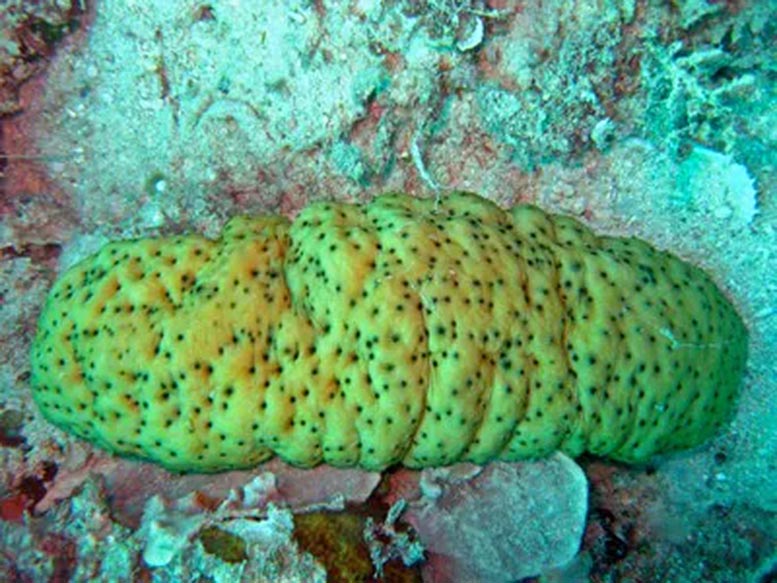
Researchers studying the effects of climate change on coral reefs at One Tree Island found that sea cucumbers play a vital role in reducing the harmful impact of ocean acidification on coral growth. By ingesting sand, sea cucumbers supply coral reefs with calcium carbonate (CaCO3) and are an important component of the natural calcium carbonate turnover process that is essential for coral survival.
Tropical sea cucumbers could play a key role in saving coral reefs from the devastating effects of climate change, say scientists at One Tree Island, the University of Sydney’s research station on the Great Barrier Reef.
“We have found that sea cucumbers play a vital role in reducing the harmful impact of ocean acidification on coral growth,” said Professor Maria Byrne, the director of One Tree Island Research Station.
“When they ingest sand, the natural digestive processes in the sea cucumber’s gut increases the pH levels of the water on the reef where they defecate, countering the negative effects of ocean acidification,” said Professor Byrne.
One of the by-products of the sea cucumber’s digestion of sand is calcium carbonate (CaCO3) a key component of coral. To survive, coral reefs must accumulate CaCO3 at a rate greater than or equal to the CaCO3 that is eroded from the reef.
“The research at One Tree Island showed that in a healthy reef, dissolution of calcium carbonate sediment by sea cucumbers and other bioeroders appears to be an important component of the natural calcium carbonate turnover,” said Professor Byrne.
“The ammonia waste produced when sea cucumbers digest sand also serves to fertilize the surrounding area, providing nutrients for coral growth,” she added.
The research, recently published in the Journal of Geophysical Research, was carried out by an international group of scientists from the University of Sydney, the Carnegie Institute for Science, Stanford, and several other institutions studying the impact of climate change on coral reefs.
Sea cucumbers are among the largest invertebrates found on tropical reefs. Some 30 species are commercially harvested by the fishery industry along the Great Barrier Reef and throughout the tropics.
“We urgently need to understand the impact of removing sea cucumbers and other invertebrates on reef health and resilience at a time when reefs face an uncertain future,” Professor Byrne said.
Notes
Coral reefs and climate change
All coral reefs are increasingly affected by climate-driven changes to ocean chemistry, a process called ocean acidification. Increased ocean acidity interferes with coral calcification. To survive in the warming and acidifying ocean, corals need to be able to make their skeleton and grow.
One Tree Island
One Tree Island Research Station and the surrounding reef is the University of Sydney’s campus on the Great Barrier Reef. A designated Scientific Research Zone, it has been free of commercial activity for over 50 years. This pristine reef is providing a unique base for scientists from around the world to study the impact of climate change on coral reefs.
A research team led by Professor Ken Caldeira from the Carnegie Institute, Stanford University, is documenting the calcification rates at One Tree Reef and comparing them with calcification rates measured in the 1970s. They have found major declines in calcification.
In conjunction with this research, Maria Byrne, Professor of Developmental and Marine Biology at the University of Sydney, is investigating the importance of invertebrates to reef health and the resilience of reefs under climate driven-changes to ocean conditions.
Never miss a breakthrough: Join the SciTechDaily newsletter.
Follow us on Google and Google News.
1 Comment
“Sand” is a name given to mineral particles of a particular size. It says nothing about the composition. The article is so poorly written that it does not give an explanation of how the sea cucumbers accomplish the claimed salvation. Nor does it give any estimate on how much the pH is supposedly increased. And, there is no link to the original article to make it easy to see if the published article does a better job. If I hadn’t been told that this peer reviewed article had been published in GPR, I might have assumed it was an early April 1st Fools Day joke, or the author(s) were self-educated quacks.