
Close Menu
    Facebook X (Twitter) Instagram
    SciTechDaily
    • Biology
    • Chemistry
    • Earth
    • Health
    • Physics
    • Science
    • Space
    • Technology
    Facebook X (Twitter) Pinterest YouTube RSS
    SciTechDaily
    Home»Space»Opportunity on the Western Rim of Endeavour Crater
    Space

    Opportunity on the Western Rim of Endeavour Crater

    By Guy Webster, Jet Propulsion LaboratoryMay 23, 2012No Comments2 Mins Read
    Facebook Twitter Pinterest Telegram LinkedIn WhatsApp Email Reddit
    Share
    Facebook Twitter LinkedIn Pinterest Telegram Email Reddit
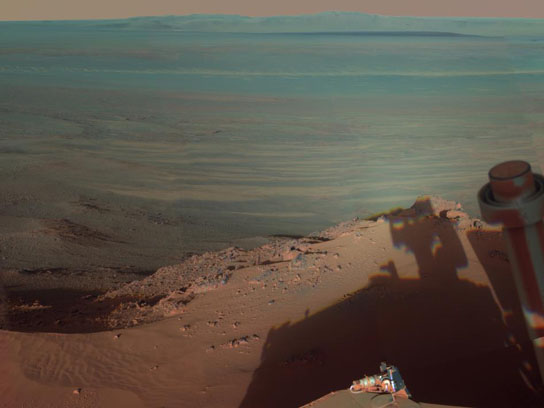
    Mars Rover Opportunity catches its own late-afternoon shadow in Endeavour Crater on Mars
    NASA’s Mars Rover Opportunity catches its own late-afternoon shadow in this dramatically lit view eastward across Endeavour Crater on Mars. Credit: NASA/JPL-Caltech/Cornell/Arizona State University

    NASA’s Mars Exploration Rover Opportunity has been exploring the edge of Endeavour Crater since August 2011, taking images and recording data about the environment.

    Like a tourist waiting for just the right lighting to snap a favorite shot during a stay at the Grand Canyon, NASA’s Mars Exploration Rover Opportunity has used a low sun angle for a memorable view of a large Martian crater.

    The resulting view catches a shadow of the rover in the foreground and the giant basin in the distance. Opportunity is perched on the western rim of Endeavour Crater looking eastward. The crater spans about 14 miles (22 kilometers) in diameter. Opportunity has been studying the edge of Endeavour Crater since arriving there in August 2011.

    The scene is presented in false color to emphasize differences in materials such as dark dunes on the crater floor. This gives portions of the image an aqua tint.

    Opportunity took most of the component images on March 9, 2012, while the solar-powered rover was spending several weeks at one location to preserve energy during the Martian winter. It has since resumed driving and is currently investigating a patch of windblown Martian dust near its winter haven.

    Opportunity and its rover twin, Spirit, completed their three-month prime missions on Mars in April 2004. Both rovers continued for years of bonus, extended missions. Both have made important discoveries about wet environments on ancient Mars that may have been favorable for supporting microbial life. Spirit stopped communicating in 2010. Since landing in the Meridiani region of Mars in January 2004, Opportunity has driven 21.4 miles (34.4 kilometers).

    NASA’s Jet Propulsion Laboratory, a division of the California Institute of Technology, in Pasadena, manages the Mars Exploration Rover Project for NASA’s Science Mission Directorate, Washington.

    Never miss a breakthrough: Join the SciTechDaily newsletter.
    Follow us on Google and Google News.

    Arizona State University Crater JPL Mars NASA
    Share. Facebook Twitter Pinterest LinkedIn Email Reddit

    Related Articles

    NASA’s Farside Seismic Suite: Measuring Moonquakes With Help From Mars InSight Lander

    Perseverance Triumphs: How SHERLOC Was Brought Back to Life on Mars

    NASA’s Curiosity Mars Rover Faces a Particularly Prickly Power Puzzle

    NASA’s Perseverance Mars Rover Unlocks the Geologic Mysteries of Bright Angel

    Atmospheric Time Capsules: Why Scientists Are Intrigued by Air in NASA’s Mars Sample Tubes

    NASA’s Perseverance Rover Crosses Ancient Martian River To Reach New Scientific Frontiers

    Radiation Surge on Mars: NASA Watches Red Planet Light Up During Epic Solar Storm

    NASA Backs 12 Innovative Studies to Enhance Mars Exploration

    Dusty Dilemmas: NASA’s Curiosity Mars Rover Navigates Rocky Riddles

    Leave A Reply Cancel Reply

    • Facebook
    • Twitter
    • Pinterest
    • YouTube

    Don't Miss a Discovery

    Subscribe for the Latest in Science & Tech!

    Trending News

    Beyond Ozempic? New Weight Loss Drug Shows Stunning Results in Major Clinical Trial

    Scientists Create a Nuclear Clock So Precise It Barely Loses a Second in 30 Million Years

    Scientists Discover Groundbreaking Clues to Tissue Regrowth and “Immortality” in the Ocean

    A New Test Upends a Long-Held Assumption About Dark Matter

    Scientists Discover an Unexpected New Way To Fight Alzheimer’s Before It Starts

    Sleeping Less Than 5 Hours Was Linked to Higher Risk of 37 Diseases

    This 345-Million-Year-Old Fossil Fooled Scientists for Decades

    Scientists Restore Limited Vision in Blind Patients Using Gene Therapy and Special Goggles

    Follow SciTechDaily
    • Facebook
    • Twitter
    • YouTube
    • Pinterest
    • Newsletter
    • RSS
    SciTech News
    • Biology News
    • Chemistry News
    • Earth News
    • Health News
    • Physics News
    • Science News
    • Space News
    • Technology News
    Recent Posts
    • Unstable Blood Pressure Linked to Higher Risk of Death and Stroke
    • Alzheimer’s Breakthrough: Scientists Protect Brain Cells Without Removing Toxic Tau
    • A Hidden Sugar in Red Meat Linked to a 63% Higher Risk of Diabetes
    • Wolves Were Supposed To Save Yellowstone. Scientists Say the Real Story Is Very Different
    • Scientists Discover 45-Million-Year-Old Crocodile With a Strange Connection to Egypt’s Great Sphinx
    Copyright © 1998 - 2026 SciTechDaily. All Rights Reserved.
    • Science News
    • About
    • Contact
    • Editorial Board
    • Privacy Policy
    • Terms of Use

    Type above and press Enter to search. Press Esc to cancel.