
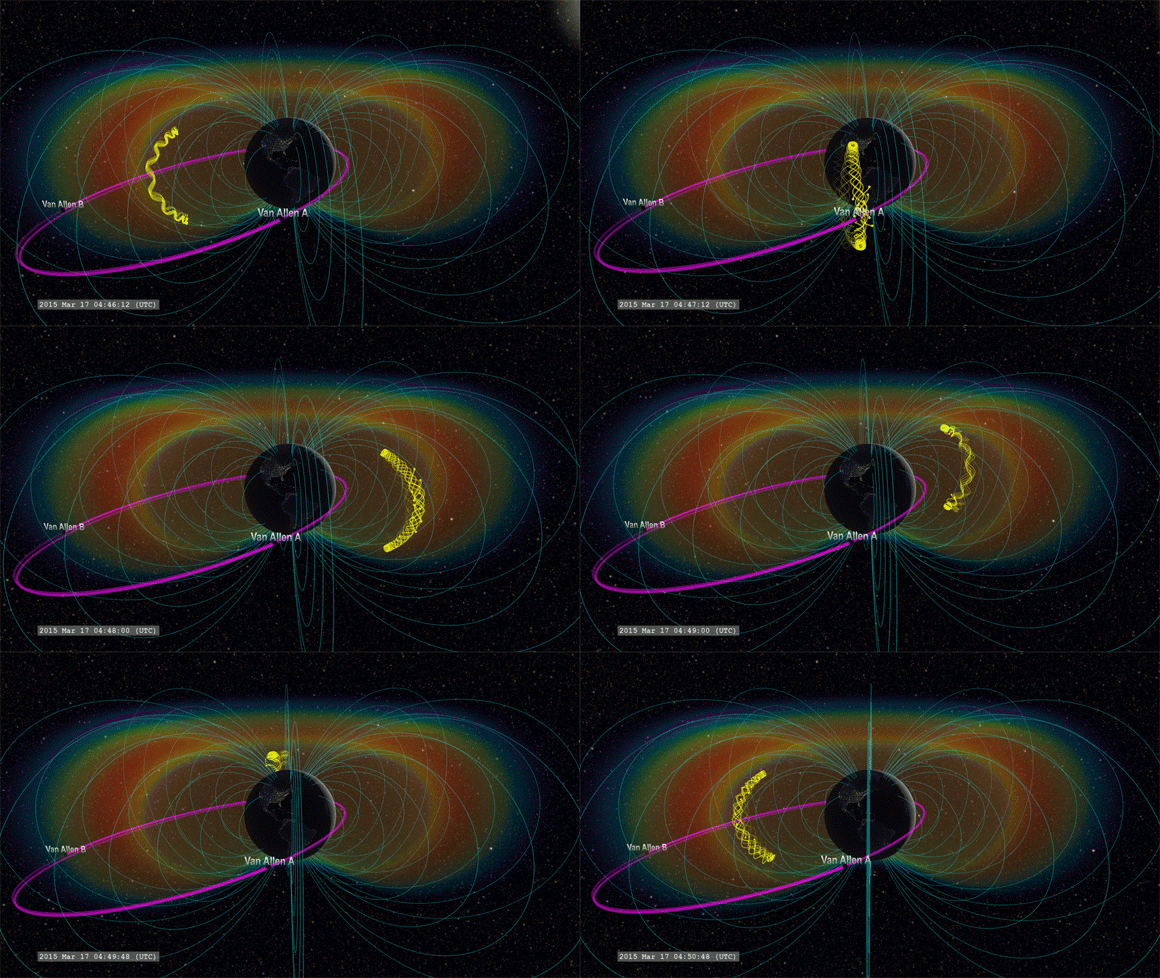
New research details how a shockwave created by the driving force of a coronal mass ejection from the sun – struck the outermost radiation belt, triggering the greatest geomagnetic storm of the preceding decade.
Our planet is nestled in the center of two immense, concentric doughnuts of powerful radiation: the Van Allen radiation belts, which harbor swarms of charged particles that are trapped by Earth’s magnetic field. On March 17, 2015, an interplanetary shock – a shockwave created by the driving force of a coronal mass ejection, or CME, from the sun – struck Earth’s magnetic field, called the magnetosphere, triggering the greatest geomagnetic storm of the preceding decade. And NASA’s Van Allen Probes were there to watch the effects on the radiation belts.
One of the most common forms of space weather, a geomagnetic storm describes any event in which the magnetosphere is suddenly, temporarily disturbed. Such an event can also lead to changes in the radiation belts surrounding Earth, but researchers have seldom been able to observe what happens. But on the day of the March 2015 geomagnetic storm, one of the Van Allen Probes was orbiting right through the belts, providing unprecedentedly high-resolution data from a rarely witnessed phenomenon. A paper on these observations was published in the Journal of Geophysical Research on August 15, 2016.
On March 17, 2015, an interplanetary shock – a shockwave created by the driving force of a coronal mass ejection, or CME, from the sun – struck the outermost radiation belt, triggering the greatest geomagnetic storm of the preceding decade. NASA’s Van Allen Probes were there to watch it.
Researchers want to study the complex space environment around Earth because the radiation and energy there can impact our satellites in a wide variety of ways – from interrupting onboard electronics to increasing frictional drag to disrupting communications and navigation signals.
“We study radiation belts because they pose a hazard to spacecraft and astronauts,” said David Sibeck, the Van Allen Probes mission scientist at NASA’s Goddard Space Flight Center in Greenbelt, Maryland, who was not involved with the paper. “If you knew how bad the radiation could get, you would build a better spacecraft to accommodate that.”
Studying the radiation belts is one part of our efforts to monitor, study, and understand space weather. NASA launched the twin Van Allen Probes in 2012 to understand the fundamental physical processes that create this harsh environment so that scientists can develop better models of the radiation belts. These spacecraft were specifically designed to withstand the constant bombardment of radiation in this area and to continue to collect data even under the most intense conditions. A set of observations on how the radiation belts respond to a significant space weather storm, from this harsh space environment, is a goldmine.
The recent research describes what happened: The March 2015 storm was initiated by an interplanetary shock hurtling toward Earth – a giant shockwave in space set off by a CME, much like a tsunami is triggered by an earthquake.
Swelling and shrinking in response to such events and solar radiation, the Van Allen belts are highly dynamic structures within our planet’s magnetosphere. Sometimes, changing conditions in near-Earth space can energize electrons in these ever-changing regions. Scientists don’t yet know whether energization events driven by interplanetary shocks are common. Regardless, the effects of interplanetary shocks are highly localized events – meaning if a spacecraft is not precisely in the right place when a shock hits, it won’t register the event at all. In this case, only one of the Van Allen Probes was in the proper position, deep within the magnetosphere – but it was able to send back key information.
The spacecraft measured a sudden pulse of electrons energized to extreme speeds – nearly as fast as the speed of light – as the shock slammed the outer radiation belt. This population of electrons was short-lived, and their energy dissipated within minutes. But five days later, long after other processes from the storm had died down, the Van Allen Probes detected an increased number of even higher energy electrons. Such an increase so much later is a testament to the unique energization processes following the storm.
“The shock injected – meaning it pushed – electrons from outer regions of the magnetosphere deep inside the belt, and in that process, the electrons gained energy,” said Shri Kanekal, the deputy mission scientist for the Van Allen Probes at Goddard and the leading author of a paper on these results.
Researchers can now incorporate this example into what they already know about how electrons behave in the belts, in order to try to understand what happened in this case – and better map out the space weather processes there. There are multiple ways electrons in the radiation belts can be energized or accelerated: radially, locally, or by way of a shock. In radial acceleration, electrons are carried by low-frequency waves toward Earth. Local acceleration describes the process of electrons gaining energy from relatively higher frequency waves as the electrons orbit Earth. And finally, during shock acceleration, a strong interplanetary shock compresses the magnetosphere suddenly, creating large electric fields that rapidly energize electrons.
Scientists study the different processes to understand what role each process plays in energizing particles in the magnetosphere. Perhaps these mechanisms occur in combination, or maybe just one at a time. Answering this question remains a major goal in the study of radiation belts – a difficult task considering the serendipitous nature of the data collection, particularly in regard to shock acceleration.
Additionally, the degree of electron energization depends on the process that energizes them. One can liken the process of shock acceleration, as observed by the Van Allen Probe, to pushing a swing.
“Think of ‘pushing’ as the phenomenon that’s increasing the energy,” Kanekal said. “The more you push a swing, the higher it goes.” And the faster electrons will move after a shock.
In this case, those extra pushes likely led to the second peak in high-energy electrons. While electromagnetic waves from the shock lingered in the magnetosphere, they continued to raise the electrons’ energy. The stronger the storm, the longer such waves persist. Following the March 2015 storm, the resulting electromagnetic waves lasted several days. The result: a peak in electron energy measured by the Van Allen Probe five days later.
This March 2015 geomagnetic storm was one of the strongest yet of the decade, but it pales in comparison to some earlier storms. A storm during March 1991 was so strong that it produced long-lived, energized electrons that remained within the radiation belts for multiple years. With luck, the Van Allen Probes may be in the right position in their orbit to observe the radiation belt response to more geomagnetic storms in the future. As scientists gather data from different events, they can compare and contrast them, ultimately helping to create robust models of the little-understood processes occurring in these giant belts.
The Johns Hopkins Applied Physics Laboratory in Laurel, Maryland, built and operates the Van Allen Probes for NASA’s Heliophysics Division in the Science Mission Directorate. The Van Allen Probes are the second mission in NASA’s Living With a Star program, an initiative managed by Goddard and focused on aspects of the sun-Earth system that directly affect human lives and society.
Reference: “Prompt acceleration of magnetospheric electrons to ultrarelativistic energies by the 17 March 2015 interplanetary shock” by S. G. Kanekal, D. N. Baker, J. F. Fennell, A. Jones, Q. Schiller, I. G. Richardson, X. Li, D. L. Turner, S. Califf, S. G. Claudepierre, L. B. Wilson III, A. Jaynes, J. B. Blake, G. D. Reeves, H. E. Spence, C. A. Kletzing and J. R. Wygant, 15 August 2016, Journal of Geophysical Research.
DOI: 10.1002/2016JA022596
Never miss a breakthrough: Join the SciTechDaily newsletter.
Follow us on Google and Google News.