
Close Menu
    Facebook X (Twitter) Instagram
    SciTechDaily
    • Biology
    • Chemistry
    • Earth
    • Health
    • Physics
    • Science
    • Space
    • Technology
    Facebook X (Twitter) Pinterest YouTube RSS
    SciTechDaily
    Home»Earth»ELFIN CubeSats to Study How Electrons Escape the Van Allen Belts
    Earth

    ELFIN CubeSats to Study How Electrons Escape the Van Allen Belts

    By Miles Hatfield, NASA’s Goddard Space Flight CenterSeptember 15, 2018No Comments3 Mins Read
    Facebook Twitter Pinterest Telegram LinkedIn WhatsApp Email Reddit
    Share
    Facebook Twitter LinkedIn Pinterest Telegram Email Reddit
    ELFIN to Study How Electrons Get Lost
    An artist’s depiction of the Van Allen Belts, showing Earth’s magnetic field lines and the trajectories of charged particles trapped by them. The twin ELFIN spacecraft are shown following their inclined polar orbit, traced in yellow. Credit: UCLA EPSS/NASA SVS

    Three hundred and ten miles above our planet’s surface, near-Earth space is abuzz with action. Here begin the Van Allen Belts, a pair of concentric rings of fast-moving particles and intense radiation that extends more than 30,000 miles (48,000 kilometers) farther into space. For the most part, these particles are confined to this special region, spiraling along Earth’s magnetic field lines. But sometimes they come too close and crash into our atmosphere — creating the eye-catching diffuse red aurora, but also potentially interfering with critical communications and GPS satellites that we depend on every day.

    A new CubeSat mission called The Electron Losses and Fields Investigation, or ELFIN, will study one of the processes that allows energetic electrons to escape the Van Allen Belts and fall into Earth. ELFIN is set to launch from the Vandenburg Air Force Base in California on September 15, 2018.


    During the last five years nearly 250 students have spent thousands of hours designing and building ELFIN, more formally the Electron Losses and Fields Investigation CubeSat. Credit: UCLA

    When magnetic storms form in near-Earth space, they create waves that jiggle Earth’s magnetic field lines, kicking electrons out of the Van Allen Belts and down into our atmosphere. ELFIN aims to be the first to simultaneously observe this electron precipitation while also verifying the causal mechanism, measuring the magnetic waves and the resulting “lost” electrons.

    Funded by NASA, The National Science Foundation, and industry partners, ELFIN is a CubeSat mission. CubeSats are small and lightweight satellites, measured in standardized 10-by-10-by-10 cubic centimeters (4-by-4-by4 cubic inches) units, that are comparatively quick to develop and come with a price tag at a fraction of larger satellite missions. ELFIN uses two identical 3U, or 3 cubic units, CubeSats — both about the size of a loaf of bread. By using two satellites instead of one, ELFIN will be able to measure how the precipitated electrons vary across space and time. Designed, built, and tested by a team of 250 UCLA students over five years, ELFIN will be the first satellite developed, managed, and operated entirely by UCLA. A key advantage of CubeSats is that they allow an inexpensive means to engage students in all phases of satellite development, operation, and exploitation through real-world, hands-on research and development experience.
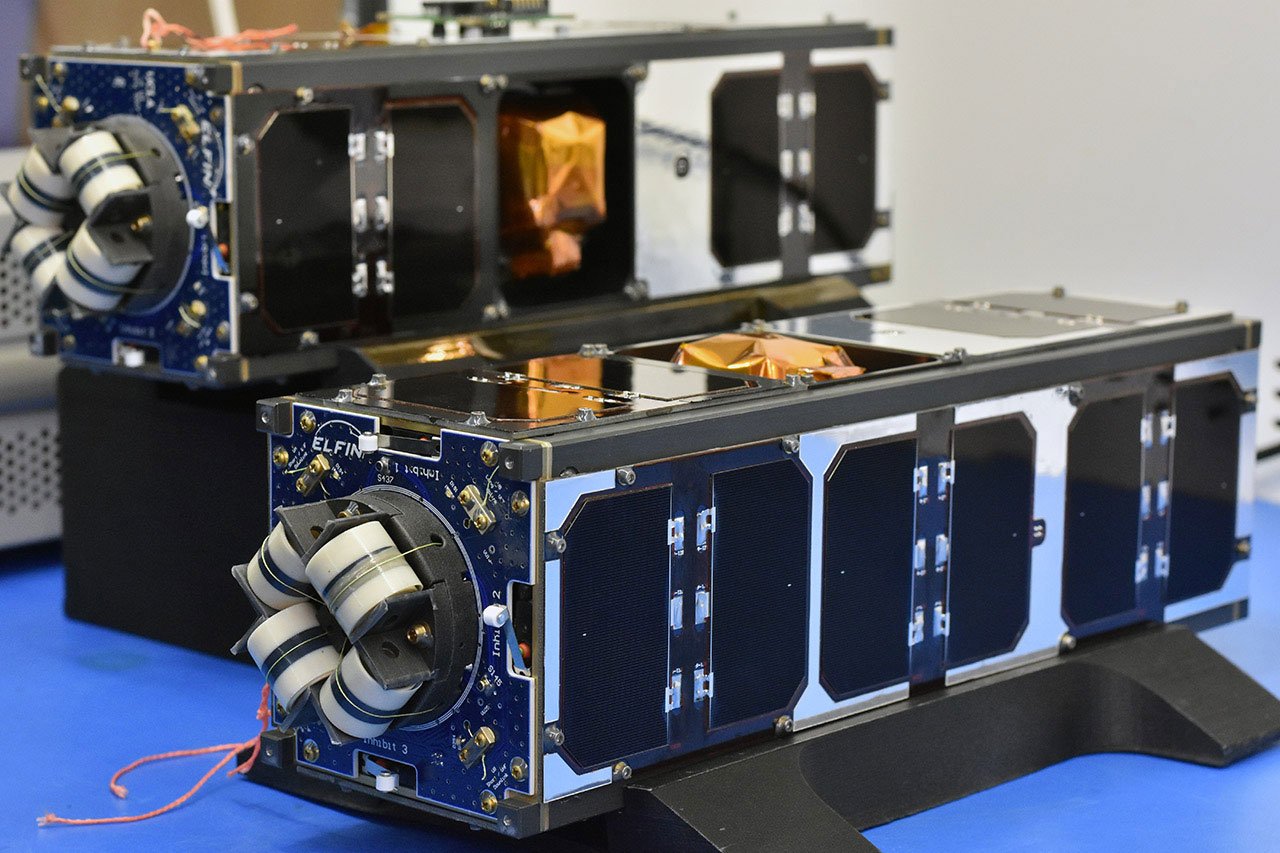
    ELFIN CubeSats
    The twin ELFIN CubeSats. Credit: UCLA EPSS

    Small satellites, including CubeSats, are playing an increasingly larger role in exploration, technology demonstration, scientific research, and educational investigations at NASA. These miniature satellites provide a low-cost platform for NASA missions, including planetary space exploration; Earth observations; fundamental Earth and space science; and developing precursor science instruments like cutting-edge laser communications, satellite-to-satellite communications, and autonomous movement capabilities.

    On launch day, ELFIN will hitch a ride as a secondary payload on a Delta II rocket with NASA’s Ice, Cloud, and land Elevation Satellite-2, or ICESat-2 mission. ICESat-2 will measure the thickness of ice sheets, glaciers, sea ice, and more to document how Earth’s cryosphere — the frozen water part of the Earth system — is changing over time.

    Never miss a breakthrough: Join the SciTechDaily newsletter.
    Follow us on Google and Google News.

    Astronomy Earth Science Van Allen Radiation Belts
    Share. Facebook Twitter Pinterest LinkedIn Email Reddit

    Related Articles

    NASA’s Van Allen Probes Begin Final Phase of Exploration

    Scientists Untangle the Volatile Processes That Shaped Earth

    NASA’s Van Allen Probes Celebrate Fifth Year in Space

    NASA’s Van Allen Probes Uncover Relativistic Electrons

    Van Allen Probes View Supercharged Radiation Belt

    Is Life on Earth Premature from a Cosmic Perspective?

    Astronomers Track the Source of Slow Solar Wind

    NASA Probes Reveal the Changing Shape of the Van Allen Belts

    NASA Probes Reveal Source of Particle Acceleration in Van Allen Radiation Belts

    Leave A Reply Cancel Reply

    • Facebook
    • Twitter
    • Pinterest
    • YouTube

    Don't Miss a Discovery

    Subscribe for the Latest in Science & Tech!

    Trending News

    Mezcal “Worm” in a Bottle Mystery: DNA Testing Reveals a Surprise

    New Research Reveals That Your Morning Coffee Activates an Ancient Longevity Switch

    This Is What Makes You Irresistible to Mosquitoes

    Shockingly Powerful Giant Octopuses Ruled the Seas 100 Million Years Ago

    Scientists Stunned by New Organic Molecules Found on Mars

    Rewriting Dinosaur Evolution: Scientists Unearth Remarkable 150-Million-Year-Old Stegosaur Skull

    Omega-3 Supplements Linked to Cognitive Decline in Surprising New Study

    First-of-Its-Kind Discovery: Homer’s Iliad Found Embedded in a 1,600-Year-Old Egyptian Mummy

    Follow SciTechDaily
    • Facebook
    • Twitter
    • YouTube
    • Pinterest
    • Newsletter
    • RSS
    SciTech News
    • Biology News
    • Chemistry News
    • Earth News
    • Health News
    • Physics News
    • Science News
    • Space News
    • Technology News
    Recent Posts
    • Male Birth Control Breakthrough: Scientists Find Way To Turn Sperm Production Off and Back On
    • A Common Vitamin Could Hold the Key to Treating Fatty Liver Disease
    • New Research Shows Vitamin B12 May Hold the Key to Healthy Aging
    • Scientists Map Thousands of Brain Connections With RNA Barcodes
    • This Gene Tweak Turns Strawberries Into Healthier, Tastier Superfruit
    Copyright © 1998 - 2026 SciTechDaily. All Rights Reserved.
    • Science News
    • About
    • Contact
    • Editorial Board
    • Privacy Policy
    • Terms of Use

    Type above and press Enter to search. Press Esc to cancel.