
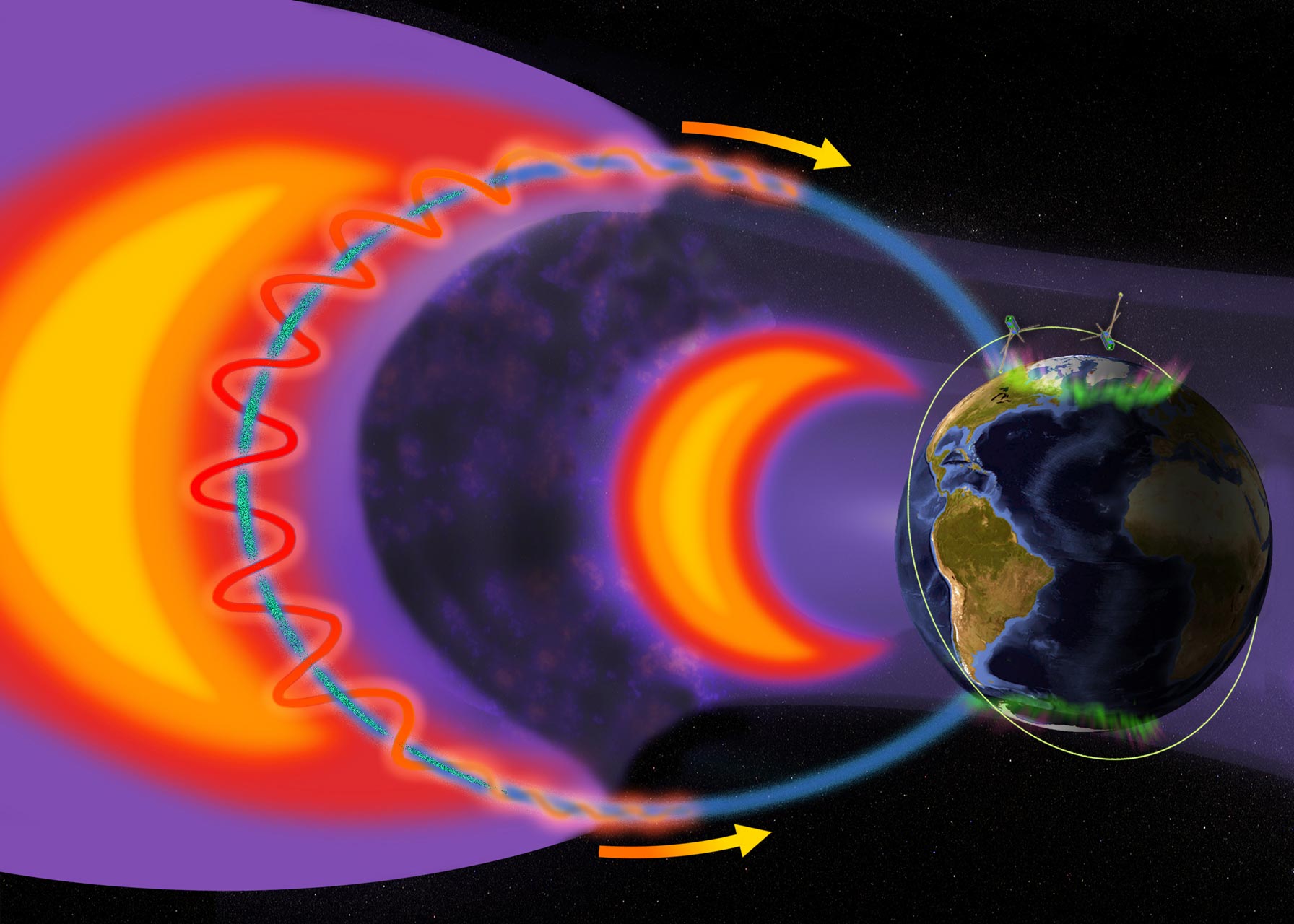
Using a NASA-funded CubeSat, scientists have uncovered a new source of super-fast, energetic electrons raining down on our planet, which can have implications for space infrastructure and atmospheric modeling.
Scientists from the University of California Los Angeles (UCLA) observed this rain, known as “electron precipitation,” from low-Earth orbit using the Electron Losses and Fields Investigation, or ELFIN, mission. ELFIN is a pair of small, cube-shaped satellites known as CubeSats. It was built and operated by UCLA undergraduate and graduate students under guidance from a small team of staff mentors.
Combining ELFIN data with more distant observations from NASA’s Time History of Events and Macroscale Interactions during Substorms, or THEMIS, spacecraft, the scientists determined that the electron rain was caused by whistler waves, a type of electromagnetic wave that ripples through plasma in space. Their results, published in Nature Communications, found more electron precipitation than leading theories had previously predicted.
“ELFIN is the first satellite to measure these super-fast electrons,” said Xiaojia Zhang, lead author on the new paper and researcher in UCLA’s Department of Earth, Planetary, and Space Sciences (EPSS). “The mission is yielding new insights due to its unique vantage point.”
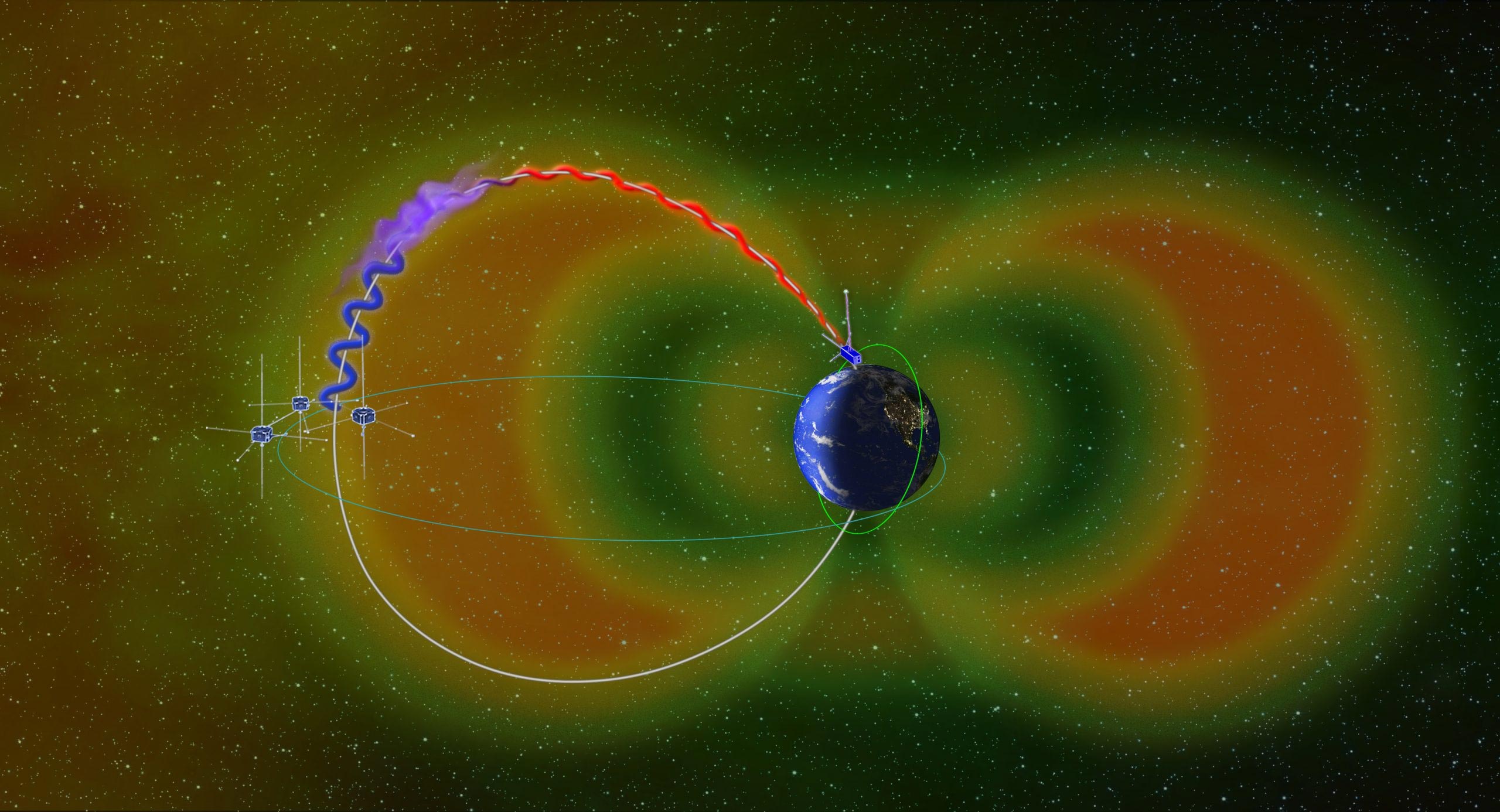
The near-Earth space environment is highly dynamic and filled with charged particles orbiting in giant rings around the planet called Van Allen radiation belts. Similar to a coiled slinky bouncing back and forth between two hands, electrons in the radiation belts travel in spirals between Earth’s North and South magnetic poles. Under certain conditions, electromagnetic vibrations called whistler waves can occur in the radiation belts, energizing and speeding up the electrons so much that they can be lost into the atmosphere, creating the electron rain.
Combining THEMIS observations of whistler waves, ELFIN’s electron data, and sophisticated computer modeling, the team saw how the whistler waves caused a rapid torrent of electrons to flow into the atmosphere, far beyond the amount expected from previous theories. Current space weather models do not account for this extra electron flow, which not only contributes to dazzling auroras, but can damage low-orbiting satellites and affect atmospheric chemistry.
ELFIN’s Contribution to Space Science
“It’s truly a rewarding feeling to have increased our knowledge of space science, using data from the hardware we built ourselves,” said Colin Wilkins, co-author, instrument lead, and space physics doctoral student in EPSS. “It takes tremendous effort and determination behind the scenes to make that happen.”
The team further showed that this type of radiation belt loss to the atmosphere can increase significantly during geomagnetic storms, which are disturbances caused by enhanced solar activity that can affect near-Earth space. Existing models do not account for this, thus underestimating the effects of electron precipitation.
Factoring in the impact of electron losses on the atmosphere is important not only for terrestrial modeling, but also for understanding Earth’s magnetic environment and predicting hazards to satellites, astronauts, and other space infrastructure. Although space is commonly thought to be separate from our upper atmosphere, the two are inextricably linked. Understanding how they’re linked can benefit satellites and astronauts passing through the region, which are increasingly important for commerce, Earth monitoring, telecommunications, and tourism.
“The ELFIN mission has given UCLA students the chance to work on an industry-caliber project right on campus, and I’m proud that we’ve been able to accomplish so much with over 300 undergraduate students without sacrificing the quality of the science,” said Ethan Tsai, co-author, project manager, and doctoral student in space physics. “Data from the ELFIN satellites are at the cutting edge of space weather studies and will be heavily used by researchers around the world over the next decade, so we’ve worked very hard to make our data open and easily accessible to the entire space science community.”
Reference: “Superfast precipitation of energetic electrons in the radiation belts of the Earth” by Xiao-Jia Zhang, Anton Artemyev, Vassilis Angelopoulos, Ethan Tsai, Colin Wilkins, Satoshi Kasahara, Didier Mourenas, Shoichiro Yokota, Kunihiro Keika, Tomoaki Hori, Yoshizumi Miyoshi, Iku Shinohara and Ayako Matsuoka, 25 March 2022, Nature Communications.
DOI: 10.1038/s41467-022-29291-8
Never miss a breakthrough: Join the SciTechDaily newsletter.
Follow us on Google and Google News.
1 Comment
Can the electron rain be captured and used as an energy source. Can the exact long range frequency be determined to cause a larger, controlled flow of the electron rain. What frequency would the collector/converted have to resonate at in order to harvest the electron rain.
These are just a few thoughts from someone who thinks out of the box and believes that there is a way to capture free electrons from the air/atmosphere; after all, I have been shocked getting out of my car with ?static electricity? It is a real current and not static when it shocks me.