
NASA’s Electrojet Explorer Mission Passes Critical Development Milestone
NASA’s EZIE mission has passed a critical review and remains on track for a launch next year. The mission aims to study auroral electrojets in Earth’s ionosphere, providing insights into the Sun-Earth connection and space weather impacts on Earth. The project will also distribute educational kits to inspire the next generation of scientists.
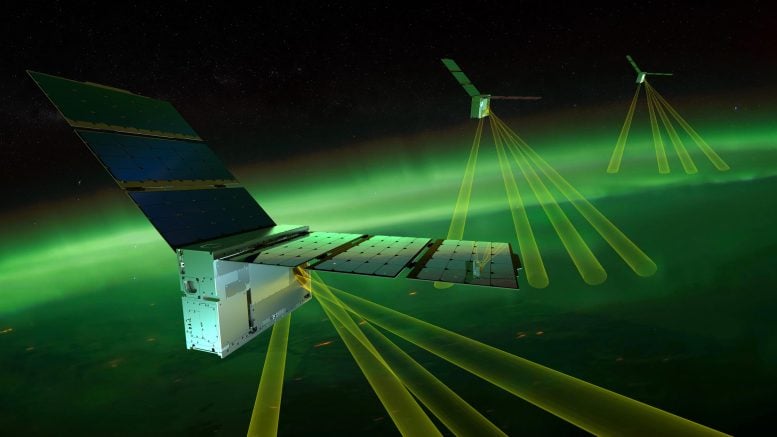
With an orbit that will take it from pole to pole, NASA’s Electrojet Zeeman Imaging Explorer (EZIE) mission will provide never-before-seen imaging of the electrical currents that link our planet and the surrounding space. But before it can do that, the EZIE team has to pass a series of reviews to demonstrate the mission is on track.
On March 23, the team successfully cleared one of those critical reviews, marking a major milestone for the project and keeping it on pace for a scheduled launch next year.
“We are excited for what we will learn from EZIE,” said Peg Luce, acting director of NASA’s Heliophysics Division at NASA Headquarters in Washington. “This mission will deepen our knowledge of the Sun-Earth connection and help us better understand the electrical currents that link beautiful aurora to Earth’s magnetosphere. This is critical because the same space weather phenomena that power the amazing aurora can cause interference with radio and communication signals and utility grids on Earth’s surface, and damage to spacecraft in orbit.”
“Congratulations to the entire EZIE team,” said Bobby Braun, head of the Space Exploration Sector at the Johns Hopkins Applied Physics Laboratory (APL) in Laurel, Maryland. “While there’s nothing easy about this mission, this talented team’s work has established a new standard for future small satellite missions and set a new bar for NASA educational and public outreach.”
The Role of CubeSats in Studying Auroral Electrojets
Led by APL, EZIE will send a trio of 6U CubeSats to study electrical currents called the auroral electrojets, which flow in Earth’s ionosphere at altitudes around 65 miles (105 kilometers). These electrical currents are part of the spectacular auroras that attract millions of tourists to the poles every year. They are just a small portion of a vast current running between Earth and its magnetosphere but can have major negative effects on society, including electrical grids and technology in space.
EZIE team members met with an independent panel of experts tasked with assessing the spacecraft’s critical design elements and the mission’s progress for NASA last month on APL’s campus. During this three-day Critical Design Review (CDR) — a review required of all NASA missions — the team presented slides on a variety of topics, including the mission’s trajectory design, mission requirements, science objectives, schedule, outreach program, costs, and risks.
“This team did a tremendous job of showing the review panel not only our mission designs and solutions to the many technical challenges of this mission but also the strong sense of camaraderie and partnership we have as a team,” said EZIE Principal Investigator Sam Yee of APL. “I’m thrilled to have completed this major step and excited to get started with the next stage of development.”
Advanced Imaging Techniques for Magnetic Fields
EZIE will remotely measure the electrojets from an orbit of roughly 200-390 miles (325-675 kilometers) above Earth’s poles for 18 months, collecting magnetic field information with an innovative imaging technique. Using drag experienced while flying through the upper atmosphere, the spacecraft will change how they’re spaced, helping scientists characterize how the electrojets evolve every 2-20 minutes.
Each spacecraft will carry an instrument built by NASA’s Jet Propulsion Laboratory (JPL) called the Microwave Electrojet Magnetogram (MEM) to capture images of both Earth’s magnetic field and the one generated by the auroral electrojets. The instrument does this by exploiting a physical phenomenon called Zeeman splitting — the separation of spectral lines of light caused by a nearby magnetic field. By capturing this information, the mission will shine new light on the vast electrical currents that connect Earth and space as well as any other magnetized planet throughout the solar system and beyond.
Building the Future of Heliophysics
“EZIE is a relatively small mission that’s already having an enormous impact, acting as a pathfinder for future heliophysics missions that are much larger,” said Nelofar Mosavi, the EZIE project manager at APL. “And of course, the data return and the impact of its outreach program will be beyond measure.”
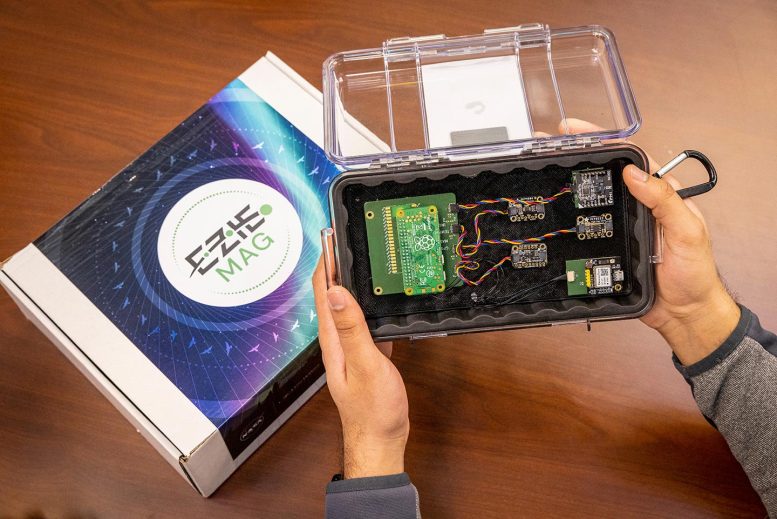
Prior to launch, the EZIE team will distribute 700 kits nicknamed EZIE-Mags to teachers and students across the United States, particularly focusing on Indigenous schools. With the kits, learners will be able to build their own miniature magnetometers to collect data from the ground that will help contextualize the data EZIE collects from space.
“I expect that our citizen scientist campaign is going to inspire, even train, the next generation of scientists,” Mosavi said.
“EZIE is truly an innovative mission and one that will shed much-needed light on a missing link between the response of Earth’s magnetosphere and the aurora,” said Jason Kalirai, APL mission area executive for Civil Space. “Huge congratulations are in order for this team, which has accomplished so much in so little time.”
With the designs complete, the team can now begin spacecraft and instrument assembly.
The financial backing for EZIE comes from the Heliophysics Division, part of NASA’s Science Mission Directorate, and is overseen by the Explorers Program Office at NASA’s Goddard Space Flight Center in Greenbelt, Maryland. The mission is directed by APL, responsible for designing, constructing, and supervising the project, while working in tandem with JPL in Southern California and Blue Canyon Technologies (BCT) in Boulder, Colorado.
Never miss a breakthrough: Join the SciTechDaily newsletter.
Follow us on Google and Google News.