

Close Menu
    Facebook X (Twitter) Instagram
    SciTechDaily
    • Biology
    • Chemistry
    • Earth
    • Health
    • Physics
    • Science
    • Space
    • Technology
    Facebook X (Twitter) Pinterest YouTube RSS
    SciTechDaily
    Home»Space»Escaping Atmospheres: Unraveling the Hydrodynamic Mysteries of Exoplanets
    Space

    Escaping Atmospheres: Unraveling the Hydrodynamic Mysteries of Exoplanets

    By Chinese Academy of SciencesMay 22, 2024No Comments4 Mins Read
    Facebook Twitter Pinterest Telegram LinkedIn WhatsApp Email Reddit
    Share
    Facebook Twitter LinkedIn Pinterest Telegram Email Reddit
    Atmospheric Escape Exoplanet Art
    Research published in Nature Astronomy advances our understanding of atmospheric escape in low-mass exoplanets by detailing hydrodynamic escape processes and introducing a new classification method based on the planet’s mass, radius, and orbital distance. This study aids in predicting the impact of such escapes on the planet’s mass, climate, and habitability. Credit: SciTechDaily.com

    New research enhances understanding of atmospheric escape in exoplanets, focusing on classification and impacts on habitability.

    A new study increases our understanding of the violent atmospheric escape processes of low-mass exoplanets, specifically a process known as hydrodynamic escape. It reveals various mechanisms driving hydrodynamic escape and proposes a new classification method for understanding these escape processes. The research was published on May 9 in Nature Astronomy and conducted by Dr. Jianheng Guo from the Yunnan Observatories of the Chinese Academy of Sciences.

    Hydrodynamic Escape in Exoplanets

    Exoplanets, i.e., planets outside our solar system, are a popular subject in astronomical research. The atmosphere of these planets can leave the planet and enter space for various reasons. One such reason is hydrodynamic escape, which refers to the upper atmosphere leaving the planet as a whole. This process is much more intense than the process of particle escape predicted in our solar system’s planets.

    Scientists theorize that hydrodynamic atmospheric escape occurred in the early stages of some of our solar system’s planets such as Venus and Earth. If Earth had lost its entire atmosphere via this process, it might have become as desolate as Mars. However, this intense escape no longer occurs on planets like Earth.

    In contrast, space and ground telescopes have observed that hydrodynamic escape still occurs on some exoplanets that are very close to their host stars. This process not only changes the planet’s mass but also affects the planet’s climate and habitability.
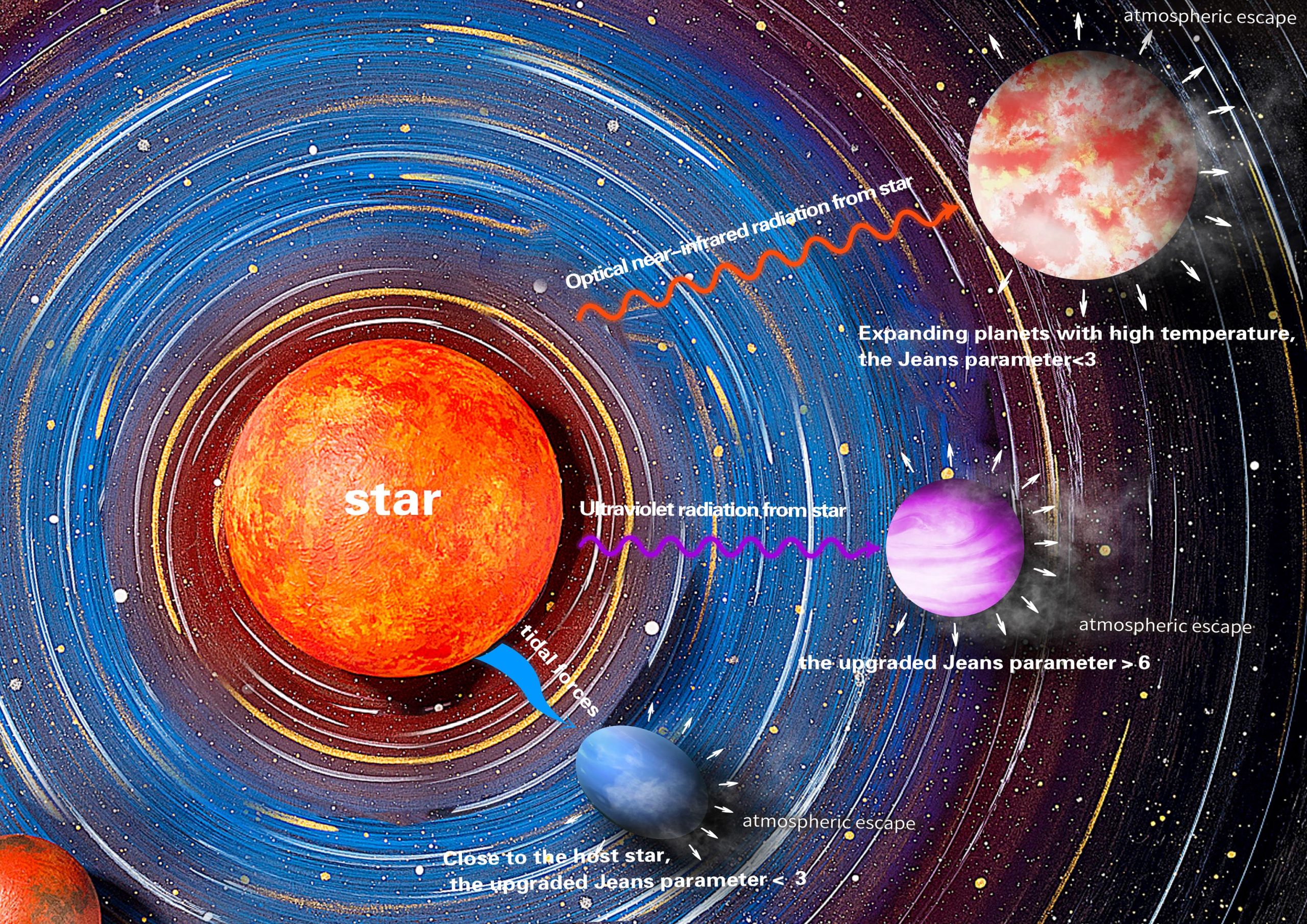
    Various Driving Mechanism Affecting the Hydrodynamic Escapes in Low-Mass Exoplanets
    Various driving mechanisms affecting the hydrodynamic escapes in low-mass exoplanets Credit: Jianheng Guo

    Mechanisms of Atmospheric Escape

    In this study, Dr. Guo found that the hydrodynamic atmospheric escape from hydrogen-rich low-mass exoplanets could be driven either solely or jointly by the planet’s internal energy, the work done by the star’s tidal forces, or heating by the star’s extreme ultraviolet radiation.

    Before this study, researchers had to rely on complex models to figure out which physical mechanism drove hydrodynamic escape on a planet, and the conclusions were often obscure. This study proposes that the basic physical parameters of the star and planet—such as mass, radius, and orbital distance—are sufficient for classifying the mechanisms of hydrodynamic escape from low-mass planets.

    New Insights Into Atmospheric Escape Dynamics

    On planets with low mass and large radius, sufficient internal energy or high temperature can drive atmospheric escape. This study shows that using the classic Jeans parameter—a ratio of the planet’s internal energy to potential energy—can determine whether the aforementioned escape occurs.

    For planets where internal energy cannot drive atmospheric escape, Dr. Guo defined an upgraded Jeans parameter by introducing tidal forces from stars. With the upgraded Jeans parameter, the roles of the star’s tidal forces and extreme ultraviolet radiation in driving atmospheric escape can be easily and accurately distinguished.

    Conclusion and Implications

    In addition, this study reveals that planets with high gravitational potential and low stellar radiation are more likely to experience a slow hydrodynamic atmospheric escape; otherwise, the planet will primarily undergo rapid hydrodynamic escape.

    This study helps scientists understand how a planet’s atmosphere evolves over time, which is important for exploring the evolution and origin of low-mass planets. In this way, we can better understand the habitability and evolutionary histories of these distant worlds.

    Reference: “Characterization of the regimes of hydrodynamic escape from low-mass exoplanets” by J. H. Guo, 9 May 2024, Nature Astronomy.
    DOI: 10.1038/s41550-024-02269-w

    Never miss a breakthrough: Join the SciTechDaily newsletter.
    Follow us on Google and Google News.

    Astronomy Astrophysics Chinese Academy of Sciences Exoplanet
    Share. Facebook Twitter Pinterest LinkedIn Email Reddit

    Related Articles

    Four New Exoplanets Orbiting a Nearby Sun-Like Star Discovered by TESS

    Four Exoplanets – Including a Super-Earth Planet – Discovered by High School Students

    Astronomers Uncover New Details About the Remarkable Seven Rocky Planets of TRAPPIST-1

    Unique Planetary System With Rhythmic Orbital Resonance Revealed by Exoplanet Watcher Cheops

    The 7 Rocky Earth-Size TRAPPIST-1 Planets Have Remarkably Similar Densities

    Puzzling Six-Exoplanet System Discovered With Resonant Rhythmic Movement

    Astronomers Discover First Cloudless, Jupiter-Like Planet – “Smoking Gun Evidence”

    A ‘Super-Puff’ Planet Like No Other – As Big as Jupiter but 10 Times Lighter

    Chinese Astronomers Discover 591 High Velocity Stars – 43 of Them Can Even Escape From the Galaxy

    Leave A Reply Cancel Reply

    • Facebook
    • Twitter
    • Pinterest
    • YouTube

    Don't Miss a Discovery

    Subscribe for the Latest in Science & Tech!

    Trending News

    Scientists May Have Found the Key to Jupiter and Saturn’s Moon Mystery

    Scientists Uncover Brain Changes That Link Pain to Depression

    Saunas May Do More Than Raise Body Temperature – They Activate Your Immune System

    Exercise in a Pill? Metformin Shows Surprising Effects in Cancer Patients

    Hidden Oceans of Magma Could Be Protecting Alien Life

    New Study Challenges Alzheimer’s Theories: It’s Not Just About Plaques

    Artificial Sweeteners May Harm Future Generations, Study Suggests

    Splashdown! NASA Artemis II Returns From Record-Breaking Moon Mission

    Follow SciTechDaily
    • Facebook
    • Twitter
    • YouTube
    • Pinterest
    • Newsletter
    • RSS
    SciTech News
    • Biology News
    • Chemistry News
    • Earth News
    • Health News
    • Physics News
    • Science News
    • Space News
    • Technology News
    Recent Posts
    • Ancient DNA Reveals Irish Goats Have a 3,000-Year-Old Lineage Still Alive Today
    • Historians Reveal Secrets of the Strange Hat Wars That Shook Early Modern England
    • “A Plague Is Upon Us”: The Mass Death That Changed an Ancient City Forever
    • This Strange Material Can Turn Superconductivity on and off Like a Switch
    • Scientists Discover Game-Changing New Way To Treat High Cholesterol
    Copyright © 1998 - 2026 SciTechDaily. All Rights Reserved.
    • Science News
    • About
    • Contact
    • Editorial Board
    • Privacy Policy
    • Terms of Use

    Type above and press Enter to search. Press Esc to cancel.