
First noticed in 1885, noctilucent clouds have left researchers with many unanswered questions and now that scientists working on NASA’s AIM mission have detected bits of ‘meteor smoke’ embedded in noctilucent clouds, which support the theory that meteor dust is the nucleating agent around which NLCs form, some of those questions may be answered.
A new ScienceCast video explains how “meteor smoke” seeds noctilucent clouds. Credit: Science@NASA
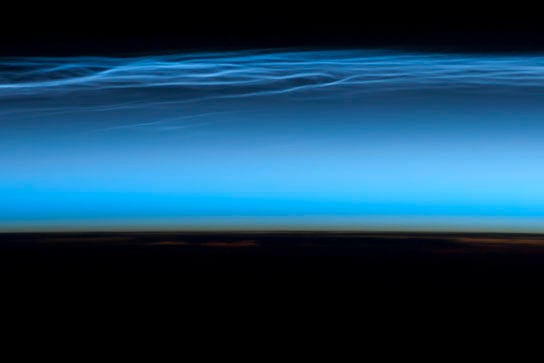
Anyone who’s ever seen a noctilucent cloud or “NLC” would agree: They look alien. The electric-blue ripples and pale tendrils of NLCs reaching across the night sky resemble something from another world.
Researchers say that’s not far off. A key ingredient for the mysterious clouds comes from outer space.
“We’ve detected bits of ‘meteor smoke’ embedded in noctilucent clouds,” reports James Russell of Hampton University, principal investigator of NASA’s AIM mission to study the phenomenon. “This discovery supports the theory that meteor dust is the nucleating agent around which NLCs form.”
Noctilucent clouds are a mystery dating back to the late 19th century. Northern sky watchers first noticed them in 1885 about two years after the eruption of Krakatoa. Ash from the Indonesian volcano caused such splendid sunsets that evening sky-watching became a worldwide pastime. One observer in particular, a German named T.W. Backhouse who is often credited with the discovery of NLCs, noticed something odd. He stayed outside longer than most people, long enough for the twilight to fully darken, and on some nights he saw wispy filaments glowing electric blue against the black sky. Scientists of the day figured they were some manifestation of volcanic dust.
Eventually, Krakatoa’s ash settled and the sunsets faded, but strangely the noctilucent clouds didn’t go away. They’re still present today, stronger than ever. Researchers aren’t sure what role Krakatoa’s ash played in those early sightings. One thing is clear, however: The dust behind the clouds we see now is space dust.
Mark Hervig of the company GATS, Inc, led the team that found the extraterrestrial connection.
“Using AIM’s Solar Occultation for Ice Experiment (SOFIE), we found that about 3% of each ice crystal in a noctilucent cloud is meteoritic,” says Hervig.
The inner solar system is littered with meteoroids of all shapes and sizes–from asteroid-sized chunks of rock to microscopic specks of dust. Every day Earth scoops up tons of the material, mostly the small stuff. When meteoroids hit our atmosphere and burn up, they leave behind a haze of tiny particles suspended 70 km to 100 km (43 mi to 62 mi) above Earth’s surface.
It’s no coincidence that NLCs form 83 km (52 mi) high, squarely inside the meteor smoke zone.
Specks of meteor smoke act as gathering points where water molecules can assemble themselves into ice crystals. The process is called “nucleation.”
Nucleation happens all the time in the lower atmosphere. In ordinary clouds, airborne specks of dust and even living microbes can serve as nucleation sites. Tiny ice crystals, drops of water, and snowflakes grow around these particles, falling to Earth if and when they become heavy enough.
Nucleating agents are especially important in the ethereal realm of NLCs. The clouds form at the edge of space where the air pressure is little more than vacuum. The odds of two water molecules meeting is slim, and of sticking together slimmer still.
Meteor smoke helps beat the odds. According to AIM data, ice crystals can grow around meteoritic dust to sizes ranging from 20 to 70 nanometers. For comparison, cirrus clouds in the lower atmosphere where water is abundant contain crystals 10 to 100 times larger.
The small size of the ice crystals explains the clouds’ blue color. Small particles tend to scatter short wavelengths of light (blue) more strongly than long wavelengths (red). So when a beam of sunlight hits an NLC, blue is the color that gets scattered down to Earth.
Meteor smoke explains much about NLCs, but a key mystery remains: Why are the clouds brightening and spreading?
In the 19th century, NLCs were confined to high latitudes—places like Canada and Scandinavia. In recent times, however, they have been spotted as far south as Colorado, Utah, and Nebraska. The reason, Russell believes, is climate change. One of the greenhouse gases that has become more abundant in Earth’s atmosphere since the 19th century is methane. It comes from landfills, natural gas, and petroleum systems, agricultural activities, and coal mining.
It turns out that methane boosts NLCs.
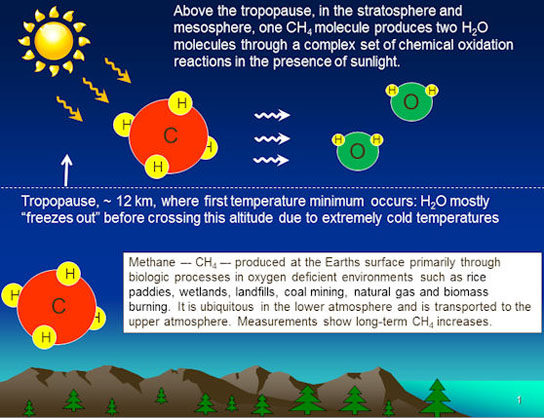
Russell explains: “When methane makes its way into the upper atmosphere, it is oxidized by a complex series of reactions to form water vapor. This extra water vapor is then available to grow ice crystals for NLCs.”
If this idea is correct, noctilucent clouds are a sort of “canary in a coal mine” for one of the most important greenhouse gases.
And that, says Russell, is a great reason to study them. “Noctilucent clouds might look alien, but they’re telling us something very important about our own planet.”
Never miss a breakthrough: Join the SciTechDaily newsletter.
Follow us on Google and Google News.