
Close Menu
    Facebook X (Twitter) Instagram
    SciTechDaily
    • Biology
    • Chemistry
    • Earth
    • Health
    • Physics
    • Science
    • Space
    • Technology
    Facebook X (Twitter) Pinterest YouTube RSS
    SciTechDaily
    Home»Space»NASA TV Will Broadcast Perseid Meteor Shower Program
    Space

    NASA TV Will Broadcast Perseid Meteor Shower Program

    By Dwayne Brown / Laurie Cantillo, NASAAugust 11, 2015No Comments3 Mins Read
    Facebook Twitter Pinterest Telegram LinkedIn WhatsApp Email Reddit
    Share
    Facebook Twitter LinkedIn Pinterest Telegram Email Reddit
    NASA to Host Perseid Meteor Shower Program
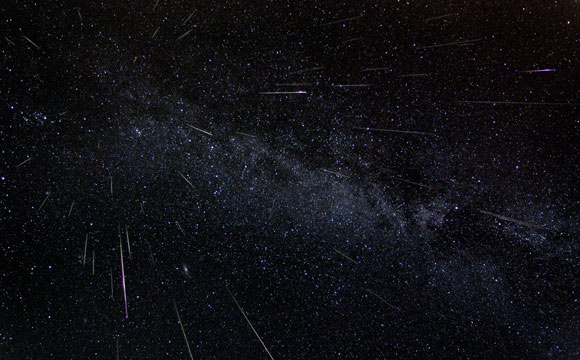
    Astronomer Fred Bruenjes recorded a series of many 30-second long exposures spanning about six hours on the night of August 11 and early morning of August 12, 2004 using a wide-angle lens. Combining those frames which captured meteor flashes, he produced this dramatic view of the Perseids of summer. There are 51 Perseid meteors in the composite image, including one seen nearly head-on. Credit: Fred Bruenjes

    NASA TV will host a program for this week’s Perseid meteor shower, which is expected to be one of the best in years.

    NASA’s Marshall Space Flight Center in Huntsville, Alabama, will broadcast a live program about this year’s Perseid meteor shower from 10 p.m. EDT Wednesday, August 12 to 2 a.m. Thursday, August 13. The event will highlight the science behind the Perseids, as well as NASA research related to meteors and comets. The program will air on NASA TV and NASA’s UStream channel.

    The Perseids have been observed for at least 2,000 years and are associated with the comet Swift-Tuttle, which orbits the sun once every 133 years. Every August, the Earth passes through a cloud of the comet’s orbital debris. This debris field — mostly created hundreds of years ago — consists of bits of ice and dust shed from the comet which burn up in Earth’s atmosphere to create one of the premier meteor showers of the year.

    The best opportunity to see the Perseid meteor shower is during the dark, pre-dawn hours of August 13. The Perseids streak across the sky from many directions, with theoretical rates as high as 100 per hour. The last time the Perseids peak coincided with a new moon was in 2007, making this one of the best potential viewings in years.


    This week, Earth passes through a stream of debris from Comet Swift-Tuttle, source of the annual Perseid meteor shower. Forecasters say the show could be especially good this year because the Moon is nearly new when the shower peaks on August 12-13.

    Special guests on the live NASA TV broadcast include meteor experts Bill Cooke, Danielle Moser, and Rhiannon Blaauw, all of NASA’s Meteoroid Environment Office, located at Marshall. They will provide on-air commentary, as well as answer questions online. Also scheduled to join the broadcast are experts from NASA’s Johnson Space Center in Houston, NASA’s Goddard Space Flight Center in Greenbelt, Maryland, NASA’s Ames Research Center in Moffett Field, California, the American Meteor Society, and others.

    Anyone can join in the conversation by tweeting questions to @NASA_Marshall with the hashtag #askNASA. Social media users may also post questions to Marshall’s Facebook page by replying to the August 12 Perseid Q-and-A post.

    Never miss a breakthrough: Join the SciTechDaily newsletter.
    Follow us on Google and Google News.

    Astronomy Meteorites Meteorology NASA NASA Marshall Space Flight Center Perseid Meteor Shower Popular
    Share. Facebook Twitter Pinterest LinkedIn Email Reddit

    Related Articles

    Don’t Miss: Best Meteor Shower of the Year Peaks This Weekend

    Astrophysicists Solve 40-Year-Old Black Hole Jet Mystery With NASA’s IXPE

    Surprising Results From NASA’s IXPE Help Unlock the Secrets of Famous Exploded Star

    Perseids Meteor Shower on the Way – But There’s a Big Problem

    NASA IXPE Observatory’s First Stunning Image: The Glowing Remains of an Exploded Star

    We Asked a NASA Expert: When Was the Last Time an Asteroid Hit Earth? [Video]

    Don’t Miss “Prime Time” for the Perseid Meteor Shower

    Vesta Meteorites Discovered on Asteroid Bennu by NASA’s OSIRIS-REx Spacecraft

    Treasure Trove of Cosmic Delights Revealed by NASA’s Chandra X-ray Observatory

    Leave A Reply Cancel Reply

    • Facebook
    • Twitter
    • Pinterest
    • YouTube

    Don't Miss a Discovery

    Subscribe for the Latest in Science & Tech!

    Trending News

    New “Nanozyme Hypothesis” Could Rewrite the Story of Life’s Origins

    Anatomy Isn’t Finished: The Human Body Still Holds Secrets

    “Pretty Close to Home”: The Hidden Earthquake Threat Beneath Seattle

    The Surprising Reason You Might Want To Sleep Without a Pillow

    Scientists Say This Natural Hormone Reverses Obesity by Targeting the Brain

    35-Million-Year-Old Mystery: Strange Arachnid Discovered Preserved in Amber

    Is AI Really Just a Tool? It Could Be Altering How You See Reality

    JWST Reveals a “Forbidden” Planet With a Baffling Composition

    Follow SciTechDaily
    • Facebook
    • Twitter
    • YouTube
    • Pinterest
    • Newsletter
    • RSS
    SciTech News
    • Biology News
    • Chemistry News
    • Earth News
    • Health News
    • Physics News
    • Science News
    • Space News
    • Technology News
    Recent Posts
    • Scientists Capture Hidden Electron Patterns Inside Quantum Materials
    • New Study Challenges Alzheimer’s Theories: It’s Not Just About Plaques
    • Scientists Discover Way To Treat Lung Cancer and Its Deadly Side Effect Together
    • Artificial Sweeteners May Harm Future Generations, Study Suggests
    • The Ocean Current Stronger Than All Rivers Changed Earth Forever
    Copyright © 1998 - 2026 SciTechDaily. All Rights Reserved.
    • Science News
    • About
    • Contact
    • Editorial Board
    • Privacy Policy
    • Terms of Use

    Type above and press Enter to search. Press Esc to cancel.