
Close Menu
    Facebook X (Twitter) Instagram
    SciTechDaily
    • Biology
    • Chemistry
    • Earth
    • Health
    • Physics
    • Science
    • Space
    • Technology
    Facebook X (Twitter) Pinterest YouTube RSS
    SciTechDaily
    Home»Space»Hubble Captures Magnificent Grand Spiral Galaxy Face-On
    Space

    Hubble Captures Magnificent Grand Spiral Galaxy Face-On

    By NASA's Goddard Space Flight CenterMay 30, 20226 Comments2 Mins Read
    Facebook Twitter Pinterest Telegram LinkedIn WhatsApp Email Reddit
    Share
    Facebook Twitter LinkedIn Pinterest Telegram Email Reddit
    NGC 3631
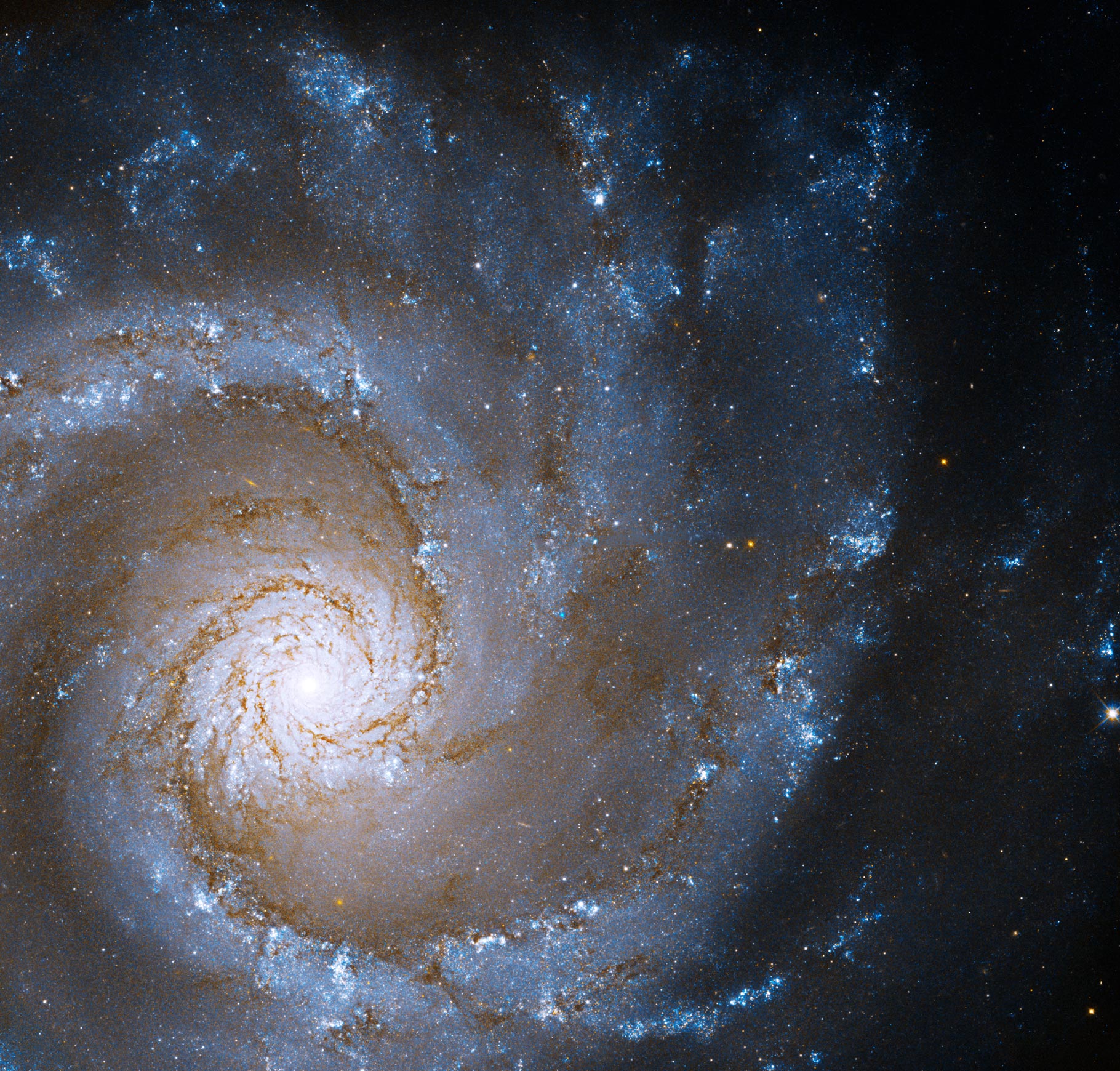
    Hubble Space Telescope image of NGC 3631, the Grand Design Spiral, located about 53 million light-years away in the direction of the constellation Ursa Major. Credit: NASA, ESA, A. Filippenko (University of California – Berkeley), and D. Sand (University of Arizona); Image Processing: G. Kober (NASA Goddard/Catholic University of America)

    This image from NASA’s Hubble Space Telescope features the Grand Design Spiral, NGC 3631, located approximately 53 million light-years away in the direction of the constellation Ursa Major. The “arms” of grand design spirals appear to wind around and into the galaxy’s nucleus.

    In contrast to multi-arm and flocculent spirals, which have softer structural elements, a grand design spiral galaxy has obvious and well-defined spiral arms. A grand design galaxy’s spiral arms stretch clearly across the galaxy through many radians and may be seen over a considerable proportion of the galaxy’s radius.

    Close inspection of NGC 3631’s grand spiral arms reveals dark dust lanes and bright star-forming regions along the inner part of the spiral arms. Star formation in spirals is similar to a traffic jam on the interstate. Like cars on the highway, slower-moving matter in the spiral’s disk creates a bottleneck, concentrating star-forming gas and dust along the inner part of their spiral arms. This traffic jam of matter can get so dense that it gravitationally collapses, creating new stars (seen here seen in bright blue-white).

    The image uses data collected from Hubble’s Wide Field Camera 3 (WFC3) and Advanced Camera for Surveys (ACS). The color blue represents visible wavelengths of blue light, and the color orange represents infrared light.

    Never miss a breakthrough: Join the SciTechDaily newsletter.
    Follow us on Google and Google News.

    Astronomy Hubble Space Telescope NASA Popular
    Share. Facebook Twitter Pinterest LinkedIn Email Reddit

    Related Articles

    The Great Escape: NASA’s Hubble and MAVEN Help Solve Mystery of Mars’ Vanishing Water

    Webb and Hubble Unite: A Breathtaking 3D Journey Through the Pillars of Creation

    Stellar Sleuths: Citizen Scientists and AI Uncover Hidden Asteroids With Hubble

    Stellar Fireworks: Hubble Revisits a Strange Star’s 40-Year Nova Mystery

    Cosmic Geode: Hubble Captures the Birth of a Sun-like Star

    Hubble Celebrates 34th Anniversary With a Spectacular View of the Little Dumbbell Nebula

    Jupiter Unveiled: Hubble Captures the Giant’s Roaring Storms and Volcanic Moon Io

    Galaxies Collide, Stars Awaken: Hubble’s Stunning Revelation

    Hubble Spots Water Vapor in Small Exoplanet’s Atmosphere

    6 Comments

    1. Sekar on May 30, 2022 10:57 pm

      Interesting.

      1.We must have a whole lot of images captured over the years by Hubble Telescope and others across a range of known spectrum over time.
      2. Can we translate and enable the description of images in Mathematical terms with multiple co-ordinates and defined shapes of things we have observed in Nature? This can become the base database.
      3. Then, can we use Pattern Recognition Software to see what are the mathematical equivalents we are observing in the images captured using Hubble and other telescopes as we keep refining Telescope Technology to make it peer further out and obtain clearer images.?
      4. What I am recommending is the Rosetta Stone of Images to be built?

      Views expressed are personal and not binding on anyone.

      Reply
      • davea0511 on May 31, 2022 10:05 am

        Databases have to be huge … like on the order of many thousands, for that kind of numerical analyses to identify new underlying features of the dataset that are otherwise hidden. I suspect in another 20 years or so the size of the dataset of known galaxies with clearly defined digitized features will be large enough where that kind of analysis would be useful. I think at the present moment however we’re just depending on the combined brainpower of astronomers the world around to ascertain those features, which is probably the best approach at the moment. No doubt, as the dataset increases to do that numerical analysis, so will computing power and AI development.

        Reply
    2. Stephen Grossman on May 31, 2022 7:13 am

      2000 light-years from home.
      -Rolling Stones

      Reply
    3. Snowball Solar System on May 31, 2022 6:53 pm

      Some day Andromeda Galaxy will fill the night sky from horizon to horizon in the greatest show on Earth.

      Reply
    4. Crystalsoul on June 2, 2022 9:20 pm

      fibonacci sequence or spiral ,
      Beautiful…

      Reply
    5. J R in WV on June 4, 2022 8:19 am

      I am continuously amazed at the beauty of the natural world.

      From the math of flower blooms and complex mineral crystals at arm’s length right here at home to Jupiter and the local galaxy’s many complex features to the millions of galaxies across the known universe, beauty is everywhere around us, no matter how far or how closely we look! Amazed!

      Reply
    Leave A Reply Cancel Reply

    • Facebook
    • Twitter
    • Pinterest
    • YouTube

    Don't Miss a Discovery

    Subscribe for the Latest in Science & Tech!

    Trending News

    Scientists Discover How Coffee Impacts Memory, Mood, and Gut Health

    Why Did the Neanderthals Disappear? Scientists Reveal Humans Had a Hidden Advantage

    Physicists Propose Strange Experiment Where Time Goes Quantum

    Magnesium Magic: New Drug Melts Fat Even on a High-Fat, High-Sugar Diet

    Weight-Loss Drugs Like Ozempic May Come With an Unexpected Cost

    Mezcal “Worm” in a Bottle Mystery: DNA Testing Reveals a Surprise

    New Research Reveals That Your Morning Coffee Activates an Ancient Longevity Switch

    This Is What Makes You Irresistible to Mosquitoes

    Follow SciTechDaily
    • Facebook
    • Twitter
    • YouTube
    • Pinterest
    • Newsletter
    • RSS
    SciTech News
    • Biology News
    • Chemistry News
    • Earth News
    • Health News
    • Physics News
    • Science News
    • Space News
    • Technology News
    Recent Posts
    • Scientists Just Captured Killer T Cells in Action Inside Tumors
    • Alaska’s Sky Explodes With Swirling Clouds and a Hidden Polar Storm
    • Warming Oceans Could Trigger a Dangerous Methane Surge
    • Harvard Scientists Reveal Secret Structure Behind How You Smell
    • Scientists Just Discovered the Hidden Trick That Keeps Your Cells Alive
    Copyright © 1998 - 2026 SciTechDaily. All Rights Reserved.
    • Science News
    • About
    • Contact
    • Editorial Board
    • Privacy Policy
    • Terms of Use

    Type above and press Enter to search. Press Esc to cancel.