
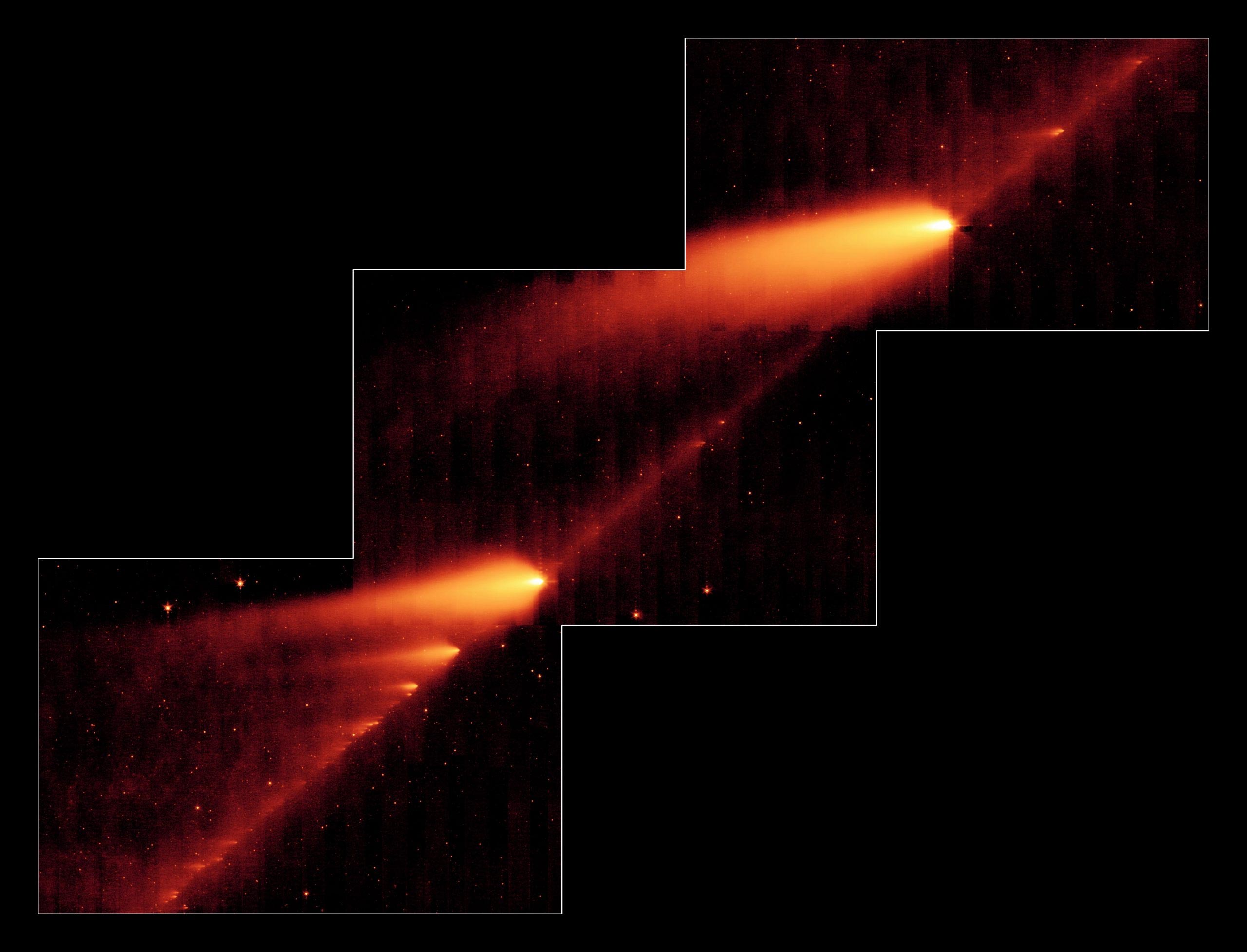
If skies are clear, be sure to watch for a potential tau Herculid meteor outburst early Tuesday morning.
With a little cosmic luck, we could potentially be in for a meteor storm of epic proportions tonight/tomorrow morning. As already reported, astronomers are excited about the possibility of a spectacular new meteor shower on May 30-31. Whether it is spectacular or nothing comes down to the timing of Earth’s crossing of the cometary orbits. With the event just around the corner, let’s look at the prospective for the shower, what went down during meteor storms of yore, and more.
tau Herculids: The Story Thus Far
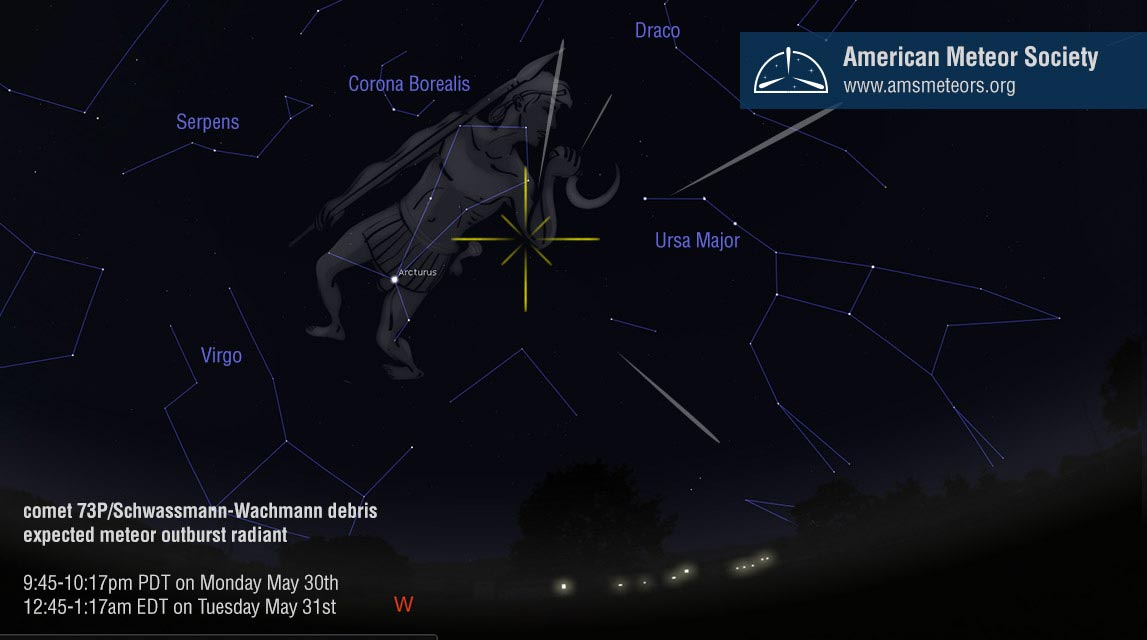
The source of the shower is short period Comet 73P/Schwassmann-Wachmann 3. Despite the name, the radiant for the tau Herculids has actually now drifted from Hercules into the adjacent constellation of Boötes the Herdsman. Unfortunately, renaming the shower the ‘Boötids’ is also problematic, as there’s also already a June meteor shower of the same name. Today, the radiant for the shower sits about 8 degrees from the bright star Arcturus, in the direction of the globular cluster Messier 3 and Alkaid (Eta Ursae Majoris) located at the tip of the handle of the Big Dipper asterism.
What’s really getting meteor shower scientists excited is Earth’s 2022 encounter with the comet’s 1995 fragmentation stream. This event saw the comet dramatically increase 400-fold in brightness. Now, the comet is nowhere near the Earth at this time—it’s actually 1.4 Astronomical Units (AU) distant, in fact—but the 1995 event should have laid down a decent particle stream for our fair planet to encounter.
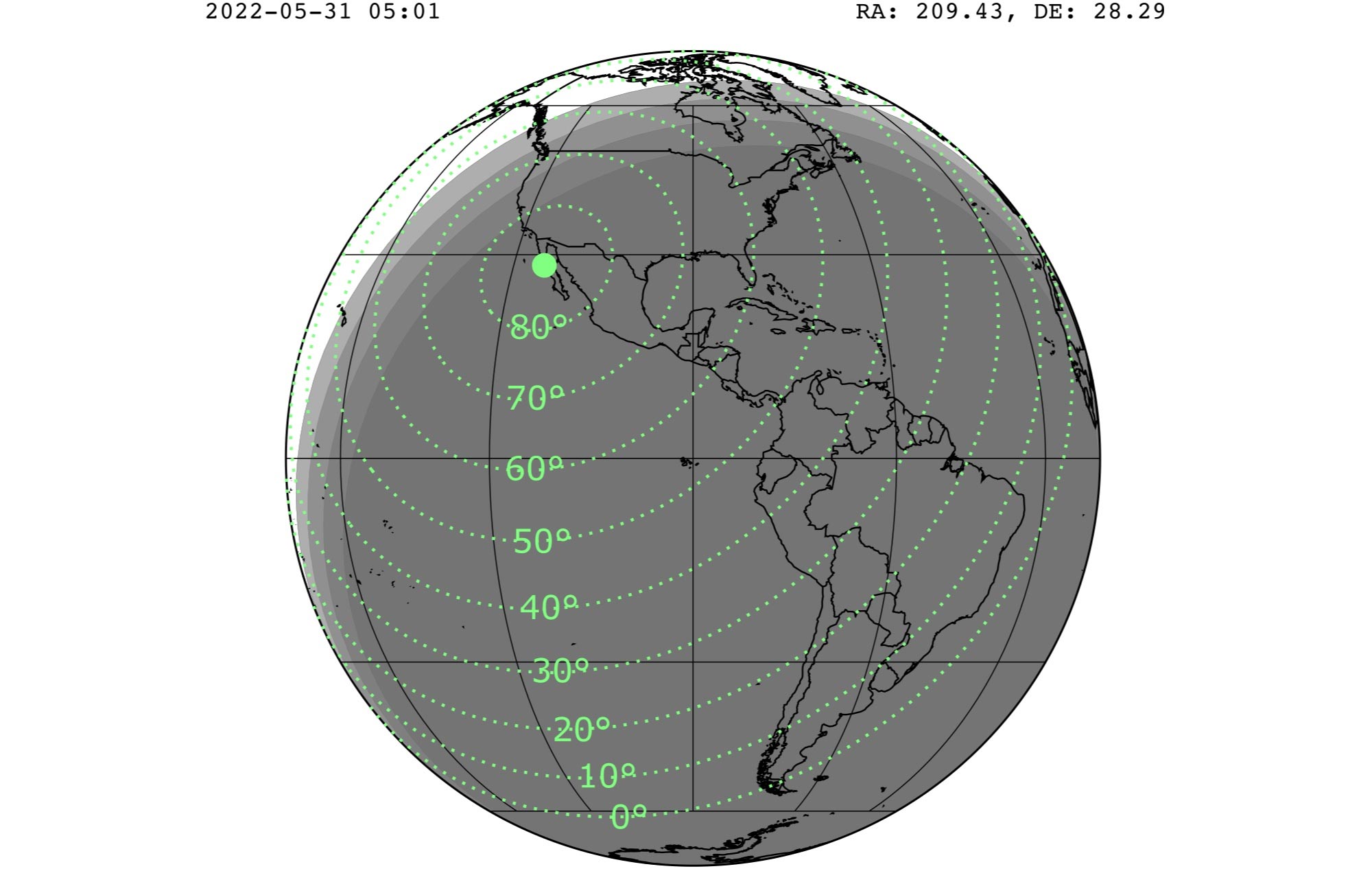
As of writing this, the American Meteor Society (AMS) has refined the key encounter time to 4:45-5:17 Universal Time (UT) / 12:45-1:17 AM U.S. Eastern Time EDT on the morning of Tuesday, May 31st or 9:45-10:17 PM Pacific Time PDT on the evening of Monday, May 30th. The radiant will be right at the zenith for Baja California around this time, though most of North and South America will be well-placed to witness any uptick in meteor activity. The Moon also reaches New the day prior on May 30th… another plus.
If we get a 10-fold increase from the tau Herculids we might see a Zenithal Hourly Rate (ZHR) of ~140 meteors per hour—similar to the annual Geminids or Perseids. If we reach a 100-fold or higher increase… well, things could get interesting.

First though, a few caveats are in order. It’s unknown just how much and in what direction Comet 73P ejected debris during the 1995 event: this could add to a more intense (or weaker) storm than expected. Also, the tau Herculid stream is approaching the Earth from behind, making them a slower shower needing bigger particles than usual to light up the sky. Finally, remember that ZHR numbers are an ideal rate, assuming dark skies with the radiant directly overhead… most observers will see less in reality.
Anatomy of a Meteor Storm
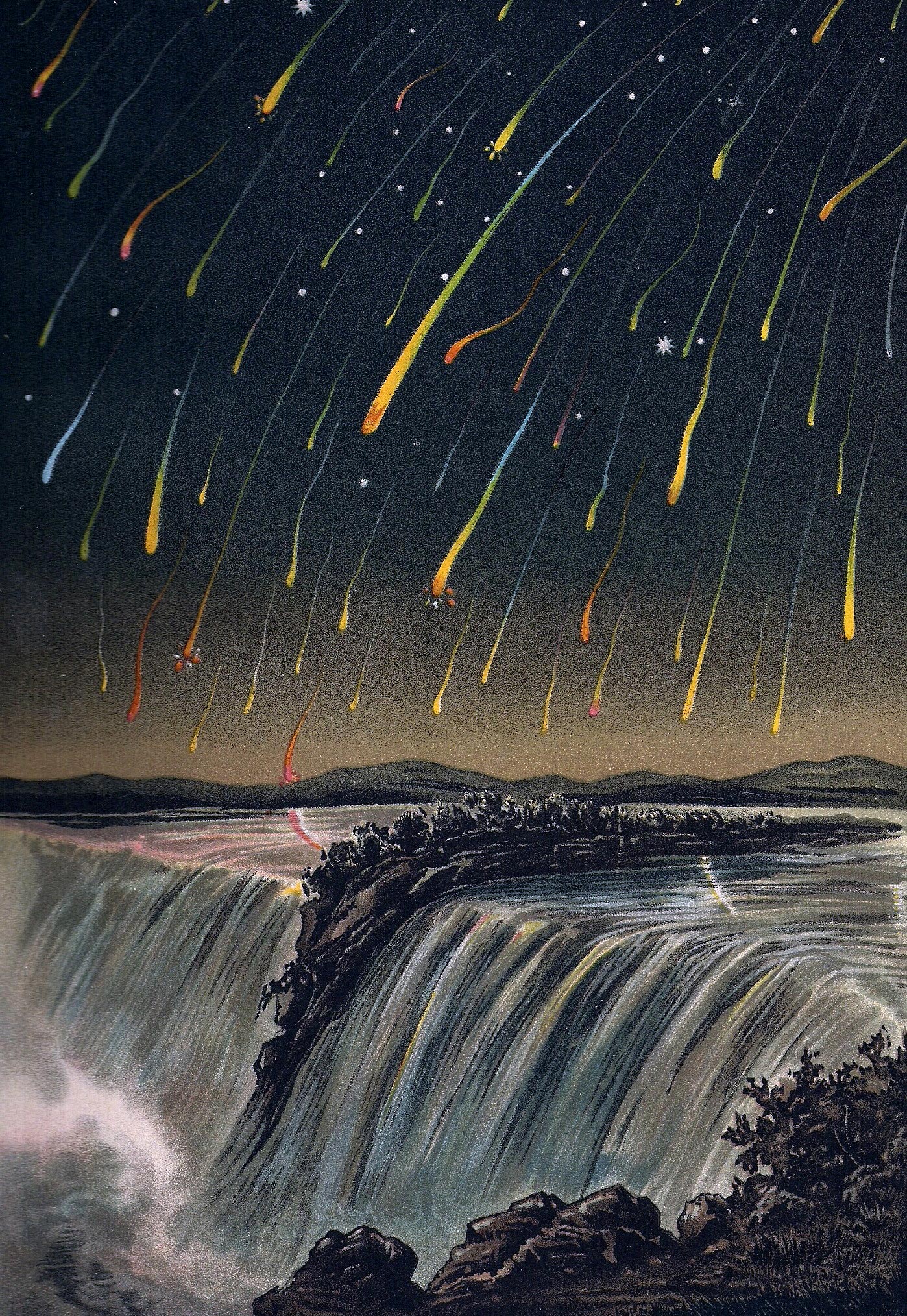
Usually, a ZHR of 1,000 or greater is considered the informal cutoff for a meteor storm, versus a paltry meteor shower. Typically during the annual Geminids or Perseids, you’ll see a meteor or two once every minute or so; at a rate of over a thousand per hour, you’re seeing a meteor every few seconds, including bright fireballs. I remember watching the 1998 Leonids reach storm levels just before sunrise, with so many bolides lighting up the Kuwaiti desert that you knew there were meteors you were missing right behind you. Observers who witnessed the 1966 Leonids which topped out at an amazing 80,000 (!) meteors per hour noted how the stream emanating from the radiant gave the viewer an actual sense of our planet’s motion through space, a very ‘Star Trek’ warp speed-like effect.
In recent years, we saw the 2012 Giacobinids (Draconids) flirt with storm levels, with a ZHR of over ~900 per hour. The anatomy of the 2022 tau Herculids bears some resemblance to another great storm of the past: the now defunct Andromedids. The source of this shower is the now defunct ‘lost comet’ 3D/Biela thought to have fragmented and produced some of the great meteor storms of the late 19th century.
Observing a Meteor Storm
The good news is, you don’t need any special equipment to watch a meteor storm: just clear skies and patience. Our typical strategy is to watch for about ten minutes: if I see meteors, I keep watching. European and U.K. observers might also want to start watching a few hours early. Meteor storms do not read predictions, and could always kick off a bit earlier than expected.
You can even hear meteors ping over a radio tuned to a vacant frequency on the FM dial. Be sure to dress warm (even in May), bring a lawn chair, bug spray, and find as dark an observing site as possible… also, bring a friend or two along to watch different patches of sky and increase the chances of catching meteors as they flit by. Bright fireballs have even been known to ‘hiss’ via a strange phenomenon known as electrophonic sound.
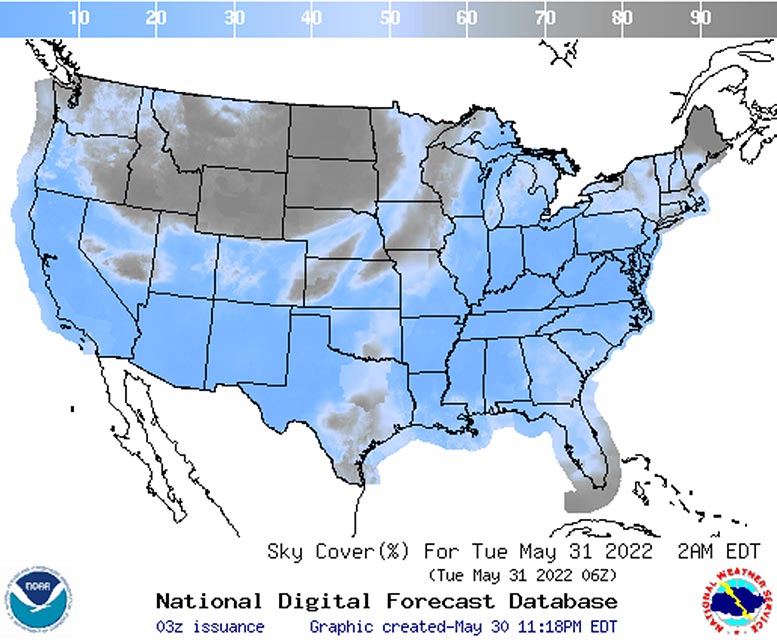
As of writing this, cloud cover prospects for the contiguous United States look to be mostly favorable. It might be worth checking out the action on NASA’s all-sky meteor camera network if you’re clouded out.
Imaging a meteor storm is as simple as setting up a tripod-mounted DSLR camera with a wide-field lens, setting the focus and priority to Manual/Bulb settings, then taking a few quick test shots to get the ISO/exposure/f-stop settings right for the sky conditions and seeing what turns up. I like to use an intervalometer to automate the process, and simply set it up to take successive series of shots, allowing me to sit back and watch the shower visually.
Also, be sure to count meteors and report what you see to the International Meteor Organization (IMO). This data will go a long way towards meteor science and modeling meteor streams and showers in the future.
Finally, be patient on your meteor vigil. You might see nothing at all… or witness the spectacle of a lifetime. Clear skies, and good luck!
Adapted from an article originally published on Universe Today.
Never miss a breakthrough: Join the SciTechDaily newsletter.
Follow us on Google and Google News.
1 Comment
It was a dud. Outside all night and seen zero!