
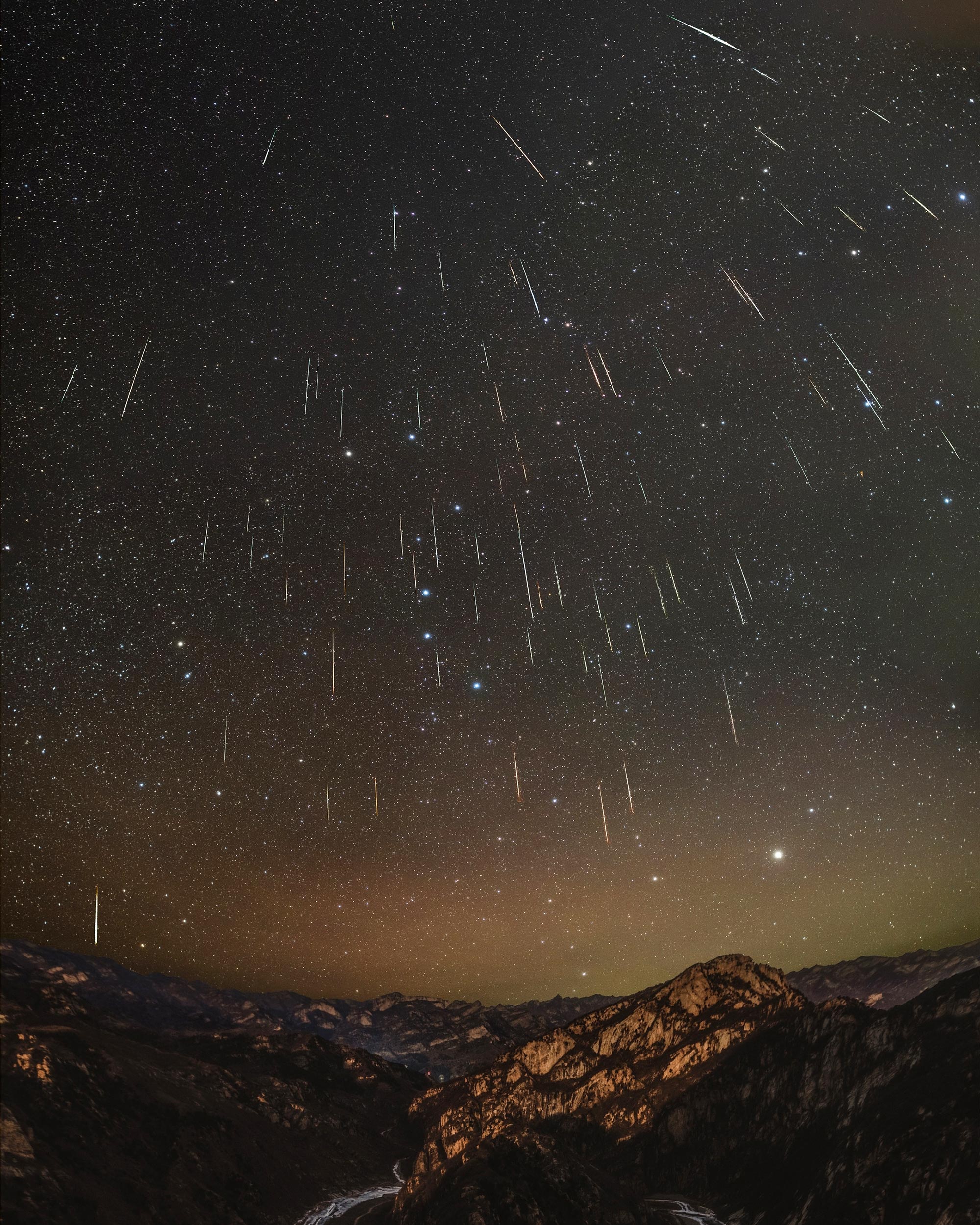
Every December we have a chance to see one of our favorite meteor showers – the Geminids. The shower is currently active until December 17 and will peak on the night of December 13 into the morning of December 14, making those hours the best time for viewing the meteor shower.
The Geminids are caused by debris from a celestial object known as 3200 Phaethon, whose origin is the subject of some debate. Some astronomers consider it to be an extinct comet, based on observations showing some small amount of material leaving Phaethon’s surface. Others argue that it has to be an asteroid because of its orbit and its similarity to the main-belt asteroid Pallas.
Whatever the nature of Phaethon, observations show that the Geminids are denser than meteors belonging to other showers, enabling them to get as low as 29 miles (47 kilometers) above Earth’s surface before burning up. Meteors belonging to other showers, like the Perseids, burn up much higher.
The Geminids can be seen by most of the world. Yet, it is best viewed by observers in the Northern Hemisphere. As you enter the Southern Hemisphere and move towards the South Pole, the altitude of the Geminid radiant – the celestial point in the sky where the Geminid meteors appear to originate – gets lower and lower above the horizon. Thus, observers in these locations see fewer Geminids than their northern counterparts.
Besides the weather, the phase of the Moon is a major factor in determining whether a meteor shower will have good rates during any given year. This is because the moonlight “washes out” the fainter meteors, resulting in sky watchers seeing the fewer bright ones. This year, the Moon will be almost 80% full at the peak of the Geminids, which isn’t ideal for our highly regarded meteor shower. Nevertheless, that bright Moon is expected to set around 2:00 a.m. wherever you are located, leaving a couple of hours for meteor watching until twilight.
“Rich in green-colored fireballs, the Geminids are the only shower I will brave cold December nights to see,” said Bill Cooke, lead for NASA’s Meteoroid Environment Office, located at Marshall Space Flight Center in Huntsville, Alabama.
NASA will broadcast a live stream of the shower’s peak December 13-14 via a meteor camera at NASA’s Marshall Space Flight Center in Huntsville, Alabama, (if our weather cooperates!), starting at 8 p.m. CST on the NASA Meteor Watch Facebook page.
Meteor videos recorded by the All Sky Fireball Network are also available each morning to identify Geminids in these videos – just look for events labeled “GEM.”
Learn more about the Geminids below:
Why are they called the Geminids?
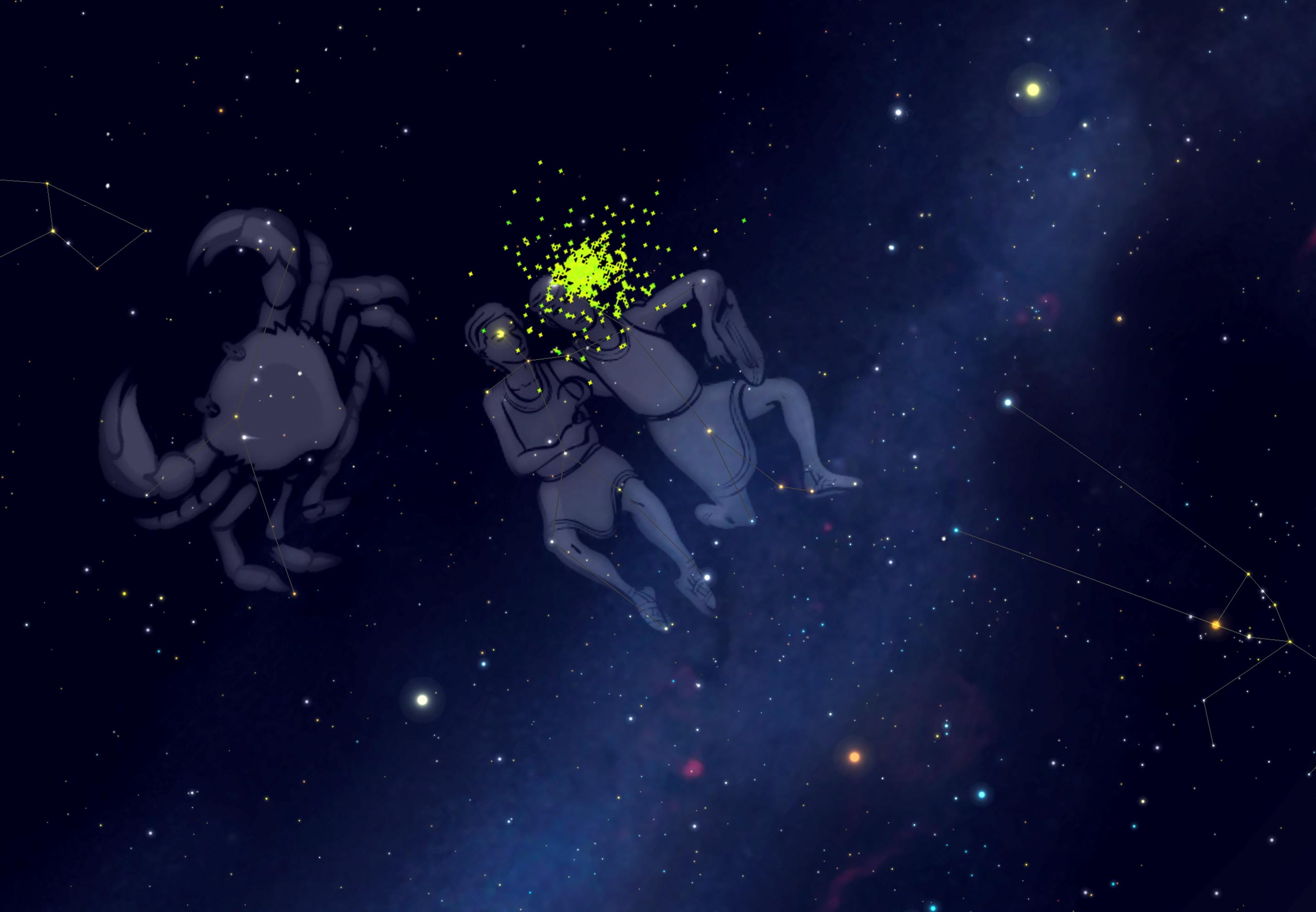
All meteors associated with a shower have similar orbits, and they all appear to come from the same place in the sky, which is called the radiant. The Geminids appear to radiate from a point in the constellation Gemini, hence the name “Geminids.”
How fast are Geminids?
Geminids travel 78,000 mph (35 km/s). This is over 1000 times faster than a cheetah, about 250 times faster than the swiftest car in the world, and over 40 times faster than a speeding bullet!
How to observe the Geminids?
If it’s not cloudy, get away from bright lights, lie on your back, and look up. Remember to let your eyes get adjusted to the dark – you’ll see more meteors that way. Keep in mind, this adjustment can take approximately 30 minutes. Don’t look at your cell phone screen, as it will ruin your night vision!
Meteors can generally be seen all over the sky. Avoid watching the radiant because meteors close to it have very short trails and are easily missed. When you see a meteor, try to trace it backwards. If you end up in the constellation Gemini, there’s a good chance you’ve seen a Geminid.
Observing in a city with lots of light pollution will make it difficult to see Geminids. You may only see a handful during the night in that case.
When is the best time to observe Geminids?
The best night to see the shower is December 13/14. Sky watchers in the Northern Hemisphere can go out in the late evening hours on December 13 to see some Geminids, but with moonlight and radiant low in the sky, you may not see many meteors.
Best rates will be seen when the radiant is highest in the sky around 2:00 a.m. local time, including the Southern Hemisphere, on December 14. The Moon will set around the same time. Therefore, observing from moonset until twilight on December 14 should yield the most meteors.
You can still see Geminids on other nights, before or after December 13-14, but the rates will be much lower. The last Geminids can be seen on December 17.
How many Geminids can observers expect to see December 13/14?
Realistically, the predicated rate for observers in the northern hemisphere is closer to 30-40 meteors per hour. Observers in the Southern Hemisphere will see fewer Geminids than those in the northern hemisphere – perhaps 25% of rates in the Northern Hemisphere.
Although this year’s conditions are not the best for viewing the Geminid meteor shower, it will still be a good show to catch in our night skies.
And, if you want to know what else is in the sky for December, check out the video below from Jet Propulsion Laboratory’s monthly “What’s Up” video series:
Never miss a breakthrough: Join the SciTechDaily newsletter.
Follow us on Google and Google News.
1 Comment
Good….