
Close Menu
    Facebook X (Twitter) Instagram
    SciTechDaily
    • Biology
    • Chemistry
    • Earth
    • Health
    • Physics
    • Science
    • Space
    • Technology
    Facebook X (Twitter) Pinterest YouTube RSS
    SciTechDaily
    Home»Space»EZIE Does It: NASA’s Next Step in Unraveling Earth’s Electrifying Space Connections
    Space

    EZIE Does It: NASA’s Next Step in Unraveling Earth’s Electrifying Space Connections

    By Denise Hill, NASAApril 11, 2023No Comments2 Mins Read
    Facebook Twitter Pinterest Telegram LinkedIn WhatsApp Email Reddit
    Share
    Facebook Twitter LinkedIn Pinterest Telegram Email Reddit
    Electrojet Zeeman Imaging Explorer (EZIE)
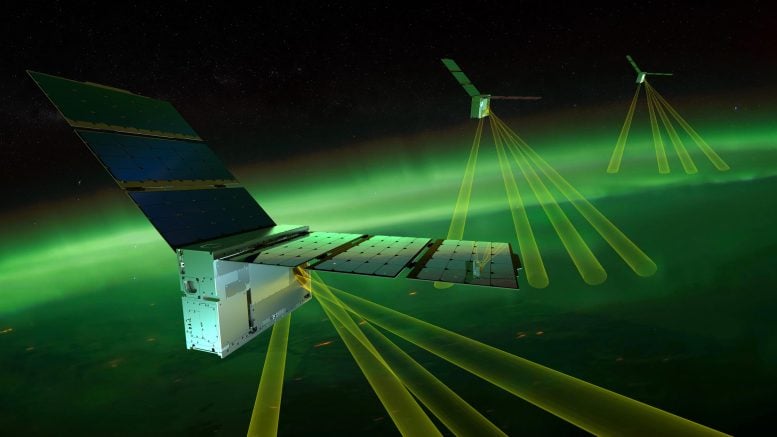
    The Electrojet Zeeman Imaging Explorer (EZIE) —is a SmallSat mission that will characterize the electric currents that link Earth’s aurora to the planet’s magnetosphere. This illustration shows the three EZIE spacecraft orbiting above the aurora at one of Earth’s poles Credit: NASA/Johns Hopkins APL/Steve Gribben

    NASA’s Electrojet Zeeman Imaging Explorer (EZIE) has passed its critical design review, keeping on track for a 2024 launch. The mission will provide unique imaging of electrical currents between Earth and space, improving our understanding of space weather phenomena and their impact on Earth.

    On March 23, 2023, NASA’s Electrojet Zeeman Imaging Explorer (EZIE) successfully passed its critical design review, marking a major milestone for the project and keeping it on pace for a scheduled launch next year.

    EZIE will provide never before seen imaging of the electrical currents that link our planet and the surrounding space.

    “We are excited for what we will learn from EZIE,” said Peg Luce acting director of NASA’s Heliophysics Division at NASA Headquarters in Washington. “This mission will deepen our knowledge of the Sun-Earth connection and help us better understand the electrical currents that link beautiful aurora to Earth’s magnetosphere. This is critical because the same space weather phenomena that power the amazing aurora can cause interference with radio and communication signals and utility grids on Earth’s surface, and damage to spacecraft in orbit.”
    NASA Electrojet Zeeman Imaging Explorer (EZIE)
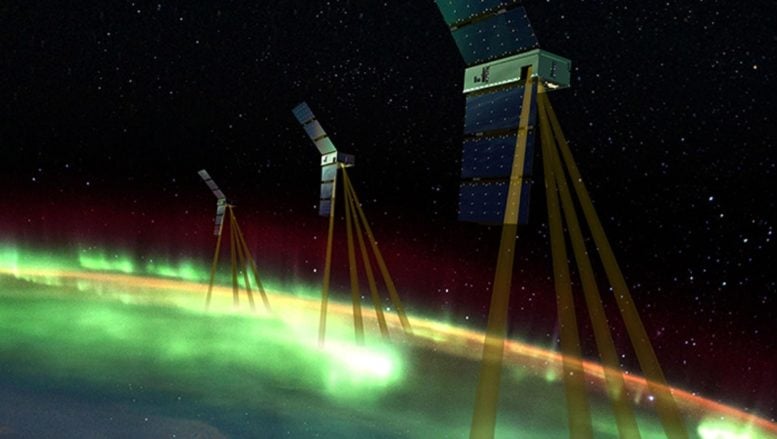
    Slated to launch no earlier than 2024, EZIE will send a trio of SmallSats to study the auroral electrojets, which are electrical currents flowing 60-90 miles (95-145 kilometers) above Earth’s poles and are just a small portion of the enormous electrical current that flows between Earth’s magnetosphere and the planet. Credit: NASA

    For more on this news, see NASA’s EZIE To Unveil the Charged Link Between Earth and Space.

    Financial support for EZIE is provided by the Heliophysics Explorers Program, overseen by the Explorers Program Office situated at NASA’s Goddard Space Flight Center in Greenbelt, Maryland. The mission is spearheaded by APL, responsible for designing, building, and managing EZIE, while collaborating with JPL and Blue Canyon Technologies (BCT).

    Never miss a breakthrough: Join the SciTechDaily newsletter.
    Follow us on Google and Google News.

    Atmospheric Science NASA NASA EZIE Space Weather
    Share. Facebook Twitter Pinterest LinkedIn Email Reddit

    Related Articles

    NASA’s EZIE Mission Launches to Uncover Earth’s Electric Secrets

    What’s Really Behind the Northern Lights? NASA Is About to Find Out

    Red Dwarf Fury: How Wolf 359’s Radiation May Fry Alien Atmospheres

    NASA Just Found the Sun’s Secret Warning Before Massive Solar Flares

    Exploring Earth’s Edge: How NASA’s TES-22 Is Tackling Space Debris and the Thermosphere

    NASA’s EZIE Mission: Capturing Magnetic Fingerprints of Earth’s Auroral Electrojets

    Auroras Unplugged: NASA’s EZIE To Unveil the Charged Link Between Earth and Space

    ELFIN CubeSat Discovers Source of Super-Fast Electron Rain

    NASA’s Juno spacecraft Detects Jupiter’s Highest-Energy Ions

    Leave A Reply Cancel Reply

    • Facebook
    • Twitter
    • Pinterest
    • YouTube

    Don't Miss a Discovery

    Subscribe for the Latest in Science & Tech!

    Trending News

    Scientists Discover 132-Million-Year-Old Dinosaur Tracks on South Africa’s Coast

    Scientists Uncover the Secret Ingredient Behind the Spark That May Have Started Life on Earth

    Physicists Observe Matter in Two Places at Once in Mind-Bending Quantum Experiment

    Stanford Scientists Discover Hidden Brain Circuit That Fuels Chronic Pain

    New Study Reveals Why Ozempic Works Better for Some People Than Others

    Climate Change Is Altering a Key Greenhouse Gas in a Way Scientists Didn’t Expect

    New Study Suggests Gravitational Waves May Have Created Dark Matter

    Scientists Discover Why the Brain Gets Stuck in Schizophrenia

    Follow SciTechDaily
    • Facebook
    • Twitter
    • YouTube
    • Pinterest
    • Newsletter
    • RSS
    SciTech News
    • Biology News
    • Chemistry News
    • Earth News
    • Health News
    • Physics News
    • Science News
    • Space News
    • Technology News
    Recent Posts
    • The Ideal Temperature for Storing Mangoes Isn’t What You Think
    • Groundbreaking Enzyme Atlas Rewrites Decades of Biology Research
    • New “Nanozyme Hypothesis” Could Rewrite the Story of Life’s Origins
    • Anatomy Isn’t Finished: The Human Body Still Holds Secrets
    • Researchers Discover Long-Lost Words of Ancient Greek Philosopher After 2,000 Years
    Copyright © 1998 - 2026 SciTechDaily. All Rights Reserved.
    • Science News
    • About
    • Contact
    • Editorial Board
    • Privacy Policy
    • Terms of Use

    Type above and press Enter to search. Press Esc to cancel.