
Close Menu
    Facebook X (Twitter) Instagram
    SciTechDaily
    • Biology
    • Chemistry
    • Earth
    • Health
    • Physics
    • Science
    • Space
    • Technology
    Facebook X (Twitter) Pinterest YouTube RSS
    SciTechDaily
    Home»Earth»Key Milestone for NASA’s EZIE Mission To Study Electrical Currents in Earth’s Upper Atmosphere
    Earth

    Key Milestone for NASA’s EZIE Mission To Study Electrical Currents in Earth’s Upper Atmosphere

    By Vanessa Thomas, NASA’s Goddard Space Flight CenterJuly 11, 2022No Comments3 Mins Read
    Facebook Twitter Pinterest Telegram LinkedIn WhatsApp Email Reddit
    Share
    Facebook Twitter LinkedIn Pinterest Telegram Email Reddit
    NASA’s EZIE Mission
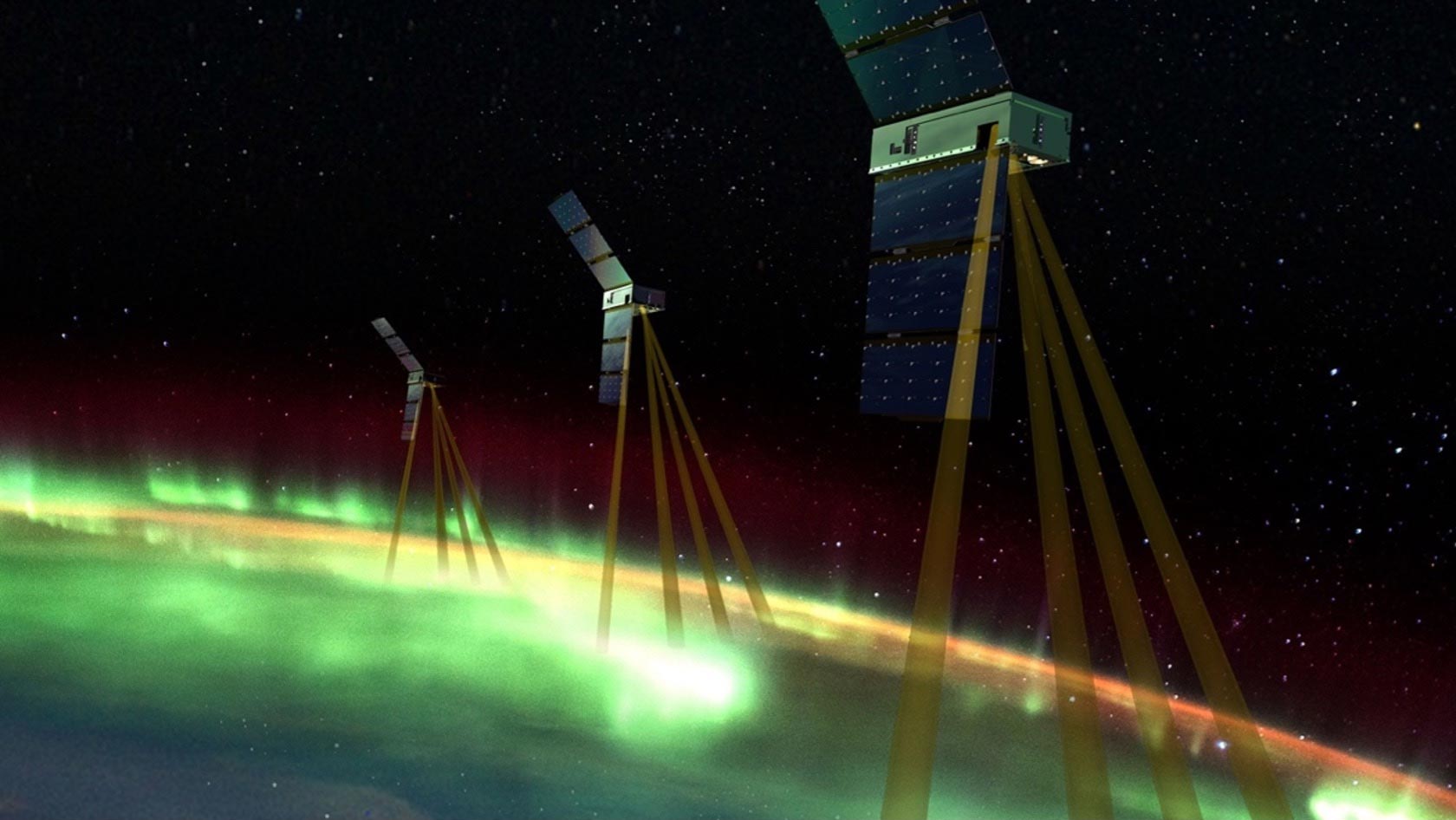
    This illustration shows the three CubeSats of NASA’s EZIE mission flying in formation above Earth. The spacecraft will study electrical currents in Earth’s atmosphere that link changes in the magnetosphere to effects at the Earth’s surface during geomagnetic storms – the same storms that trigger the colorful auroral displays. Credit: NASA/Johns Hopkins APL

    The EZIE mission will investigate electrical currents in Earth’s ionosphere using CubeSats that measure magnetic fields via Zeeman splitting, advancing knowledge of auroral electrojets and space weather.

    NASA’s Electrojet Zeeman Imaging Explorer (EZIE) project – a mission to explore electrical currents in Earth’s upper atmosphere – has passed a crucial developmental milestone, after rigorous review, moving the mission from the design phase to the construction phase.

    EZIE will investigate auroral electrojets, which are powerful electrical currents flowing approximately 65 miles (100 kilometers) above the ground in the ionosphere, a region of Earth’s atmosphere rich in ions ( charged atoms). These electrojets are connected to the beautiful auroras that dance across the polar night skies. They are part of a vast electrical circuit flowing between Earth and the surrounding space, out to some 100,000 miles (160,000 kilometers) away. The discoveries of EZIE will help to resolve decades-old arguments regarding the structure and evolution of the electrojets, paving the way for a more thorough understanding of Earth’s space weather — magnetic events in space that can affect our ever increasingly technological society.

    EZIE will fly three identical CubeSats that will orbit the globe in a pearls-on-a-string formation when it launches, which will be no earlier than September 2024. Each spacecraft will measure the electrojet current by imaging its “fingerprint.” The spacecraft will look at light being emitted from oxygen molecules below the electrojets at just 50 miles (80 kilometers) above the surface. The spacecraft will do this by exploring a phenomenon called Zeeman splitting, which is the splitting of a molecule’s light spectrum when placed near a magnetic field. Doing this means they can derive the magnetic field created by the electrojets as they flow and, in turn, detect the electrojets’ current. This new application of the Zeeman effect will allow scientists to infer the magnetic field produced by an electrojet current in the overlying ionosphere and, in turn, learn how the size and strength of these electrojets change when solar storms impact the magnetosphere.

    Funding for EZIE comes from the Heliophysics Explorers Program, managed by the Explorers Program Office at NASA’s Goddard Space Flight Center in Greenbelt, Maryland. The principal investigator for the mission is Jeng-Hwa (Sam) Yee of the Johns Hopkins University Applied Physics Laboratory in Laurel, Maryland. NASA’s Jet Propulsion Laboratory will build the satellite instruments. Blue Canyon Technologies will provide the spacecraft and mission operations center, and it will perform systems integration and testing as well as mission operations. Maverick Space Systems will provide launch and deployment operations.

    Never miss a breakthrough: Join the SciTechDaily newsletter.
    Follow us on Google and Google News.

    JPL NASA NASA EZIE NASA Goddard Space Flight Center Space Weather
    Share. Facebook Twitter Pinterest LinkedIn Email Reddit

    Related Articles

    Wildflowers Are Blooming – And NASA Just Got the Best View

    The Northern Lights Hold a Shocking Secret and NASA’s EZIE Mission Will Reveal It

    NASA’s AWE Mission Launching to Space Station To Study Atmospheric Gravity Waves via Airglow

    Strange Things Happening in Earth’s Atmosphere: NASA Launches Rocket To Investigate Mysterious Area Above the North Pole

    Earth’s Magnetosphere: Protecting Our Planet From Harmful Space Radiation

    Surprising Standing Waves at Edge of Earth’s Magnetic Bubble Found in NASA Data

    NASA GOLD’s Bird’s-Eye Reveals Mysterious Dynamics in Earth’s Interface to Space

    NASA Super Soaker Mission Seeks to Understand Bright Night-Shining Clouds by Creating One

    16 Years of Ice Sheet Loss Mapped by Most Advanced Earth-Observing Laser NASA Has Ever Flown in Space

    Leave A Reply Cancel Reply

    • Facebook
    • Twitter
    • Pinterest
    • YouTube

    Don't Miss a Discovery

    Subscribe for the Latest in Science & Tech!

    Trending News

    A Star Near the Milky Way’s Black Hole Is Losing Mass at an Astonishing Rate

    Scientists Solve a Vitamin B12 Mystery With an Unexpected Culprit

    Has the Autism Spectrum Become Too Broad? Leading Scientist Warns of Hidden Consequences

    Rewriting History: Researchers Uncover a Forgotten Amazon Civilization That May Have Housed 3 Million People

    New Research May Change How We Think About Weight Loss Drugs Like Ozempic

    Coffee Drinkers Show Surprising Differences in Fat, Muscle, and Hormones

    New Treatment Targets Gum Disease Without Killing Good Bacteria

    Scientists Discover a 245-Million-Year-Old Reptile With Its Organs Still Preserved

    Follow SciTechDaily
    • Facebook
    • Twitter
    • YouTube
    • Pinterest
    • Newsletter
    • RSS
    SciTech News
    • Biology News
    • Chemistry News
    • Earth News
    • Health News
    • Physics News
    • Science News
    • Space News
    • Technology News
    Recent Posts
    • JWST Finds a Galaxy Cluster That Shouldn’t Be This Mature So Early in the Universe
    • Scientists Think Fungi Could Turn Martian Dirt Into Farmland
    • Have We Found Alien Life? Here’s What Scientists Really Think
    • Neuroscientist Challenges the Idea That Your Brain “Makes” Decisions
    • Mysterious “Golden Tree” Coral Discovered in Costa Rica’s Deep Pacific
    Copyright © 1998 - 2026 SciTechDaily. All Rights Reserved.
    • Science News
    • About
    • Contact
    • Editorial Board
    • Privacy Policy
    • Terms of Use

    Type above and press Enter to search. Press Esc to cancel.