
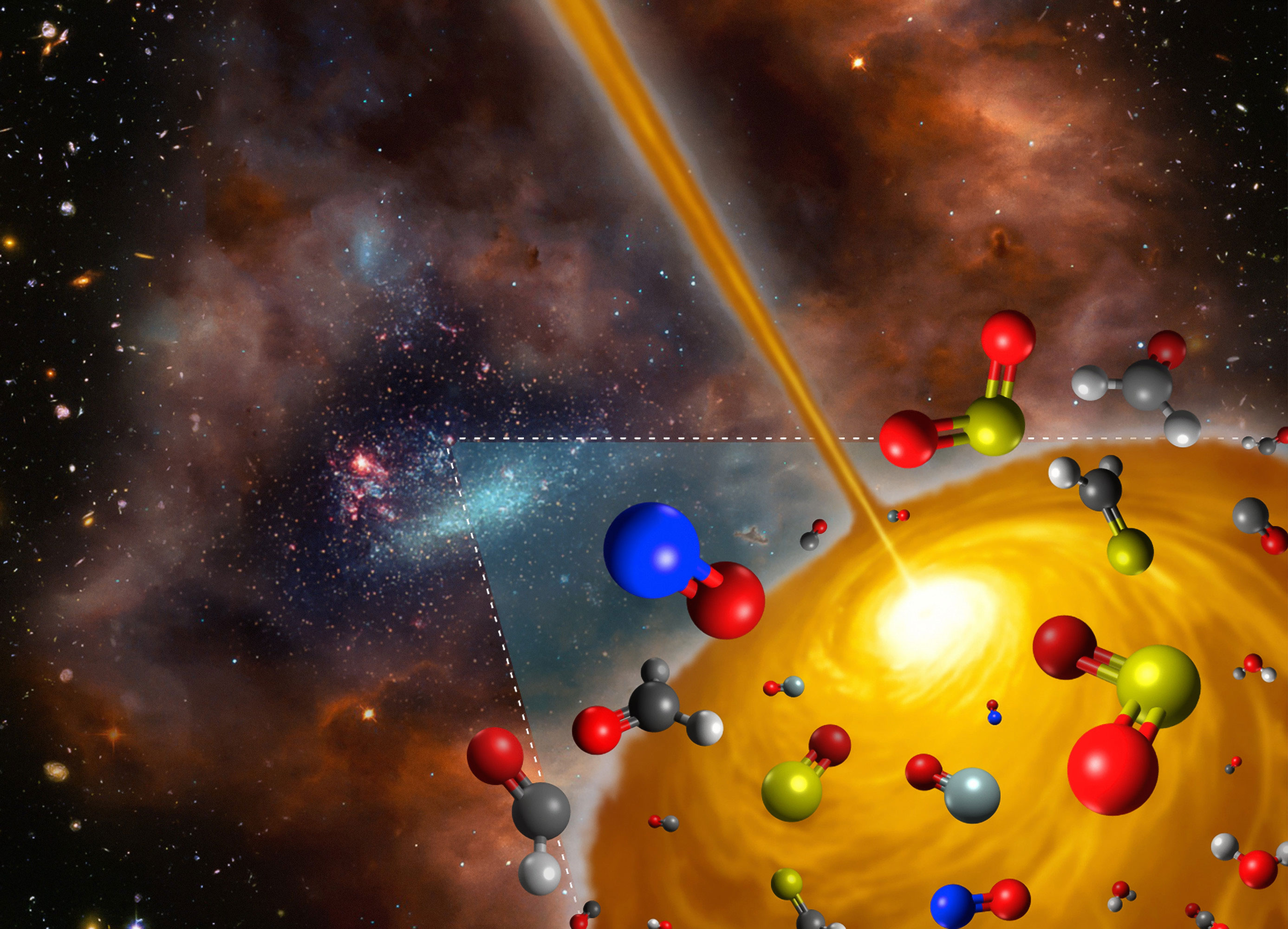
Using the Atacama Large Millimeter/submillimeter Array, a team of astronomers reveal the first hot core to be found outside the Milky Way.
A hot and dense mass of complex molecules, cocooning a newborn star, has been discovered by a Japanese team of astronomers using ALMA. This unique hot molecular core is the first of its kind to have been detected outside the Milky Way galaxy. It has a very different molecular composition from similar objects in our own galaxy — a tantalizing hint that the chemistry taking place across the Universe could be much more diverse than expected.
A team of Japanese researchers have used the power of the Atacama Large Millimeter/submillimeter Array (ALMA) to observe a massive star known as ST11 in our neighboring dwarf galaxy, the Large Magellanic Cloud (LMC). Emission from a number of molecular gases was detected. These indicated that the team had discovered a concentrated region of comparatively hot and dense molecular gas around the newly ignited star ST11. This was evidence that they had found something never before seen outside of the Milky Way — a hot molecular core.
Takashi Shimonishi, an astronomer at Tohoku University, Japan, and the paper’s lead author enthused: “This is the first detection of an extragalactic hot molecular core, and it demonstrates the great capability of new generation telescopes to study astrochemical phenomena beyond the Milky Way.”
The ALMA observations revealed that this newly discovered core in the LMC has a very different composition from similar objects found in the Milky Way. The most prominent chemical signatures in the LMC core include familiar molecules such as sulfur dioxide, nitric oxide, and formaldehyde — alongside the ubiquitous dust. But several organic compounds, including methanol (the simplest alcohol molecule), had remarkably low abundance in the newly detected hot molecular core. In contrast, cores in the Milky Way have been observed to contain a wide assortment of complex organic molecules, including methanol and ethanol.

Takashi Shimonishi explains: “The observations suggest that the molecular compositions of materials that form stars and planets are much more diverse than we expected.”
The LMC has a low abundance of elements other than hydrogen or helium. The research team suggests that this very different galactic environment has affected the molecule-forming processes taking place surrounding the newborn star ST11. This could account for the observed differences in chemical compositions.
It is not yet clear if the large, complex molecules detected in the Milky Way exist in hot molecular cores in other galaxies. Complex organic molecules are of very special interest because some are connected to prebiotic molecules formed in space. This newly discovered object in one of our nearest galactic neighbors is an excellent target to help astronomers address this issue. It also raises another question: how could the chemical diversity of galaxies affect the development of extragalactic life?
Reference: “Detection of a hot molecular core in the Large Magellanic Cloud with ALMA” by Takashi Shimonishi, Takashi Onaka, Akiko Kawamura and Yuri Aikawa, 9 August 2016, The Astrophysical Journal.
DOI: 10.3847/0004-637X/827/1/72
arXiv:1606.02823
Never miss a breakthrough: Join the SciTechDaily newsletter.
Follow us on Google and Google News.
1 Comment
First organic molecules such as Formaldehyde in addition to Nitric oxide and Sulfur dioxide outside the range of Milky Way Galaxy and also its neighboring Large Magellanic cloud shows that the process of life formation starts from there itself and then gets imbibed into the galaxies and stars where they are scattered among the planets in the atmosphere. Star formation and Planets formation is not just Planet`s inorganic chemistry era and also organic chemistry era which started side by side. Finally these organic chemistry yielded higher molecules of self duplicating molecules which finally resulted in the life forming amino acids. So the seeds of life is scattered everywhere in the Universe, but chance of life sustaining and going on evolution (which is also in a sense duplication of such organic molecules in a macro sense), is limited to only few planets in this galaxy which gets the correct ambiance and time scale of formation. Thank You.