
Close Menu
    Facebook X (Twitter) Instagram
    SciTechDaily
    • Biology
    • Chemistry
    • Earth
    • Health
    • Physics
    • Science
    • Space
    • Technology
    Facebook X (Twitter) Pinterest YouTube RSS
    SciTechDaily
    Home»Space»Astronomers Reveal a Planet Forming in an Earth-Like Orbit Around Young Star TW Hydrae
    Space

    Astronomers Reveal a Planet Forming in an Earth-Like Orbit Around Young Star TW Hydrae

    By Harvard-Smithsonian Center for AstrophysicsMarch 31, 20161 Comment4 Mins Read
    Facebook Twitter Pinterest Telegram LinkedIn WhatsApp Email Reddit
    Share
    Facebook Twitter LinkedIn Pinterest Telegram Email Reddit
    Astronomers Find a Planet Forming in an Earth-like Orbit around a Young Star
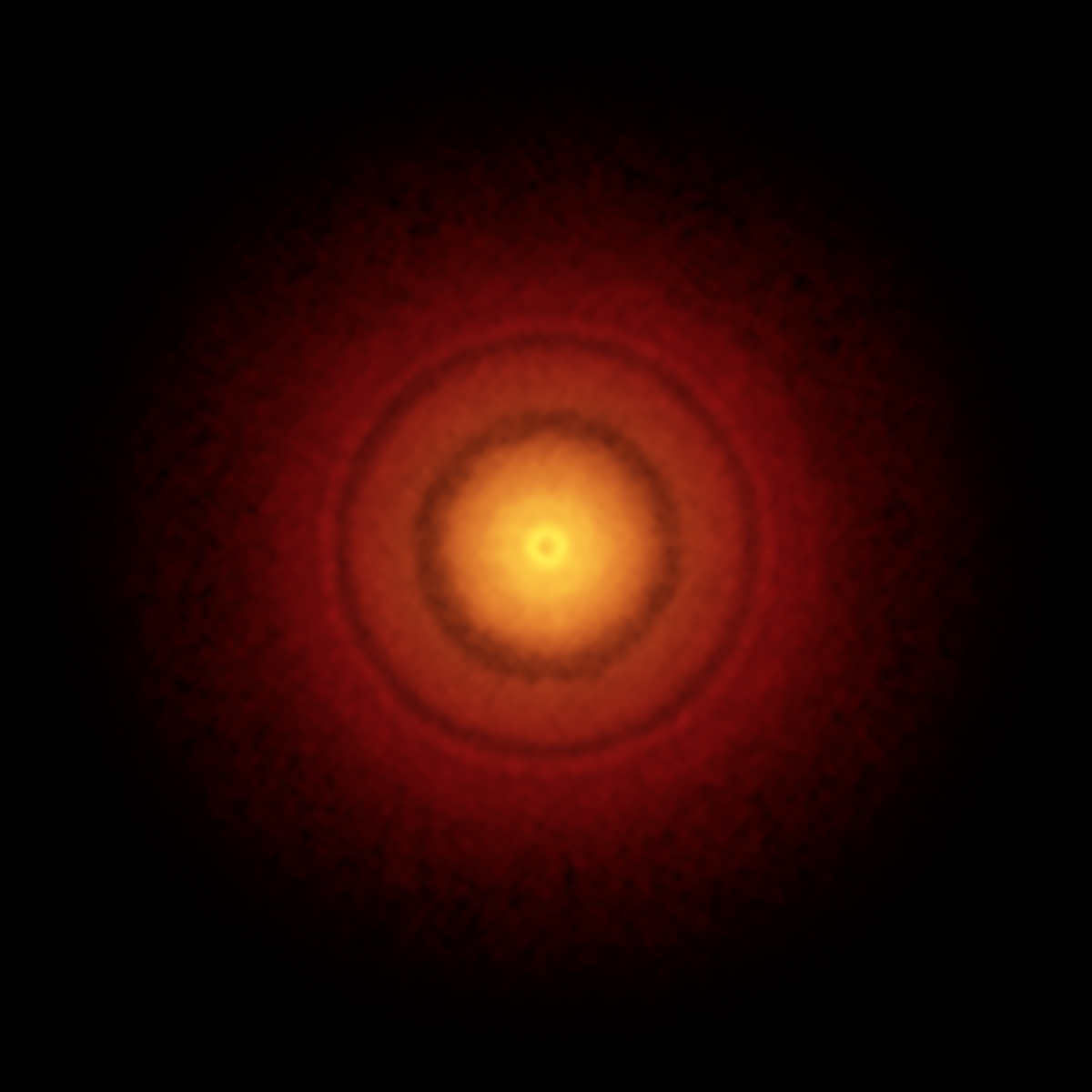
    ALMA image of the disk around the young star TW Hydrae. ALMA obtained its best image of a protoplanetary disk to date, revealing the classic rings and gaps that signify planets are in formation in this system.

    Using data from the Atacama Large Millimeter/submillimeter Array, astronomers reveal a planet-forming disk in unprecedented detail, revealing a series of concentric dusty bright rings and dark gaps, including intriguing features that suggest a planet with an Earth-like orbit is forming there.

    Disks of dust and gas that surround young stars are the formation sites of planets. New images from the Atacama Large Millimeter/submillimeter Array (ALMA) reveal never-before-seen details in the planet-forming disk around a nearby Sun-like star, including a tantalizing gap at the same distance from the star as the Earth is from the Sun.

    This structure may mean that an infant version of our home planet, or possibly a more massive “super-Earth,” is beginning to form there.

    The star, TW Hydrae, is a popular target of study for astronomers because of its proximity to Earth (approximately 175 light-years away) and its status as a veritable newborn (about 10 million years old). It also has a face-on orientation as seen from Earth. This affords astronomers a rare, undistorted view of the complete disk.

    “Previous studies with optical and radio telescopes confirm that this star hosts a prominent disk with features that strongly suggest planets are beginning to coalesce,” said Sean Andrews of the Harvard-Smithsonian Center for Astrophysics, and lead author on a paper published in Astrophysical Journal Letters. “The new ALMA images show the disk in unprecedented detail, revealing a series of concentric dusty bright rings and dark gaps, including intriguing features that suggest a planet with an Earth-like orbit is forming there.”

    Other pronounced gap features are located at distances from the central star of 3 billion and 6 billion kilometers, similar to the distances from the Sun to Uranus and Pluto in our own Solar System. They too are likely the result of particles that came together to form planets, which then swept their orbits clear of dust and gas and shepherded the remaining material into well-defined bands.

    Inner Region of the TW Hydrae Protoplanetary Disk
    The inner region of the TW Hydrae protoplanetary disk as imaged by ALMA. The image has a resolution of 1 AU (Astronomical Unit, the distance from the Earth to the Sun in our own Solar System). This new ALMA image reveals a gap in the disk at 1 AU, suggesting that a planet with the same orbit as Earth is forming there.

    For the new TW Hydrae observations, astronomers imaged the faint radio emission from millimeter-size dust grains in the disk, revealing details on the order of one astronomical unit (about 150 million kilometers, or the distance between the Earth and the Sun). These detailed observations were made possible with ALMA’s high-resolution, long-baseline configuration. When ALMA’s dishes are at their maximum separation, up to 15 kilometers, the telescope is able to resolve finer details. “This is the highest spatial resolution image ever of a protoplanetary disk from ALMA, and that won’t be easily beat going forward,” said Andrews.

    “TW Hydrae is quite special. It is the nearest known protoplanetary disk to Earth and it may closely resemble our Solar System when it was only 10 million years old,” said co-author David Wilner, also with the Harvard-Smithsonian Center for Astrophysics.

    Earlier ALMA observations of another system, HL Tau, show that even younger protoplanetary disks – a mere 1 million years old – can display similar signatures of planet formation. By studying the older TW Hydrae disk, astronomers hope to better understand the evolution of our own planet and the prospects for similar systems throughout the Galaxy.

    The astronomers’ next phase of research is to investigate how common these kinds of features are in disks around other young stars and how they might change with time or environment.

    Reference: “Ringed Substructure and a Gap at 1 AU in the Nearest Protoplanetary Disk” by Sean M. Andrews, David J. Wilner, Zhaohuan Zhu, Tilman Birnstiel, John M. Carpenter, Laura M. Pérez, Xue-Ning Bai, Karin I. Öberg, A. Meredith Hughes, Andrea Isella, and Luca Ricci, 31 March 2016, The Astrophysical Journal Letters.
    DOI: 10.3847/2041-8205/820/2/L40

    Never miss a breakthrough: Join the SciTechDaily newsletter.
    Follow us on Google and Google News.

    ALMA Astronomy Astrophysics Cosmology Harvard-Smithsonian Center for Astrophysics Planetary Science Popular
    Share. Facebook Twitter Pinterest LinkedIn Email Reddit

    Related Articles

    ALMA Views Fomalhaut Star System in Never-Before-Seen Detail

    CEMP Stars Could Host Carbon Planets

    Astronomers Show Magnetic Field is Critical for Life

    Preliminary Reference Earth Model Shows Earth-like Planets Have Earth-like Interiors

    ALMA Telescope Reveals Planetary Influences on Young Stellar Disks

    Kepler-78b, A Lava World with an Earth-Like Density

    ALMA Reveals First Ever Snow Line Seen Around a Distant Star

    Water Planets in the Habitable Zone: A Closer Look at Kepler 62e and 62f

    Earth-like Planets May Have Older and More Evolved Life

    1 Comment

    1. kamir bouchareb st on November 16, 2020 1:58 am

      very good

      Reply
    Leave A Reply Cancel Reply

    • Facebook
    • Twitter
    • Pinterest
    • YouTube

    Don't Miss a Discovery

    Subscribe for the Latest in Science & Tech!

    Trending News

    First-of-Its-Kind Discovery: Homer’s Iliad Found Embedded in a 1,600-Year-Old Egyptian Mummy

    Beyond Inflammation: Scientists Uncover New Cause of Persistent Rheumatoid Arthritis

    A Simple Molecule Could Unlock Safer, Easier Weight Loss

    Scientists Just Built a Quantum Battery That Charges Almost Instantly

    Researchers Unveil Groundbreaking Sustainable Solution to Vitamin B12 Deficiency

    Millions of People Have Osteopenia Without Realizing It – Here’s What You Need To Know

    Researchers Discover Boosting a Single Protein Helps the Brain Fight Alzheimer’s

    World-First Study Reveals Human Hearts Can Regenerate After a Heart Attack

    Follow SciTechDaily
    • Facebook
    • Twitter
    • YouTube
    • Pinterest
    • Newsletter
    • RSS
    SciTech News
    • Biology News
    • Chemistry News
    • Earth News
    • Health News
    • Physics News
    • Science News
    • Space News
    • Technology News
    Recent Posts
    • Mezcal “Worm” in a Bottle Mystery: DNA Testing Reveals a Surprise
    • Scientists Turn Red Lettuce Green, Unlocking Hidden Nutrients
    • Researchers Discover Natural Compound That Disarms Deadly Superbug
    • New Research Reveals That Your Morning Coffee Activates an Ancient Longevity Switch
    • Researchers Identify the Most Common Recessive Neurodevelopmental Disorder Ever Discovered
    Copyright © 1998 - 2026 SciTechDaily. All Rights Reserved.
    • Science News
    • About
    • Contact
    • Editorial Board
    • Privacy Policy
    • Terms of Use

    Type above and press Enter to search. Press Esc to cancel.