
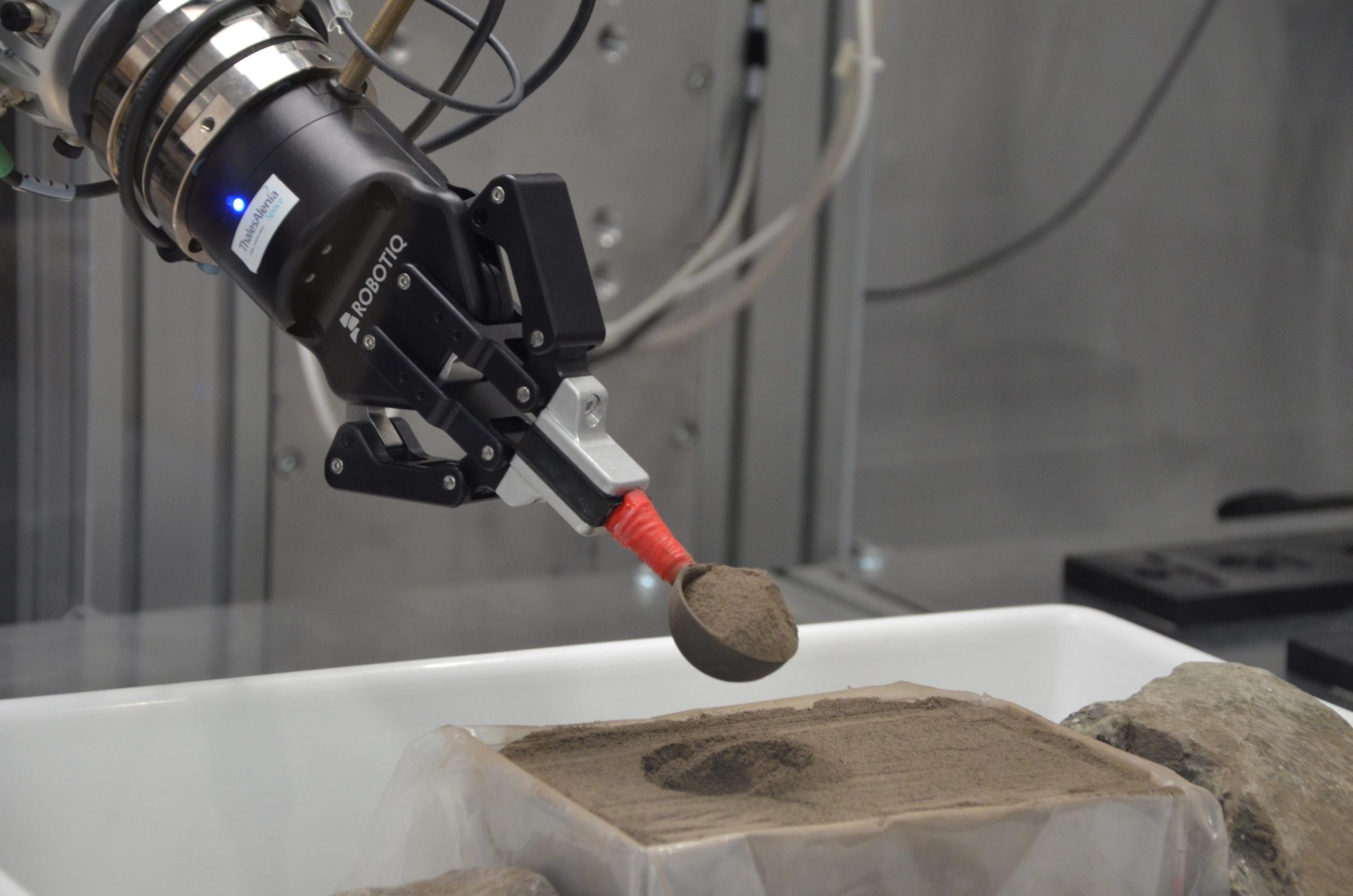
A new simulation technology developed by the University of Bristol enables effective remote control of lunar robots for moon dust collection, supporting astronaut training and potentially reducing the cost and complexity of lunar missions.
Teleoperated robots for collecting moon dust are one step closer to reality, thanks to new research from scientists at the University of Bristol.
The scientists successfully completed a sample collection task by controlling a virtual simulation, which then sent commands to a physical robot to replicate the simulation’s actions. Remarkably, they accomplished this while only monitoring the simulation, without needing physical camera streams. This system, detailed in a new paper presented at the IROS 2024 (IEEE/RSJ International Conference on Intelligent Robots and Systems), could be especially beneficial for delayed teleoperation on the Moon.

Lunar Resource Extraction: Current Research
Alongside a boom in lunar lander missions this decade, several public and private organizations are now researching how best to extract valuable resources, such as oxygen and water, from readily available materials such as lunar regolith (moon dust). Remote handling of regolith will be an essential step in these activities, as it would first need to be collected from the Moon’s surface. Beyond this, moon dust is not easy to work with. It’s sticky and abrasive and will be handled under reduced gravity.
Lead author Joe Louca from the Bristol’s School of Engineering Mathematics and Technology, and the Bristol Robotics Laboratory, explained: “One option could be to have astronauts use this simulation to prepare for upcoming lunar exploration missions.
“We can adjust how strong gravity is in this model, and provide haptic feedback, so we could give astronauts a sense of how Moon dust would feel and behave in lunar conditions – which has a sixth of the gravitational pull of the Earth’s.
“This simulation could also help us to operate lunar robots remotely from Earth, avoiding the problem of signal delays.”

Future Applications and Implications
Using a virtual model of regolith can also reduce the barriers to entry for people looking to develop lunar robots. Instead of needing to invest in expensive simulants (artificial dust with the same properties as regolith), or have access to facilities, people developing lunar robots could use this simulation to carry out initial tests on their systems.
Now, the team will investigate how people actually respond to this system when controlling a robot with several seconds of delay. Systems with human operators that are technically effective may still have to overcome non-technical barriers, like whether a person trusts that the system will work.

Louca added: “The model predicted the outcome of a regolith simulant scooping task with sufficient accuracy to be considered effective and trustworthy 100% and 92.5% of the time.
“In the next decade we’re going to see several crewed and uncrewed missions to the Moon, such as NASA’s Artemis program and China’s Chang’e program.
“This simulation could be a valuable tool to support preparation or operation for these missions.”
The testing was carried out at the European Space Agency’s European Centre for Space Applications and Telecommunications site in Harwell.
Reference: “Demonstrating Trustworthiness in Open-Loop Model Mediated Teleoperation for Collecting Lunar Regolith Simulant” by Joe Louca, Aliz Zemeny, Antonia Tzemanaki and Romain Charles, IROS 2024 (IEEE/RSJ International Conference on Intelligent Robots and Systems).
Never miss a breakthrough: Join the SciTechDaily newsletter.
Follow us on Google and Google News.