
Using several telescopes including Chandra, astronomers have shown that a galaxy in the early Universe called SPT0346-52 is undergoing an extraordinary burst of star formation. The absence of X-rays from Chandra shows that there is no actively growing, supermassive black hole in the center of the galaxy. This means that the rate amount of infrared emission detected by other telescopes can only be explained by an extremely high rate of star formation.
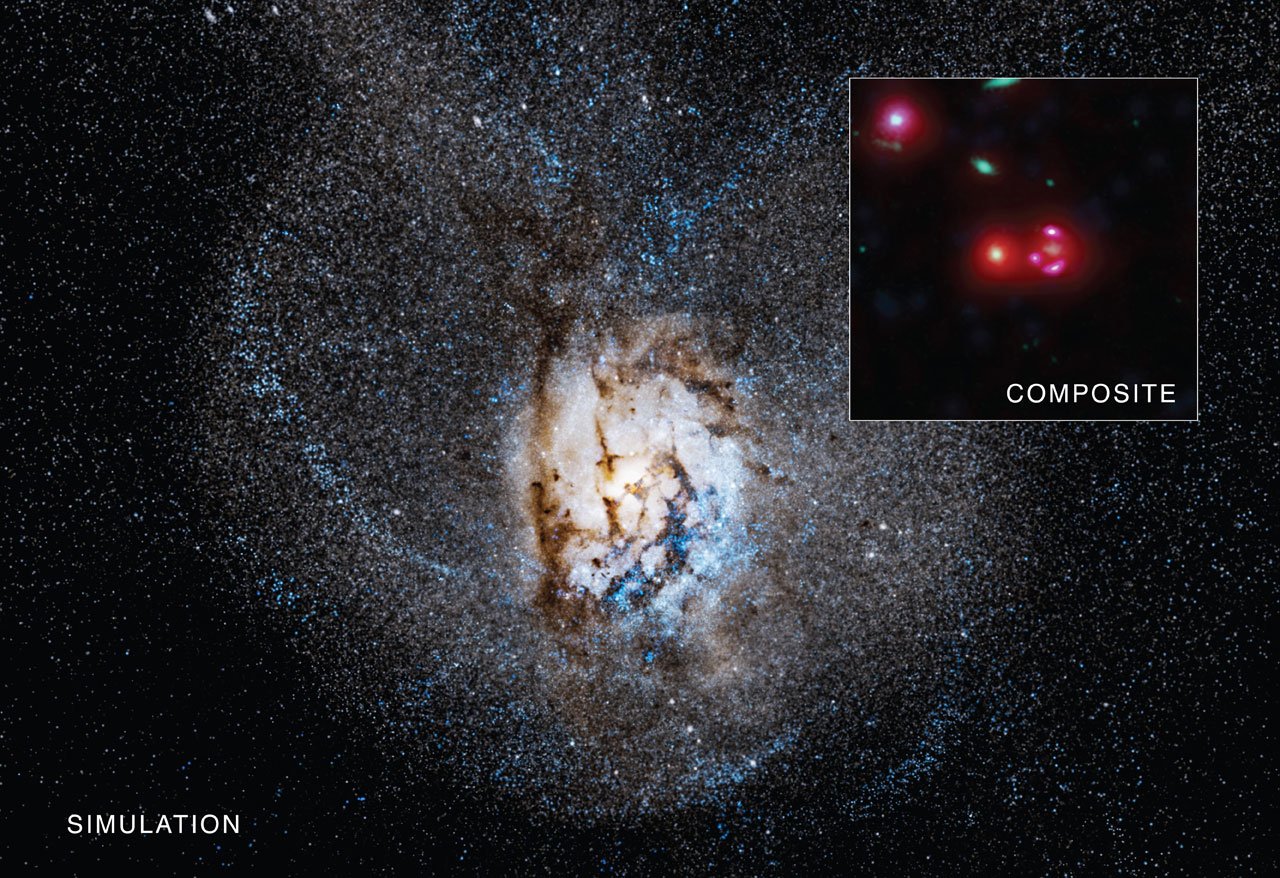
This graphic shows a frame from a computer simulation (main image) and astronomical data (inset) of a distant galaxy undergoing an extraordinary construction boom of star formation, as described in our press release. The galaxy, known as SPT0346-52, is 12.7 billion light-years from Earth. This means that astronomers are observing it at a critical stage in the evolution of galaxies, about a billion years after the Big Bang.
Astronomers were intrigued by SPT0346-52 when data from the Atacama Large Millimeter/submillimeter Array (ALMA) revealed extremely bright infrared emission from this galaxy. This suggested that the galaxy is undergoing a tremendous explosion of star birth.
However, another possible explanation for the excess infrared emission was the presence of a rapidly growing supermassive black hole at the galaxy’s center. In this scenario, gas falling towards the black hole would become much hotter and brighter, causing surrounding dust and gas to glow in infrared light.
To distinguish between these two possibilities, researchers used NASA’s Chandra X-ray Observatory and CSIRO’s Australia Telescope Compact Array (ATCA), a radio telescope. Neither X-rays nor radio waves were detected, so astronomers were able to rule out a growing black hole generating most of the bright infrared light. Therefore, they determined that SPT0346-52 is undergoing a tremendous amount of star formation, an important discovery for a galaxy found so early in the Universe.
The main panel of the graphic shows one frame of a simulation produced on a supercomputer. The distorted galaxy shown here results from a collision between two galaxies followed by their merging. Astronomers think such a merger could be the reason why SPT0346-52 is having such a boom of stellar construction. Once the two galaxies collide, gas near the center of the merged galaxy (shown as the bright region in the center of the simulation) is compressed, producing the burst of new stars seen forming in SPT0346-52. The dark regions in the simulation represent cosmic dust that absorbs and scatters starlight.
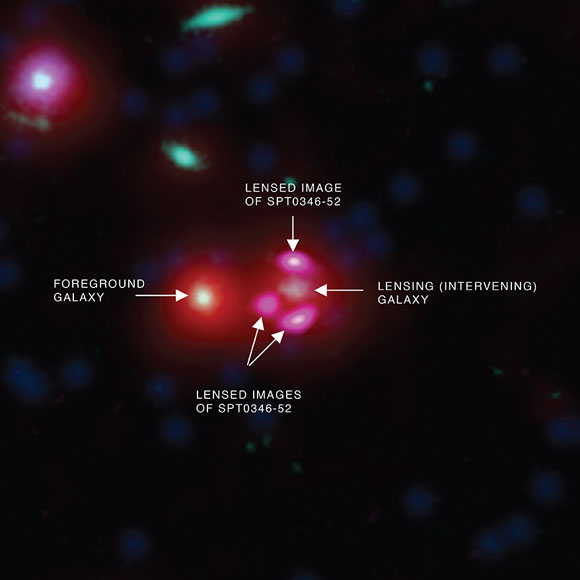
The inset in this graphic contains a composite image with X-ray data from Chandra (blue), short wavelength infrared data from Hubble (green), infrared light from Spitzer (red) at longer wavelengths, and infrared data from ALMA (magenta) at even longer wavelengths. In the latter case the light from SPT0346-52 is distorted and magnified by the gravity of an intervening galaxy, producing three elongated images in the ALMA data located near the center of the image. SPT0346-52 is not visible in the Hubble or Spitzer data, but the intervening galaxy causing the gravitational lensing is detected. The bright galaxy seen in the Hubble and Spitzer data slightly to the left of the image’s center is unrelated to SPT0346-52.
There is no blue at the center of the image, showing that Chandra did not detect any X-rays that could have signaled the presence of a growing black hole. The ATCA data, not shown here, also involved the non-detection of a growing black hole. These data suggest that SPT0346-52 is forming at a rate of about 4,500 times the mass of the Sun every year, one of the highest rates seen in a galaxy. This is in contrast to a galaxy like the Milky Way that only forms about one solar mass of new stars per year.
A paper describing these results, with first author Jingzhe Ma (University of Florida), has been accepted for publication in The Astrophysical Journal and is available online. NASA’s Marshall Space Flight Center in Huntsville, Alabama, manages the Chandra program for NASA’s Science Mission Directorate in Washington. The Smithsonian Astrophysical Observatory in Cambridge, Massachusetts, controls Chandra’s science and flight operations.
Reference: “SPT0346-52: Negligible AGN Activity in a Compact, Hyper-starburst Galaxy at z = 5.7” by Jingzhe Ma, A. H. Gonzalez, J. D. Vieira, M. Aravena, M. L. N. Ashby, M. Bethermin, M. S. Bothwell, W. N. Brandt, C. de Breuck, J. E. Carlstrom, S. C. Chapman, B. Gullberg, Y. Hezaveh, K. Litke, M. Malkan, D. P. Marrone, M. McDonald, E. J. Murphy, J. S. Spilker, J. Sreevani, A. A. Stark, M. Strandet and S. X. Wang, 22 November 2016, The Astrophysical Journal.
DOI: 10.3847/0004-637X/832/2/114
arXiv: 1609.08553
Never miss a breakthrough: Join the SciTechDaily newsletter.
Follow us on Google and Google News.
1 Comment
There are some very complicated issues of galaxy formation. Unfortunately, here is the same problem as with the stars. The origin of galaxies remains unclear, in spite of huge activity in the field. What the “formation” means? It means that we have the material that is assembling into galaxies.