
Close Menu
    Facebook X (Twitter) Instagram
    SciTechDaily
    • Biology
    • Chemistry
    • Earth
    • Health
    • Physics
    • Science
    • Space
    • Technology
    Facebook X (Twitter) Pinterest YouTube RSS
    SciTechDaily
    Home»Space»New Cassini Spacecraft Image of Enceladus
    Space

    New Cassini Spacecraft Image of Enceladus

    By SciTechDailyMarch 7, 20171 Comment1 Min Read
    Facebook Twitter Pinterest Telegram LinkedIn WhatsApp Email Reddit
    Share
    Facebook Twitter LinkedIn Pinterest Telegram Email Reddit
    Cassini Views Enceladus Up Close
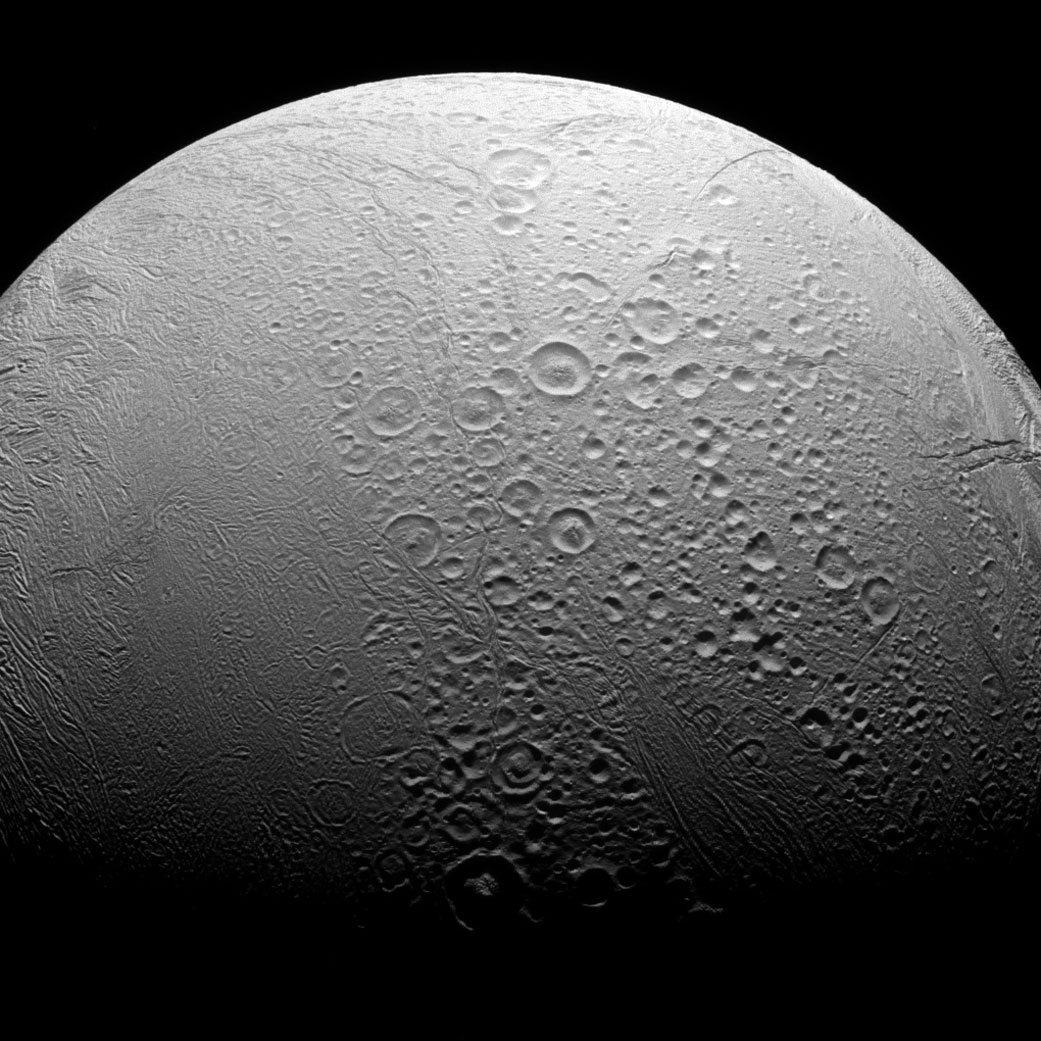
    Enceladus, Saturn’s moon, is divided – the north has many craters, while the south is smoother with wrinkles from geological activity. Credit: NASA/JPL-Caltech/Space Science Institute

    This newly released Cassini image shows Enceladus at a distance of approximately 41,000 miles (66,000 kilometers) away.

    Enceladus is a world divided. To the north, we see copious amounts of craters and evidence of the many impacts the moon has suffered in its history. However, to the south we see a smoother body with wrinkles due to geologic activity.

    Most solar system bodies lacking an atmosphere are heavily cratered like Enceladus’ (313 miles or 504 kilometers across) northern region. However, the geologic activity in the south, including the famous plume above the moon’s south pole, can erase craters and leave a younger, smoother-looking surface.

    This view looks toward the anti-Saturn hemisphere of Enceladus. North on Enceladus is up and rotated 4 degrees to the right. The image was taken in visible light with the Cassini spacecraft narrow-angle camera on November 27, 2016.

    The view was obtained at a distance of approximately 41,000 miles (66,000 kilometers) from Enceladus. Image scale is 1,310 feet (398 meters) per pixel.


    Never miss a breakthrough: Join the SciTechDaily newsletter.
    Follow us on Google and Google News.

    Cassini-Huygens Mission Enceladus Planetary Science
    Share. Facebook Twitter Pinterest LinkedIn Email Reddit

    Related Articles

    Cassini’s Deepest-Ever Dive Through the Enceladus Plume

    Cassini Reveals the Diverse Hemisphere of Enceladus

    NASA Prepares for Historic Flyby of Icy Saturn Moon Enceladus

    NASA’s Cassini Reveals New Views of Saturn’s Moon Enceladus

    Cassini Spacecraft to Begin Flyby of Saturn’s Moon Enceladus

    Cassini Reveals Global Ocean in Saturn’s Moon Enceladus

    Activity on Enceladus Could Be ‘Curtain Eruptions’

    Astronomers Track Icy Tendrils Reaching into Saturn’s E Ring

    NASA Detects Ocean Inside Saturn’s Moon Enceladus

    1 Comment

    1. Madanagopal.V.C. on March 13, 2017 3:08 am

      Why don’t we can compare this to the one sided cratered surface of Pluto while the other side is more even? More mateors on anti- sun side of Pluto caused by the stones in the cometary belt originating beyond Pluto. Thank You.

      Reply
    Leave A Reply Cancel Reply

    • Facebook
    • Twitter
    • Pinterest
    • YouTube

    Don't Miss a Discovery

    Subscribe for the Latest in Science & Tech!

    Trending News

    Black Hole Collisions May Follow a Surprisingly Simple Rule

    The Eye Has a Hidden Cleanup System and Scientists Just Discovered It

    The Truth About Vikings Is More Complicated Than Museums Admit

    New Catalyst Turns Stubborn Plant Waste Into Valuable Chemicals

    Quantum Gravity May Be Far Less Quantum Than Physicists Expected

    New Tool Supercharges Immunotherapy Against Prostate Cancer

    The Hidden Cancer Risk of Ketogenic Diets

    One Asteroid Collision May Have Rocked Earth, Mars, and the Moon

    Follow SciTechDaily
    • Facebook
    • Twitter
    • YouTube
    • Pinterest
    • Newsletter
    • RSS
    SciTech News
    • Biology News
    • Chemistry News
    • Earth News
    • Health News
    • Physics News
    • Science News
    • Space News
    • Technology News
    Recent Posts
    • Scientists Crack the Code for Making “Impossible” Nanocrystals
    • Earth’s Hidden Thermostat Has Regulated Climate for 60 Million Years
    • This 518-Million-Year-Old Creature Reveals How Spiders Got Their Bite
    • Forgotten for 20 Years, This 240-Million-Year-Old Fossil Reveals a New Reptile Species
    • 190-Year-Old Museum Specimen Solves a Pangolin Mystery
    Copyright © 1998 - 2026 SciTechDaily. All Rights Reserved.
    • Science News
    • About
    • Contact
    • Editorial Board
    • Privacy Policy
    • Terms of Use

    Type above and press Enter to search. Press Esc to cancel.